Daily Catholic Lectio
Sat, 25 July 2026
Saint James, Apostle
2 Cor 4:7-15. Mt 20:20-28
Treasure in a Clay Jar
Today we celebrate the feast of Saint James, the Apostle. In English he is called “James,” in Spanish “Jaime,” and in Italian “Giacomo.” His Latin name is Sanctus Iacobus. This later became Santiago.
In the tradition of the Church, he is known as “James Major,” or James the Greater. He is the son of Zebedee and the brother of John. Then who is called “James Minor,” or James the Lesser? He is James, the son of Alphaeus (cf. Mt 10:2).
Jesus had twelve apostles. But among those twelve, three were close to Jesus like His “power house”: Peter, James, and John. These three were with Jesus at His transfiguration. These three were also kept near Him when Jesus raised the daughter of Jairus. These three were also with Jesus in the Garden of Gethsemane during His agony and sweat of blood.
Tradition also says that he was the first martyr.
He seems to have been an important leader in the early Church. He also presided over the first Council of Jerusalem (Acts 15) and strongly presented the idea that the Gentiles too have a share in the plan of salvation.
He also writes a letter to his Church. From this letter comes the sacrament of the Anointing of the Sick. He also presents the ideas that “faith and works must go together” and that “life comes only through suffering.”
His body was taken from Jerusalem and buried in a place called “Compostela” in Spain. “Compostela” means “the remains of the bones of the body.” Even today this road is called “the road to Santiago.” Many people go on pilgrimage by foot from Rome, Lourdes, and Fatima. It is still believed that those who want the purpose of their life to become clear receive a vision during this journey.
May Saint James help us to discover the purpose of our life!
In today’s Gospel, his mother comes to Jesus with him and his brother John to know the purpose of his life. She says, “Command that one of these two sons of mine sit at your right and the other at your left.”
But Jesus asks, “Can you drink the cup?” When I go to Jesus asking, “What is the meaning of my life?” there are many possibilities that He may also disturb me in this way. Then what must be done? What has been prepared for each person will be given to that person. Until then?
Let us do the work that is given to us — James, John, and we.
In the end, he gives his life as a martyr for Jesus. On the box of bones found in his tomb, it is written: “James, the brother of Jesus.” These words are considered extra-biblical evidence that Jesus, as a historical person, lived.
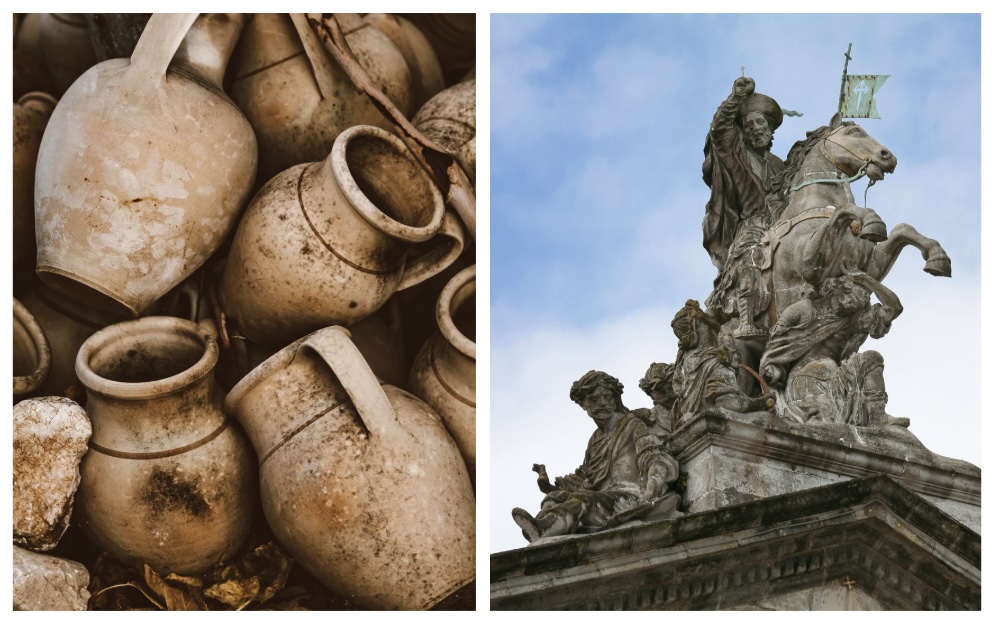
In today’s first reading (2 Cor 4:7-15), Paul writes: “We have this treasure, the glory of God, in clay jars, so that it may be clear that this extraordinary power belongs to God and does not come from us.”
Let us take for our reflection this image: “treasure in a clay jar.” To understand this image, it is necessary to understand the context of Paul’s time. In the time of Paul, four kinds of vessels were used: gold vessels for the worship of God, silver vessels for eating food, clay vessels for collecting dirt and urine, and wooden vessels for spitting and vomiting. Among these, the master of the house handled the gold and silver vessels. The slaves handled the clay and wooden vessels. Since clay and wooden vessels were used for lowly purposes, they were kept outside the house. They remained outside in rain and sun. Since they were used for things without value, they too remained without value.
Paul remembers that he was in such a state in his former life, and says that God’s call came to him like a treasure.
What happens if gold and treasure are suddenly placed in a clay jar that was used to collect dirt? The value of the clay jar increases. The clay jar is kept safely inside the house. But what increases the value of the clay jar is the gold and treasure inside it. In the same way, when the apostles were simple people, God chose them, gave them the gold of His call, and raised their value.
A clay jar, in itself, is weak, without value, and lowly. Yet the head of the house chooses it.
James, who was raised to the state of an apostle, was like a clay jar when he was mending nets on the seashore. The Lord Jesus called him to the work of His Kingdom. The one who was catching fish became one who catches people.
What do this image and this feast tell us?
First, God chooses us in our simple state. He raises our value.
Second, like a clay jar, we too are weak and easily broken. God embraces our brokenness.
Third, because there is now treasure in the clay jar, it must be more careful than before. It must make itself worthy so that it may protect the treasure within it. The clay jar that has been set apart for a higher value must no longer go towards lowly things.
Let us pray that we too may receive the courage and firmness of heart that shone in Saint James the Apostle.
Fr. Yesu Karunanidhi
Archdiocese of Madurai
A Yesni Prays Initiative
 Yesu Karunanidhi
Leave a comment