Daily Catholic Lectio
Tue, 15 Sep 2026
Our Lady of Sorrows, Memoria
1 Cor 12:12-14, 27-31. Lk 2:33-35
Seven Sorrows of Mary
Today we remember the Seven Sorrows of the Blessed Virgin Mary. In the year 1232, seven young men in Tuscany founded the Order of the Servants of Mary. A few years later, remembering the seven sorrows of Mary, they accepted the Blessed Virgin Mary standing at the foot of the Cross as their patroness. Devotions such as the Rosary of the Seven Sorrows, the Scapular of the Seven Sorrows, and the novena to Our Lady of Sorrows were promoted through this tradition.
In 1913, Pope Pius X fixed this memorial on 15 September, the day after the Feast of the Exaltation of the Holy Cross. This placement is meaningful. After contemplating the Cross of Jesus, the Church invites us to contemplate the sorrow of Mary. The Son is lifted on the Cross. The Mother stands beneath the Cross. The suffering of the Son and the sorrow of the Mother stand together.
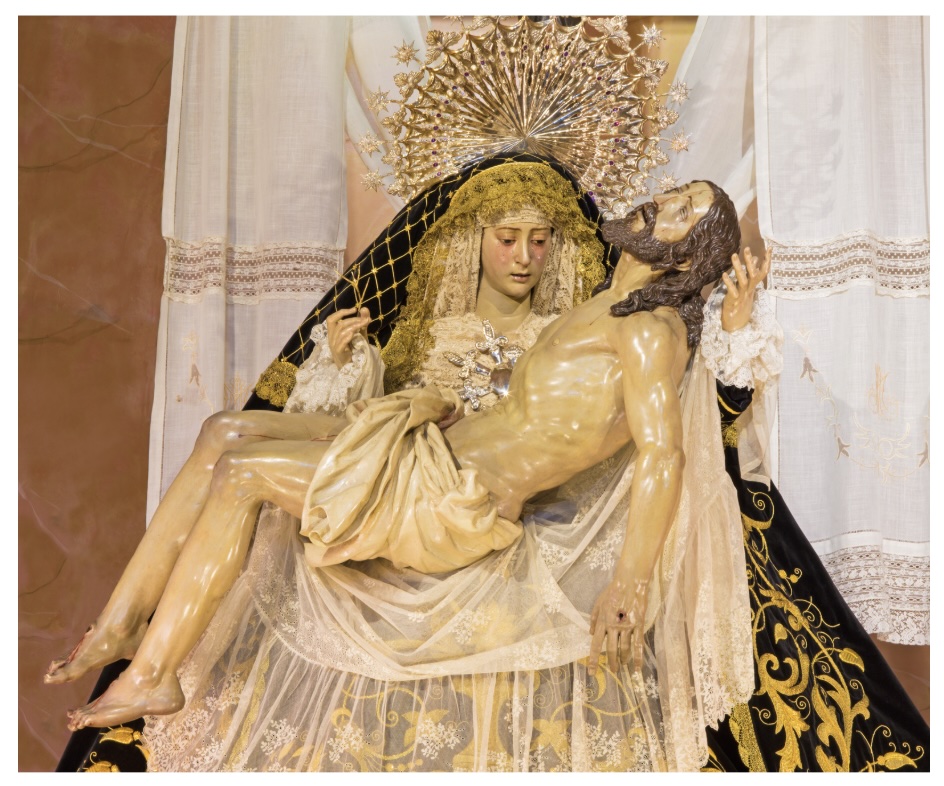
The seven sorrows of Mary reveal seven forms of human suffering. The prophecy of Simeon brings the suffering of waiting. The flight into Egypt brings the suffering of helplessness. The loss of Jesus in the Temple brings the suffering of loss. The meeting of Jesus on the way of the Cross brings the suffering of powerlessness. The death of Jesus on the Cross brings the suffering of shame. The holding of the dead body of Jesus brings the suffering of becoming a victim. The burial of Jesus brings the suffering of emptiness.
These seven sorrows are not far from us. They are the sorrows we too experience in different ways. Waiting, helplessness, loss, powerlessness, shame, victimhood, and emptiness enter every human life.
The Gospel today presents Simeon’s prophecy to Mary: “A sword will pierce your own soul too.” Mary hears at the beginning what she will experience at the end. From the Temple to Calvary, her life carries this word. Her sorrow is not an idea. It is a path she walks.
What does this memorial teach us?
First, suffering is a reality of life. In Genesis, suffering enters through sin. But Mary, who is free from sin, also suffers. Though she is spiritually free from sin, she shares the real condition of human life. Therefore, suffering is not always a punishment. It is not always the result of personal failure. It is part of the fragile reality of human existence.
Many times, we try to give suffering a spiritual or moral colour. We say that children suffer for parents, parents suffer for children, teachers suffer for students, husband suffers for wife, and wife suffers for husband. But in a deeper sense, no one can suffer in the place of another. We suffer. That is the reality. Mary suffered. That is enough to say. Her sorrow teaches us to face suffering without hiding it behind easy explanations.
Second, sorrow is a deep human feeling. Ecclesiastes says, “Sorrow is better than laughter, for by sadness of face the heart is made better.” Suffering may be an event, but sorrow becomes an experience that remains in the heart. If I twist my ankle on the road, I suffer. When the pain goes away, the suffering ends. But when I lose my father, the event may pass, yet the sorrow remains in memory.
Mary’s sorrow is of this kind. It is not only pain in a moment. It becomes a deep feeling that shapes the heart. Sorrow tills the heart. When land is ploughed, it is cut open. But through that opening, the soil receives air, seed, water, and life. In the same way, when sorrow cuts the heart, it can also open us to new experiences, deeper compassion, and a truer knowledge of ourselves.
After Adam and Eve are sent out of the garden, Adam gives his wife the name Eve, meaning mother of all the living. Before Cain is born, she is already called mother. After suffering, a new identity appears. Those who pass through sorrow are often lifted into a new stage of life.
Third, suffering becomes memory. Indian wisdom teaches us that our memories often become our suffering. We do not think of our little finger every day. But if it is crushed in a door, it remains constantly in our memory. A sandal that fits well is forgotten. A sandal that hurts is remembered because it gives pain. What fits does not hurt. What does not hurt does not remain in memory.
That is why people in sorrow often try to forget or change their memories. Some turn to drink. Some move to new places. Some keep themselves busy. They are trying to escape or reshape the memory that causes pain.
Mary’s seven sorrows are not simply devotional themes. They are the paths of life through which she walked. We must not praise her sorrows in such a way that we make her distant from us. She is close to us precisely because she knew sorrow.
In the first reading, Paul speaks of the Church as one body with many members. When one member suffers, the whole body suffers. Mary’s sorrow also teaches us this truth. She does not stand as an isolated woman. She stands as Mother within the Body of Christ. Her pierced soul reminds us that suffering is never completely private. The pain of one member touches the whole body.
Today many swords pierce our heart, body, and memory. Some we pull out. Some we treat with medicine. Some we continue to carry. Some break inside us when we try to remove them. With wounds and scars, we keep walking.
Fr. Yesu Karunanidhi
Archdiocese of Madurai
A Yesni Prays Initiative
 Yesu Karunanidhi
Leave a comment