Daily Catholic Lectio
Wed, 28 Oct 2026
Saints Simon and Jude, Apostles – Feast
Eph 2:19-22; Lk 6:12-19
Saint of the Helpless
Today Holy Mother Church celebrates the feast of the Apostles Saints Simon and Jude. Luke calls them “Simon, who was called the Zealot, and Judas son of James,” or Thaddeus. Devotion centred on Simon is not very widespread. But after the Blessed Virgin Mary and Saint Anthony, Saint Jude Thaddeus may be counted among the saints who attract a very large number of devotees throughout the world. He is known as the “patron of abandoned causes” or the “patron of the helpless.” Tradition also holds that he was a relative of Jesus, and that the wedding at Cana, where Jesus changed water into wine, was his wedding. In devotional images, he is often shown carrying a club, a scroll representing his letter, and an image of the face of Jesus.
The Apostles are the connecting lines or bridges between Jesus and us. Paul calls them foundations (cf. first reading).
What do these two Apostles tell us today?
(a) Receiving the experience of being called
We read quickly in the Gospel: “Jesus went up the mountain, prayed to God, and when day came, He called His disciples and chose twelve of them, whom He named apostles.” But when we imagine the event, it becomes deeply moving. There is a large crowd. Among them are some disciples. Everyone is standing there. Jesus stands before them and says, “You, come! Simon… you, come! Thaddeus! Yes, you… come!” What joy they must have felt among the other disciples and among the crowd! Perhaps they ran forward asking, “Me?” Some may have hesitated. But all who were called went to Him. To be called by name from among a crowd is an important experience. We do not like to be treated merely as part of a crowd, because our uniqueness disappears in the crowd. The experience of vocation is God reminding me of my uniqueness. Even today, this is the meaning of calling candidates by name at priestly ordination, at diaconate ordination, at first and final profession in religious life, and at Baptism. This experience of being called is not a one-day event. It must become a daily experience.
(b) Standing with Him
They must stand with Jesus. Therefore, from now on, they no longer have a separate place of their own. They cannot stand only with their family, relatives, or friends. To stand with Jesus, they must be ready to lose other things. Otherwise, they may end up trying to stand with Jesus while still holding tightly to everything else. To stand with Jesus, I must let go of my own priorities.
(c) Doing His works
Luke records that Jesus stands with the Apostles on a level place and carries out three ministries: He speaks to the people or teaches them, He heals their diseases, and He drives out evil spirits. Teaching, healing, and removing evil—these are the three works of an Apostle. One who is an Apostle must never compromise in these three ministries.
Finally, the Gospel ends by saying: “All in the crowd were trying to touch Him.”
The Apostles are instruments through whom people can touch Jesus. If you and I become apostles, many more people will be able to touch Jesus—today and always.
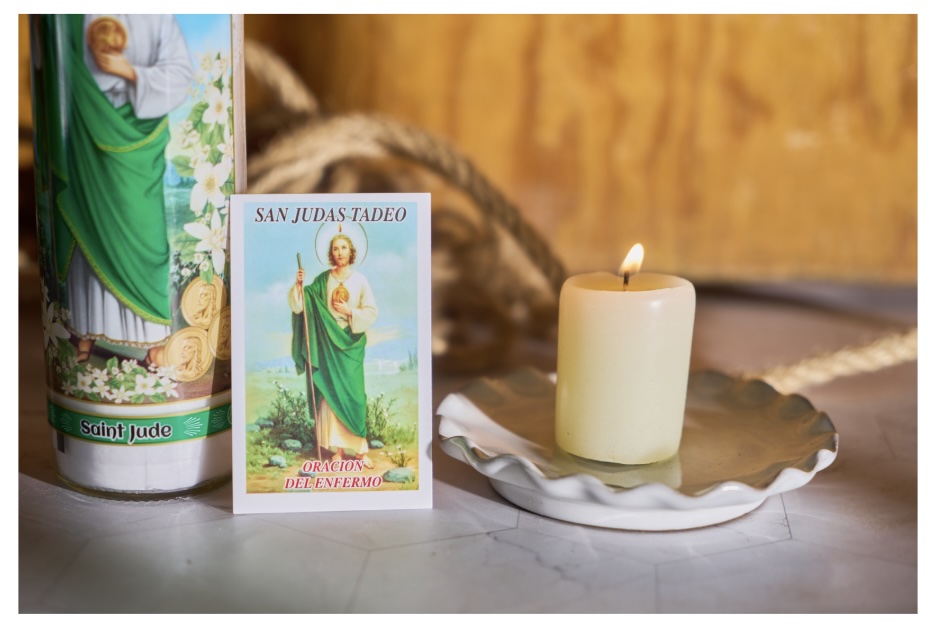
We may have seen an image or statue of Saint Jude Thaddeus. He is often shown wearing a green cloak, holding a staff in one hand and a scroll in the other, with a flame above his head.
Devotion to this saint is very popular in the United States, especially among Spanish-speaking communities. People travel for many hours to seek his intercession. Many Hispanic devotees believe that he helped them reach the United States safely.
There is also a traditional story connected with the image of Saint Jude holding a cloth or scroll. According to the tradition, King Abgar of Edessa, in present-day Turkey, sent a letter asking Jesus to come and heal him of leprosy. Jesus did not go to Edessa, but impressed the image of His face on a cloth and sent it through Jude Thaddeus. Through that image, the saint healed the king.
After Pentecost, Saint Jude carried out missionary work in the Middle East and eventually died there as a martyr. His remains were later brought to Rome and placed near the tomb of Saint Peter.
According to devotional tradition, Jesus appeared to Saint Bridget and Saint Bernard and revealed that Saint Jude Thaddeus was one who brings help in impossible situations. From then on, he came to be honoured as the patron of the abandoned and of those in desperate need.
Saint Jude teaches us three lessons for life today.
(a) Place your trust in Jesus Christ
There is a letter attributed to Saint Jude in the New Testament. Though it is a very short book, it contains profound ideas. The Letter of Jude gathers the whole biblical story into one chapter and invites us to place our trust in Jesus. “Build yourselves up on your most holy faith” (cf. v. 20). It also says, “Have mercy on those who doubt” (cf. v. 22), inviting us to accept those who struggle in faith. His message is that even in times of unexpected loss, weariness, and hopelessness, God continues to show mercy toward us.
(b) Stay close to Jesus
As one of the Apostles, Jude Thaddeus remained with Jesus and stayed faithful in that companionship until the end. We too must remain with God not only in happiness, but also in suffering.
(c) Be ready to go where God sends you
Jude went to the land to which God wished to send him. In our being and in our movement, we bear fruit only when we remain united with God. Therefore, it is good to be ready to go wherever He sends us.
Fr. Yesu Karunanidhi
Archdiocese of Madurai
A Yesni Prays Initiative


Leave a Reply