Sun, 6 April ‘25
Fifth Sunday of Lent
Isaiah 43:16-21. Philippians 3:8-14. John 8:1-11
Keep Running!
When we’re walking or driving and suddenly the road ends, with no way forward, we call it a “dead end.” At that point, we’re left with only two choices: stay stuck or turn back. Sometimes, in desperation, we may try to break through a wall or cross a dangerous barrier ahead to escape.
In today’s Scripture readings, we encounter three people or groups who find themselves at a dead end: (a) The Israelites in the First Reading, stuck in Babylonian captivity. (b) Paul, in the Second Reading, held back by his old identity and legalistic pride. (c) The woman caught in adultery in the Gospel, facing imminent death by stoning. For each of them, God offers a third option beyond staying stuck or going backward. That divine invitation is simple: “Keep running!”
Not only does God say it, He opens up a new path so that the journey may continue.
So, in the light of today’s Word, what seems to us like an end is merely a bend when God is involved.
First Reading – Isaiah 43:16–21: A New Way Through the Wilderness
Speaking to the Israelites exiled in Babylon, the Lord, through the prophet Isaiah, recalls His past wonders—especially the Red Sea crossing:
“I made a way in the sea, a path in the mighty waters… I extinguished mighty warriors like a wick.” When Israel had the sea before them and Pharaoh’s army behind, with no way out, God opened up the sea.
“Do not be afraid. Stand firm. The Lord will fight for you; you have only to be still.” (Exod 14:13–14)
Then the Lord says something surprising: “Forget the former things; do not dwell on the past. See, I am doing something new!”
Why would He say that, right after recalling the past?
Because Israel, though once free, now carried deep scars of defeat and slavery in Babylon. They believed nothing could change. But God declares: “I will make a way in the wilderness, rivers in the desert.”
In other words, even what once destroyed (water) now becomes life-giving. Even in the desert, God brings streams. He asks Israel to forget their bitter past and trust in the new path He is creating.
Second Reading – Philippians 3:8–14: A New Goal in Christ
St. Paul shares the radical shift in his life. Once proud of his religious and cultural identity—circumcised on the eighth day, from the tribe of Benjamin, a Pharisee—Paul now counts it all as loss:
“I consider everything a loss because of the surpassing worth of knowing Christ Jesus my Lord.” He sets a new goal: to know Christ, to share in His sufferings, and to attain resurrection.
Paul says: “Forgetting what is behind and straining toward what is ahead, I press on toward the goal.” Earlier in 1 Corinthians, Paul also urges: “Run in such a way as to win the prize.” (1 Cor 9:24)
Paul once found himself at a “dead end,” but Christ gave him a new road. Leaving behind his old path, he keeps running forward in the new life of Christ.
Gospel – John 8:1–11: A New Life After Sin
This passage appears only in John’s Gospel. Though debated in manuscript history, it is widely accepted and deeply powerful.
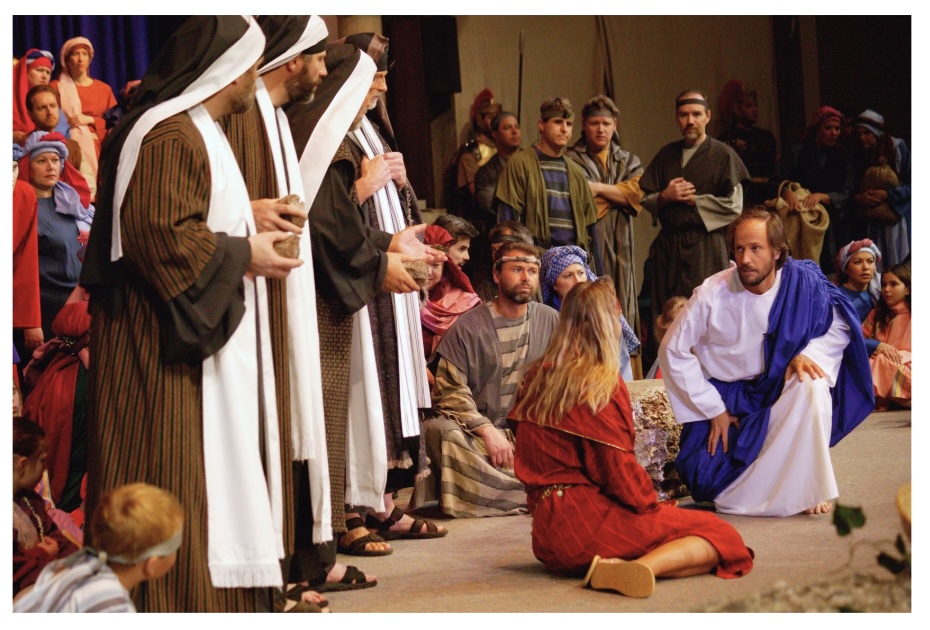
In the early morning, Jesus is teaching in the temple. The scribes and Pharisees bring before Him a woman caught in adultery—but not the man. Their motive is not justice but a trap.
“Teacher,” they say (a mock title here), “Moses commanded us to stone such women. What do you say?”
If Jesus says, “stone her,” He violates Roman law, which reserved capital punishment for the state. If He says “don’t,” He violates Moses’ law. It’s a perfect trap.
But Jesus stoops and writes on the ground. Then He says:
“Let the one without sin cast the first stone.” Silence. Slowly, one by one, they all leave. Only Jesus and the woman remain.
He asks gently:
“Woman, where are they? Has no one condemned you?”
“No one, Lord.”
“Neither do I condemn you. Go, and sin no more.”
The one they called “this woman” is now respectfully called “woman”—a title of dignity.
In that single word, Jesus restores her. Then He gives her direction: “Go. Sin no more.”
He opens a new path and invites her to run again—not into sin, but into life.
Three Lessons for the Journey
(a) Forget the past
All three readings call for a forgetting—not a denial, but a release from being stuck in the past. The Israelites must forget their shame. Paul must forget his former pride. The woman must forget her guilt.
Our minds, like muscles, must learn what to hold on to—and what to let go. Like the story of the elephant chained since childhood, we often don’t realise the chain is breakable. God calls us to break free from our mental slavery and move forward.
(b) Fix your goal
It’s not enough to forget the past—we must fix our eyes on what’s ahead. Paul’s goal was clear: Christ. Just like an athlete train with the finish line in view, we must live with purpose. If life blocks our way, we must look beyond the wall and find the next goal. Even pain and loss can give way to a new calling.
When the road ends, don’t sit down and cry—draw a mural on the wall! Make the obstacle your target.
(c) Widen your vision
The accusers saw only the woman’s past. Jesus saw her future. When our eyes widen, our roads stretch longer. Jesus not only widened the woman’s vision, but also those of the accusers. If we can see the whole picture of life, not just isolated dots, we’ll see what God sees.
Final word
“Dead ends” will come—personally, physically, emotionally, professionally. But many before us—St. Augustine, our parents, our mentors—have moved past them. They didn’t sit in despair. They knew one truth: With Christ, what looks like an end is the beginning of something new.
Fr. Yesu Karunanidhi
Archdiocese of Madurai
Missionary of Mercy


 Yesu Karunanidhi
Leave a comment