Daily Catholic Lectio
Sun, 18 October 2026
XXIX Sunday in Ordinary Time
World Mission Sunday
Isa 45:1, 4-6; 1 Thess 1:1-5a; Mt 22:15-21
God’s Sovereignty
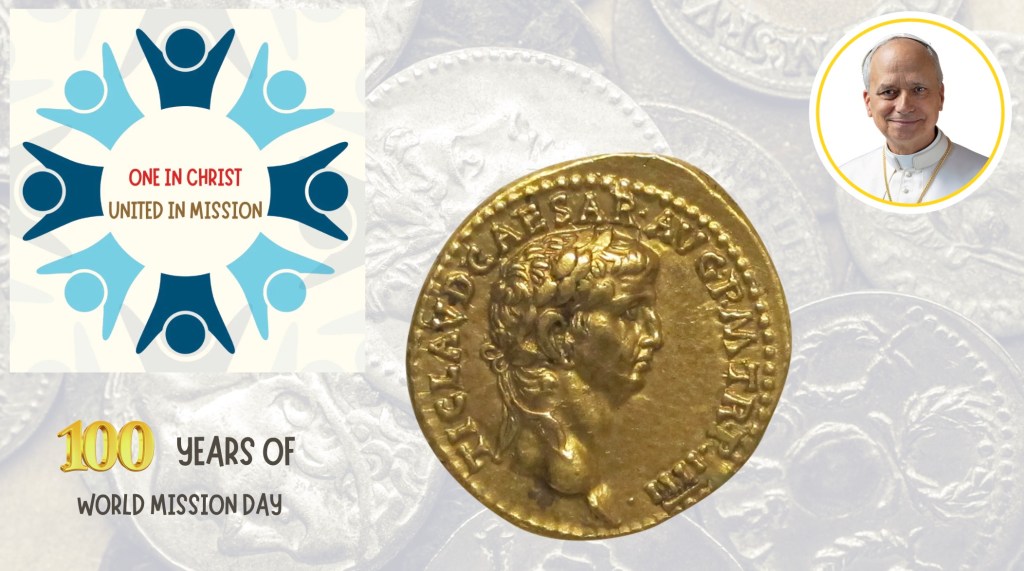
Today is the XXIX Sunday in Ordinary Time. We celebrate this day as World Mission Sunday. This day reminds us that, as Christians, we are all united as one family and that we are called to bear witness to our Christian faith in the world. The message given by Pope Leo XIV for the centenary celebration is: “One in Christ, United in Mission.”
Today’s first reading (cf. Isa 45:1, 4-6) is taken from the section known as Second Isaiah. It is a passage that gives consolation and hope to the people of Israel living in Babylonian captivity (Isa 44:24–45:8). The captivity and exile of Israel in Babylon come to an end through Cyrus, king of Persia. In 539 BC, Cyrus conquers Babylon and issues a decree allowing the captives to return to their own lands (cf. 2 Chr 36:22-23). For Isaiah, it is God Himself who acts through King Cyrus. Or, we may say that the God who allowed Israel to be wounded through King Nebuchadnezzar now heals that wound through King Cyrus. Therefore, although Nebuchadnezzar enslaved the people, his power was limited, because God raised up Cyrus against him. Isaiah calls Cyrus “the Lord’s anointed.” The expression “anointed one” was normally used only for the kings of Israel. But because Cyrus freed Israel from slavery, he becomes the servant whom God calls by name “for the sake of Jacob, my servant, and Israel, my chosen one.”
Yet Cyrus himself does not know this. That is why the Lord says: “Though you do not know me, I call you by your name,” and “Though you do not know me, I strengthen you.” This tells us two things: first, God alone is ultimately the Lord of history; second, God can use us and work through us even when we ourselves are not fully aware of it.
This reading therefore contains three truths: God’s grace crosses boundaries. God holds history within His hands. God is almighty.
Today’s second reading (cf. 1 Thess 1:1-5) is the greeting and introduction to Paul’s First Letter to the Thessalonians. This letter, generally considered the earliest written book of the New Testament, was written around AD 51 from Corinth. The Church of Thessalonica was a community in Macedonia. The structure of this letter later appears in many of Paul’s other letters. Paul gives thanks to God for the life and activity of the Church in Thessalonica. His words, “We always give thanks to God for all of you,” show that he recognises that it was God who brought the community together. He also praises their values and virtues: “your work of faith, your labour of love, and your steadfastness of hope in our Lord Jesus Christ.” Paul therefore acknowledges that he himself is not the reason for the life and growth of the Thessalonian Church. God and the faithful themselves are responsible for its growth.
Here too, there are three lessons: faith must become visible in action. All our labour must be motivated by love. Perseverance must keep our hope alive.
The setting of today’s Gospel (cf. Mt 22:15-21) is Jerusalem. After entering Jerusalem triumphantly, Jesus cleanses the Temple. This action provokes the anger of His opponents. Then, through the parables of the two sons, the wicked tenants, and the wedding banquet, Jesus points out that the chosen people of Israel have failed to respond properly to the invitation of the Kingdom. This increases the anger of His opponents. They therefore begin looking for ways to act against Him and trap Him in His words.
The Pharisees join with some Herodians and ask Him a question intended to trap Him: “Is it lawful to pay taxes to Caesar or not?” It is a dangerous question. If Jesus says, “Yes,” they can turn the people against Him by saying that He is not the king who has come to liberate Israel and that He accepts their slavery. If He says, “No,” they can accuse Him before Rome of opposing the Roman Empire and its rulers.
Jesus understands their evil intention and calls them “hypocrites.” He then asks them to show Him the coin used to pay the tax. They give Him a coin. On it was the image and inscription of Tiberius, son of the divine Augustus. The people of Israel lived in the land that God had promised them. Yet they carried in their hands and pockets a Roman coin bearing an inscription that referred to Augustus as divine. Every day they prayed, “The Lord our God is one Lord” (cf. Deut 6:4), yet they carried a coin that gave divine honour to another ruler. Jesus wants them to recognise this contradiction. That is why He calls them hypocrites and says: “Give to Caesar what belongs to Caesar, and to God what belongs to God.”
With these words, Jesus accepts the political reality of Roman rule and the payment of taxes. At the same time, He firmly declares that what belongs to Caesar is limited. The coin may belong to Caesar. But there are things that belong to God alone. “Give to God what belongs to God” means: give to God your life, your good works, your virtues, your strength, your love, your energy, and everything that you are. Jesus therefore teaches that there are realities far greater than what belongs to Caesar. Caesar is never God. Every human authority remains under the authority of God. Caesar may control the economic and political situation of Palestine or Jerusalem. But he cannot control the ultimate meaning of human life or the destiny of the human person. Human authority is always subject to divine authority.
Jesus reminds His contemporaries of the limits of Caesar and invites them to remain open to the action of God, who is greater than Caesar. The Lord is always God. Caesar is not.
Cyrus, Caesar, and every other ruler stand under the sovereignty of the Lord. As today’s Responsorial Psalm (cf. Ps 96) proclaims: “Give the Lord glory and power.”
Here Jesus brings about not only a spiritual revolution but also a political one. In effect, He says: “What belongs to Caesar may be given to Caesar. But what belongs to God must be given completely to God.” The land and the people ultimately belong to God. The people of Jesus’ time had forgotten that they themselves were created in the image and likeness of God, while they stood holding a coin bearing the image of Caesar.
What lessons does today’s Liturgy of the Word give us?
(a) Whose image do we carry? Do we carry the image and likeness of God? Or do we allow our work, profession, nationality, social status, money, or fame to become our identity?
(b) Give to each what belongs to each. We must give to God what belongs to God, to the State what belongs to the State, to our family what belongs to our family, to our friends what belongs to them, and to our work what belongs to our work. The Pharisees and Herodians who asked whether it was lawful to pay taxes to Caesar had forgotten another side of life. Jesus reminds them that we must discern what belongs to Caesar and what belongs to God. We must give proper time and energy both to our responsibilities in the world and to our relationship with God. We should not reduce our life only to ourselves and our family. We are also called to participate in society, parish life, and diocesan life. We must extend ourselves towards social responsibility, the uplift of the poor, and the care of creation. We receive so much from society, from the world, and from God. We must also learn to give something back.
(c) God works through everyone. Nebuchadnezzar took the people of Israel into captivity in Babylon. Yet this happened only because the Lord permitted it. Cyrus, king of Persia, conquered Babylon and sent the people back to their homeland. The Lord was also working through him. Therefore, “He is the One who does this. He is the Lord, and there is no other.” Every authority in this world is limited. No one rules everywhere and forever. All human authority eventually comes to an end. Therefore, if we hold authority today, let us exercise it with humility. If we are under authority, let us live with patience.
(d) Action – labour – perseverance. Our Christian faith must not remain merely a belief in ideas. It must become visible through acts of love. Our labour must be built on love. Our hope in Jesus must give us perseverance. Through action, labour, and perseverance, we can develop a proper authority over our own life. Even if there are rulers who govern us, I must first learn to govern myself. I must keep my own life under discipline. I must take responsibility for my words and actions. Let us examine everything we do. Are we giving the necessary effort to our actions? When our efforts seem fruitless, do we have the maturity to continue with perseverance?
The Psalmist says: “Give to the Lord glory and power” (cf. Ps 96).
On this World Mission Sunday, it is good for us both to experience and to proclaim God’s sovereignty.
Fr. Yesu Karunanidhi
Archdiocese of Madurai
A Yesni Prays Initiative


Leave a Reply