Full Squares, Empty Pews
What Pope Leo XIV’s Journeys Are Telling the Church
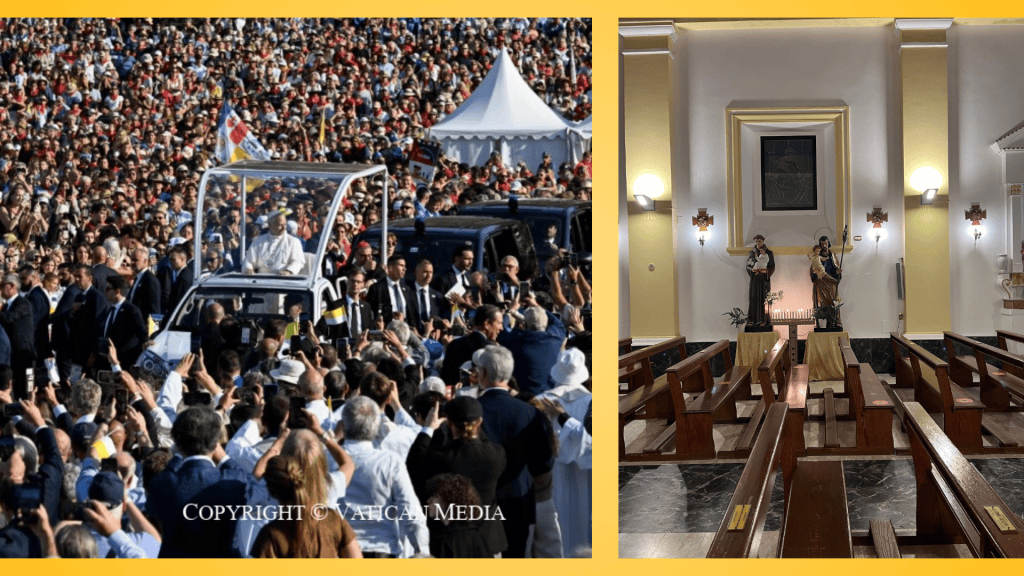
The images from Pope Leo XIV’s recent apostolic journeys are impressive.
In Spain, Africa, Paris, and Lourdes, enormous crowds gathered to welcome him, pray with him, and participate in the Eucharist. Such scenes show that the Pope, pilgrimage, sacred places, and religious experience still have the power to draw people.
But they also raise an important question:
If so many people gather when the Pope comes, why are so many churches half-empty on ordinary Sundays?
Perhaps the first thing we need to understand is that a papal crowd and a Sunday congregation measure two different realities.
A papal visit reveals religious attraction.
Sunday Mass reveals religious belonging and commitment.
A person may travel several hours to see the Pope and yet rarely attend Mass. Someone may visit Lourdes, enter a cathedral, light a candle, or feel deeply moved by a religious celebration without considering himself or herself a practising Catholic.
That does not necessarily mean such faith is superficial. It may mean that religion today is being lived differently.
From inherited faith to chosen faith
For generations, especially in Europe, Christianity was largely inherited. People were baptized, belonged to a parish, and celebrated Christian feasts because family and society transmitted the faith almost naturally.
That situation has changed.
Today, faith increasingly has to be personally chosen.
This helps explain an interesting development in France. Regular religious practice has declined considerably, yet the number of adults asking for baptism has grown strongly in recent years.
Something is changing.
Christianity may be becoming less automatic but, for some, more intentional.
We may be moving from an age of inherited Christianity to an age of chosen Christianity.
People have not stopped searching
We should therefore be careful when we say that religion has become irrelevant.
The deepest human questions have not disappeared.
Who am I?
What gives my life meaning?
How do I face suffering?
Can I be forgiven?
What happens when someone I love dies?
Is there something greater than myself?
Modern society provides enormous possibilities, but it cannot remove the human need for meaning, hope, reconciliation, belonging, and transcendence.
People may no longer automatically bring these questions to the Church.
But the questions remain.
Why do papal visits attract people?
A papal visit creates something extraordinary: pilgrimage, beauty, prayer, music, community, public witness, and the experience of belonging to something greater than oneself.
The Pope also becomes a kind of threshold.
Practising Catholics see the successor of Peter. Distant Catholics may rediscover something they had forgotten. Young people may encounter Christianity in a new way. Even non-believers may be attracted by the spiritual and moral significance of the event.
But then comes the decisive question:
What happens after the Pope leaves?
From crowd to community
The success of an apostolic journey cannot finally be measured by crowd size.
The real movement must be:
from attraction to encounter,
from encounter to conversion,
from conversion to belonging,
from belonging to discipleship,
and from discipleship to mission.
This requires a serious pastoral response.
First, every parish should become a welcoming community, not merely a place where services are provided. A stranger who enters should be noticed, greeted, and invited to return.
Second, dioceses should create clear pathways for seekers: simple introductory evenings, Bible groups, opportunities for prayer, catechumenal accompaniment, and spaces where people can ask questions without fear.
Third, special attention must be given to those who return after a pilgrimage, papal visit, retreat, baptism, wedding, funeral, or personal crisis. These moments are pastoral doors. They should not be allowed to close.
Fourth, parishes must invest in small communities. Large celebrations attract people, but small groups help them remain. Faith grows through friendship, accompaniment, Scripture, shared prayer, and service.
Fifth, the Church must rediscover the power of beautiful and reverent liturgy. In a noisy and distracted culture, silence, sacred music, good preaching, hospitality, and meaningful celebration can become a powerful form of evangelization.
Sixth, young adults need serious intellectual formation. They are asking questions about science, technology, sexuality, suffering, freedom, identity, and purpose. The Church must offer more than slogans.
Finally, every experience of faith must lead outward in service. People should encounter a Church that feeds the hungry, visits the sick, accompanies migrants, protects the vulnerable, and remains close to the lonely.
The real question
The challenge is not simply:
How do we fill the empty pews?
The deeper question is:
How do we accompany the people who are still searching?
The great crowds around Pope Leo XIV do not prove that secularization has ended.
But they do reveal something important:
people have not stopped searching for the sacred.
The Pope’s journey ends when he leaves.
The Church’s real work begins afterwards.
Image courtesy: Vatican Media, Yesni Prays


Leave a comment