Daily Catholic Lectio
Wed, 11 Nov 2026
XXXII Week in Ordinary Time
Tit 3:1-7. Lk 17:11-19
Returning
In today’s Gospel, Jesus heals ten lepers. But only one of them returns to thank Him — and he is a Samaritan.
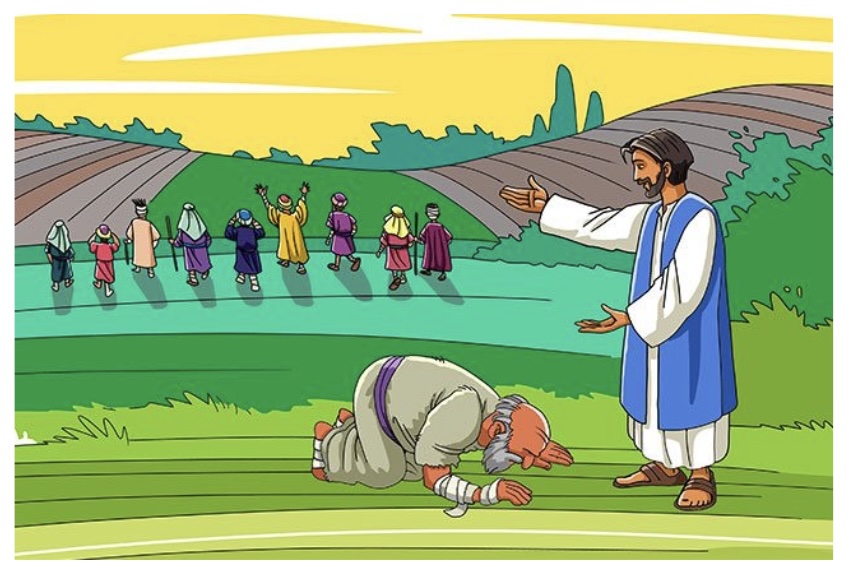
Jesus is on His way to Jerusalem, passing through the border region of Galilee and Samaria. Ten lepers come towards Him and cry out, “Jesus, Master, have mercy on us!” Jesus tells them, “Go and show yourselves to the priests.” As they go, they are healed. But only the Samaritan returns, praising God.
Why does only the Samaritan come back?
Perhaps while they were suffering from leprosy, the other nine accepted him simply as one of them. But once they were healed, did they begin again to say, “He is a Samaritan,” and reject him?
Or perhaps the Samaritan thought, “What relationship do I have with the Jewish Temple in Jerusalem and with the Jewish priests?”
Or perhaps he realised: “If God Himself is here before me, why should I go elsewhere?”
We cannot know for certain. But one thing is clear: he returns.
Returning is very important in life. There are at least two kinds of returning. The first is the return of the younger son in the parable. He leaves his father’s house, receives his share of the property, loses everything, comes to his senses, and returns home. This kind of return happens as conversion.
The second is the return of Jesus Himself. After spending the day in ministry and with the disciples, Jesus often returns at night to a lonely place to be with His Father. This kind of return is not only conversion; it is gratitude, communion, and praise.
The Samaritan leper returns in this second sense.
The philosopher Martin Heidegger often spoke about “homecoming.” He understood homecoming as returning to our roots, looking back at the journey we have travelled, and rediscovering our beginning. The Samaritan in today’s Gospel returns in all these ways. He recognises Jesus as his true source. He looks back at the road he has travelled and at the healing he has received. And by falling at the feet of Jesus, he recognises Him not merely as a healer, but as the One in whom God is present.
How does this returning happen?
First, we must stop.
Only the one who stops can turn back. A person who keeps running cannot change direction without falling. While the others continue walking, the Samaritan stops. A peaceful heart knows how to stop. An anxious heart keeps running.
Second, we must recognise our condition.
According to the Law of Moses, those healed of leprosy had to show themselves to the priests before returning to the community. But the Samaritan realises that before being accepted into the human community, he must acknowledge the One who restored him. He understands that the reason for his new condition is Jesus.
Third, we must be ready to walk in the opposite direction.
This is very important. The others may even have tried to stop him: “Why are you turning back? Didn’t He tell us to go to the priests? Come, let us go!” But the Samaritan has the courage to change direction.
Walking in the opposite direction is never easy. By then Jesus may already have continued His journey. Still, the Samaritan returns with the hope that he will find Him.
Jesus praises his return.
“Stand up and go; your faith has saved you.”
The others receive healing in their bodies. But this man receives something more. By recognising the true source of his healing, he is healed also within.
The Samaritan invites us today to walk a little extra mile — not only forward, but sometimes backward.
Sometimes the most important journey is the journey back: back to gratitude, back to our roots, back to the One who gave us life, healing, and grace.
Image courtesy: author unknown
Fr. Yesu Karunanidhi
Archdiocese of Madurai
A Yesni Prays Initiative


Leave a Reply