Daily Catholic Lectio
Sun, 23 Aug 2026
XXI Sunday in Ordinary Time
Isa 22:19-23. Rom 11:33-36. Mt 16:13-20
Confession – Authority – Silence
Today’s Gospel passage is called Peter’s confession of faith. The event in which Peter confesses who Jesus is is found in Matthew, Mark, and Luke. This passage is also considered the centre of these Gospels. The sections before this event search for the answer to the question, “Who is Jesus?” The sections after this event answer the question, “What kind of Messiah is Jesus?”
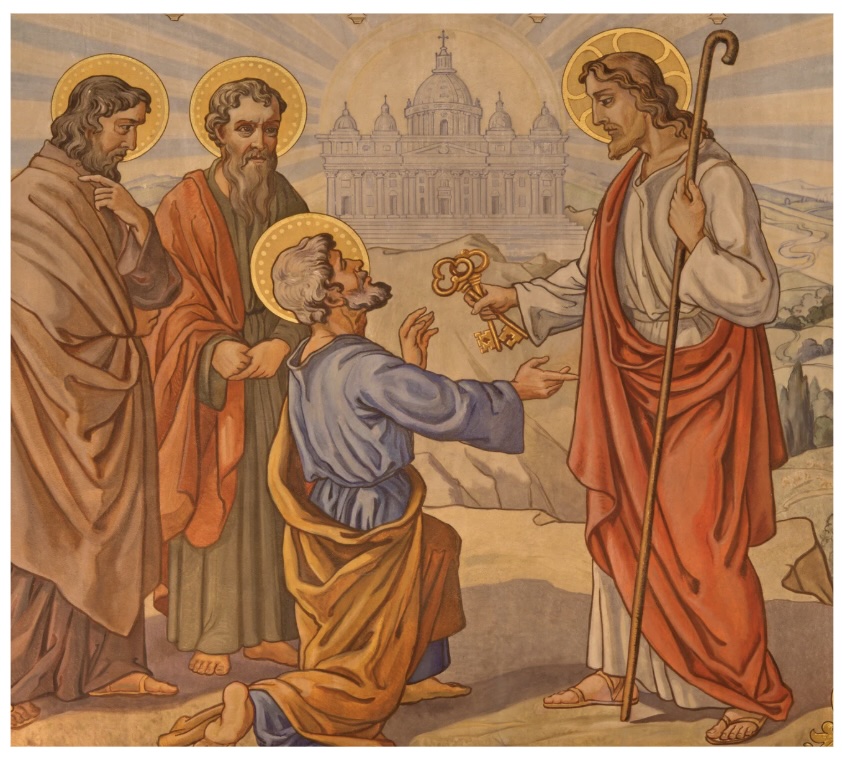
In today’s Gospel, we see three movements: first, Peter confesses Jesus as the Messiah and the Son of God; second, Jesus gives authority by handing over the keys; third, Jesus commands the disciples to keep silence about His messianic identity.
The event takes place in the region of Caesarea Philippi. This city was built by Philip Herod, one of the sons of Herod the Great, in honour of the Roman emperor Augustus Caesar. It was a place where many pagan gods were worshipped. It was also a place of political power. Therefore, the question “Who is Jesus?” becomes important both religiously and politically in this place.
Jesus asks the question in two stages. First, “Who do people say that the Son of Man is?” Second, “But who do you say that I am?”
People see Jesus as one of the prophets: John the Baptist, Elijah, Jeremiah, or one of the prophets. In the time of Jesus, many expected the Messiah as a priest or king. Since people saw Jesus as a prophet, they thought of Him as a forerunner of the Messiah, but not as the Messiah Himself.
Here the confession of Peter becomes great. When no one thinks of Jesus as the Messiah, Peter says, “You are the Messiah, the Son of the living God.” “Messiah” points to the mission of Jesus. “Son of God” points to the identity of Jesus.
Jesus praises Peter: “Blessed are you!” He says that this confession is possible only through divine revelation. Then Jesus says, “On this rock I will build my Church.” The confession of one person becomes the confession of the community. Those who confess Jesus as the Messiah become members of this community.
Then Jesus gives authority to Peter. The “key” is a symbol of authority. To open and to close belongs to one who has been given responsibility.
At the end of the Gospel, Jesus commands the disciples to keep silence about this revelation. Knowing and confessing Jesus must first be a personal event. It must not become empty noise.
For Matthew’s community, this event gives meaning in two ways. First, it presents the leadership and primacy of Peter. Second, it invites every believer to answer in the heart the question, “Who is Jesus?”
In today’s first reading, we find the image of the key. The Lord God removes authority from Shebna and places it on the shoulder of Eliakim, the son of Hilkiah. Opening and closing happen through the authority entrusted to him.
In the second reading, Paul asks, “Who has known the mind of the Lord?” Unless the Lord reveals Himself, no one can know Him. The responsorial psalm says, “Do not forsake the work of your hands.” We are the work of God’s hands.
Today’s readings give us three lessons.
First, God has built His Church on weak human beings. God chooses to work through human persons. In the words of Paul, we hold this treasure in earthen vessels. The lower must not overcome the higher. Our weakness must not hide the treasure entrusted to us.
Second, we must ask: Who is God for me? What is my personal confession about Jesus? How do I understand God? What image of God do I carry? Sometimes we think of God as a police officer who punishes our actions. Sometimes as a tablet for headache. Sometimes as a washing machine that washes away our sins. Sometimes as a Santa Claus who gives gifts. But Peter’s confession asks us to go deeper: “You are the Messiah, the Son of the living God.”
Third, silence is necessary in spirituality. We do not need to prove our God to everyone. Our words cannot fully reveal God. Our doctrines describe God, but they do not contain Him. God is greater than our doctrines. We do not need to use our doctrines to prove to one another who our God is.
Confession, authority, and silence belong together. We confess Jesus as Lord. We receive responsibility in His Church. We remain silent before the mystery that is greater than our words.
May the Lord help us to confess Him truly, serve with the authority entrusted to us, and remain silent before His mystery.
Fr. Yesu Karunanidhi
Archdiocese of Madurai
A Yesni Prays Initiative


Leave a comment