Daily Catholic Lectio
Sat, 25 April 2026
Third Week of Easter
Feast of Saint Mark
1 Peter 5:6–14; Mark 16:15–20
Mark and His Gospel
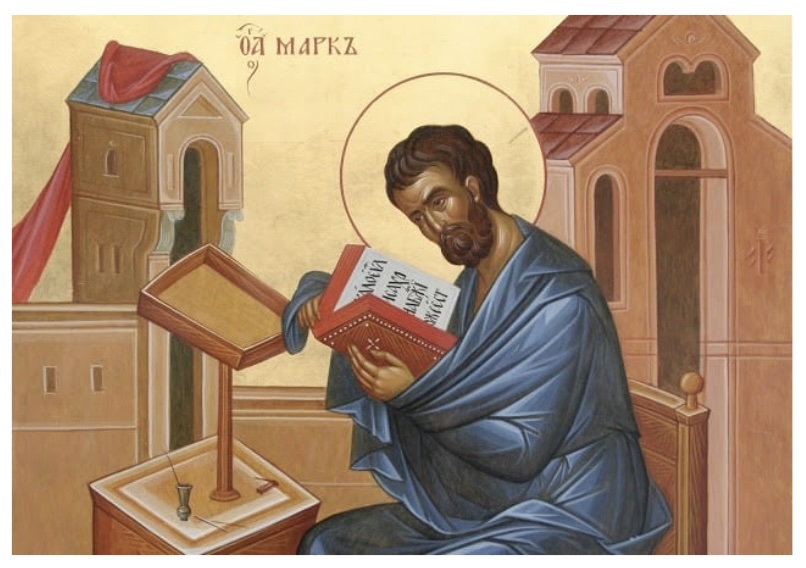
Today we celebrate the feast of Saint Mark, the Evangelist. In the first reading (cf. 1 Peter 5:13), Peter writes with affection: “My son Mark sends you greetings.” This simple phrase opens a window into a deep relationship—Mark, a disciple, a companion, a son in faith.
Tradition tells us many things about him: that he was close to Peter, that he may have been the young man carrying a jar of water when the disciples prepared the Passover, that the Last Supper was held in his house, that the Holy Spirit descended in that same upper room, that he may be the young man who fled when Jesus was arrested, and that his Gospel was the first to be written. He is also known as John Mark. These details, whether historical or traditional, all point to one truth: Mark stands close to the heart of the early Church.
What life lessons do Mark and his Gospel offer us today?
(a) A Second Chance
Mark’s journey is not a straight line. During Paul’s first missionary journey, Mark begins with enthusiasm but leaves midway and returns to Jerusalem. Later, when he wishes to rejoin Paul, he is not accepted. Even in the second journey, Paul refuses to take him along.
And yet, something changes. In his letter to Timothy, Paul writes: “Bring Mark with you, for he is useful to me in ministry” (cf. 2 Timothy 4:11). From rejection to reconciliation, from hesitation to usefulness—Mark grows.
We do not know why Mark withdrew the first time. It may have been fear, weakness, misunderstanding, or even illness. But what matters is this: he returns, he matures, and he becomes indispensable.
This is a quiet hope for all of us. When first opportunities are lost—or when we ourselves fail—we need not lose heart. God works patiently. What is broken can be restored. What is incomplete can be fulfilled.
(b) Action
Scholars often say that Mark’s Gospel is a Gospel of action. Jesus is constantly moving—walking, healing, meeting people, performing mighty deeds. There are fewer long speeches, but many concrete actions.
Two things become clear. First, it is not our words but our actions that reveal who we truly are. Words can be many; actions speak with clarity. Second, the actions we repeat daily shape our life. They are within our control. Instead of overthinking, we are invited to act—faithfully, consistently.
A life of small, faithful actions becomes a life of witness.
(c) Immediately
The word “immediately” appears again and again in Mark—over forty times. Jesus calls, and the disciples follow immediately. He acts without delay.
This urgency reflects not anxiety, but clarity. In Mark’s time, there was an expectation that the Lord’s coming was near. That sense of nearness shaped a Gospel of movement, of readiness.
For us, this becomes a spiritual invitation. Do not postpone the good. Do not delay conversion. Do not wait endlessly. There is a grace in acting at the right moment. Promptness guards us from indecision and from the burden of overthinking.
(d) The Gospel as a Literary Form
Mark begins his book with a striking line: “The beginning of the Gospel of Jesus Christ, the Son of God” (Mark 1:1). The word “Gospel”—euangelion—is not just a title; it is a new way of writing.
It is not merely history, and not merely story. It is a proclamation that calls for a response. When we read Mark, we are not just informed—we are invited.
At the end of the reading, a question quietly emerges: Who is Jesus for me? The Gospel is complete only when the reader answers this question with life.
(e) Suffering as a Reality
Suffering runs through Mark’s Gospel. Jesus is presented as the suffering servant. He walks the path of rejection, misunderstanding, and the cross.
The early Christian community, including Peter and Mark, also experienced suffering (cf. first reading). To such a community, Mark offers not explanation, but consolation: the Lord himself has walked this path.
This gives strength. Our suffering is not outside God’s presence. Christ has entered it. And because he has, suffering can become a place of hope.
(f) The Messianic Secret
A unique feature of Mark’s Gospel is the “Messianic secret.” The identity of Jesus is often hidden, revealed slowly, almost mysteriously. Even miracles are followed by silence.
This reminds us of a deep truth: God is not fully grasped. There is always a distance—a sacred distance—that evokes awe and wonder. As long as there is wonder, faith remains alive.
In today’s Gospel, we hear the final words of Jesus. He ascends and is seated at the right hand of God. Yet, from there, he continues to act—confirming the words of the disciples through signs. God remains hidden, yet active. Invisible, yet present.
Faith is our response to this hidden revelation.
Today, let us take a simple step: to read at least a few passages from the Gospel of Mark. Not quickly, but attentively. Not just to know, but to respond.
Saint Mark does not only tell us about Jesus. He leads us to meet him.
Fr. Yesu Karunanidhi
Archdiocese of Madurai
A ‘Yesni Prays’ Initiative
 Yesu Karunanidhi
Leave a comment