Daily Catholic Lectio
Mon, 2 Nov 2026
Commemoration of All the Faithful Departed
Readings: From the Masses for the Dead
Remembering the Dead and the Fulfilment of Life
“Is there life after death?” In some places, the Bible answers “yes,” while in other places it seems to answer “no.”
“Is the suffering of souls connected with a place or with a state?” The Council of Trent tended to understand purification in terms of a place, while the Second Vatican Council helps us understand it more as a state.
But today is not the day to ask whether there is life after death or not, or whether purification is a place or a state.
“If the passion, death, and resurrection of Jesus have taken away our sins, why should we still suffer after death?”
“How can the prayers we offer within time and space reach souls who have passed beyond time and space?”
“What happens to those who belong to religions that do not believe in heaven, hell, or purification, or to those who do not accept life after death?”
Like death itself, we do not have complete answers to all these questions.
What, then, do we do today?
Today is the day when those who are alive remember those who lived before us. Because they were with us and for us yesterday, they continue to remain with us and for us today and always. They are important to us in three ways.
(a) They made way for us.
If everyone who came into this world remained here forever, there would be no room for those who came after them. They left this world and made way for us to enter it.
(b) They showed us the way.
As father, mother, husband, wife, son, daughter, friend, relative, well-wisher, or spiritual guide, they lived certain values and showed us the way.
(c) They continue to walk with us.
They remain our companions on the journey. They watch over us, protect us, and intercede for us.
Saint Augustine gives us an important insight in his Confessions when he describes the death of his mother, Monica.
What does he say?
After his mother’s death, Augustine thought that she would want to be buried beside her husband. But she said: “Bury my body wherever you wish. Do not be troubled about it. Only remember me at the altar of the Lord. My Lord is able to raise me wherever I may be.”
This account of Augustine teaches us three things.
(a) After death, the body is no longer the central concern. The body dies, but the soul continues to live.
(b) We must remember the dead in prayer.
(c) All of us who die will rise again. Only the Lord has the power to raise us.
These are the truths we remember today.
The belief that the human soul does not perish is found not only in religions, but also in the reflections of many philosophers. The body is like a garment worn by the soul, or like a rented house in which the soul lives. The visible body must perish. But the invisible soul continues to live in a place or state beyond our sight. There it rests in God.
Today gives us three lessons.
(a) The passing nature of life
Anything can happen at any time. Everyone who comes here must one day go there. They have gone; we too will go. This is the reality of life.
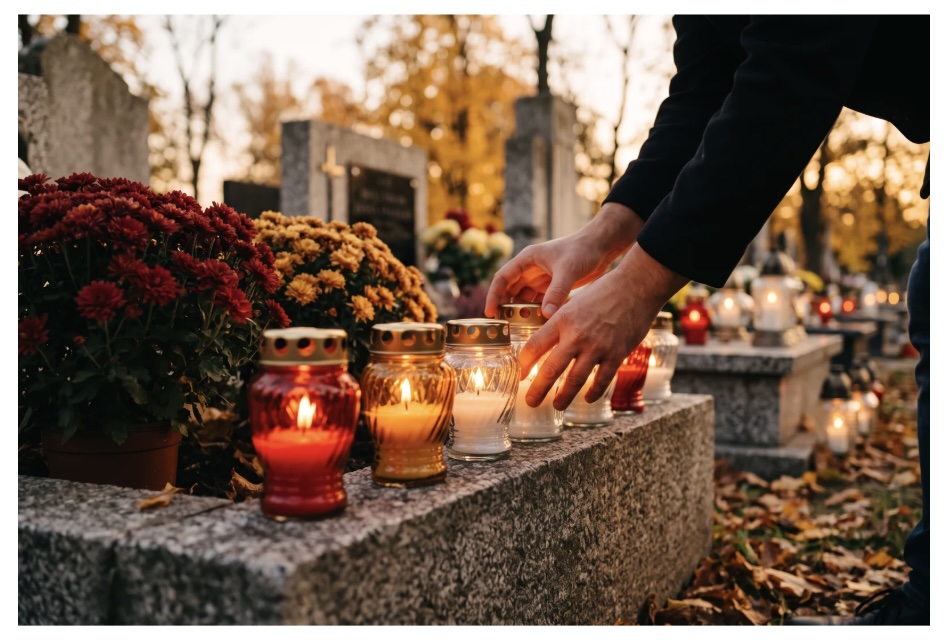
The candle we light at a grave melts away little by little. In the same way, our life is melting away each day. The incense we burn disappears into the air as smoke; in the same way, we too disappear. But until then, we burn. Until then, we spread fragrance. As long as our eyes are open, everything before us appears alive. When we close our eyes, everything disappears from our sight. To see the God who never disappears, one day we must close the eyes of the body.
Today invites us to keep that day in mind.
(b) Life before death determines life after death
We often think about life after death and forget life before death. But if this life determines that life, then it is wise to live this short life well.
In management, there is an idea sometimes called “living backwards.” It means asking: “What do I want people to say about me at my funeral?” Then I begin living today in such a way that those words may become true. For example, if I want people to say, “He lived a very simple life,” then I must begin living simply now.
The Psalmist says: “Our span is seventy years, or eighty for those who are strong; and most of these are emptiness and pain. They pass swiftly, and we are gone” (cf. Ps 90:10).
Even if we live seventy years, when we count life in decades, we have only seven decades. The first thirty-five years may pass in learning and establishing ourselves. After that, we slowly begin to decline.
Our years move through learning, standing, and fading. Therefore, it is good to hold firmly to what truly matters.
(c) In death, we are not alone
One reason death seems so frightening is that we must experience it personally and alone. But in death, we are not truly alone.
This memorial teaches us that there are relatives and friends who remember us. Just as we accompany our departed ancestors through prayer, the generations who come after us will accompany us in prayer.
Death, therefore, cannot completely separate us or leave us alone.
Today, let us remember as many of our departed loved ones as possible.
In Celtic tradition, there is a beautiful image: the stars are like openings in the heavens through which those who have died have passed. Through those openings, the light of heaven shines down upon us as stars.
Today, let us join the light of our candles with the light of those stars.
Finally, I would like to conclude with something I read on a poster a few days ago. “When someone dies, we say, ‘Rest in peace.’ But do we ever look at someone who is alive and say, ‘Live in peace’? Perhaps it is not only the dead who need peace. The living need peace even more.”
There is much truth in this.
The living certainly need peace. But sometimes they themselves lose it, and they themselves can also recover it.
The dead, however, cannot obtain peace for themselves in the same way. We are called to help them through our prayer.
This is how I understand the words of the Beatitudes: “Blessed are the peacemakers” (Mt 5:9). Blessed are those who, through their prayers, bring peace to the departed, for they shall be called children of God.
Fr. Yesu Karunanidhi
Archdiocese of Madurai
A Yesni Prays Initiative


Leave a Reply