Daily Catholic Lectio
Sun, 1 November 2026
Solemnity of All Saints
Rev 7:2-4, 9-14; 1 Jn 3:1-3; Mt 5:1-12a
Holiness Is the Fruit of Grace
“Holiness is our continuous response to the grace of God; it is the fruit we offer to God after having received His grace.”
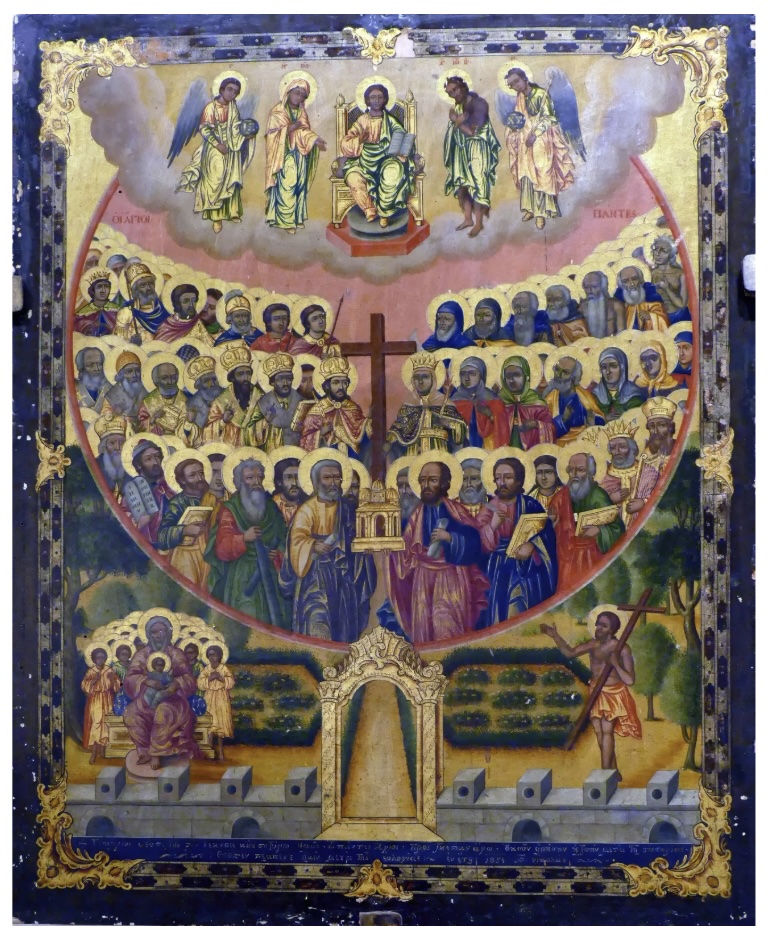
Today we rejoice in celebrating the Solemnity of All Saints. The Church is traditionally spoken of in three states: the Church pilgrim on earth, the Church being purified, and the Church glorified in heaven. Today is the feast of the third: those who have reached the fullness of holiness in God. It is also the feast of countless men and women whose names do not appear in the liturgical calendar, but who lived holy lives and now share in the glory of God.
In today’s first reading (cf. Rev 7:2-4, 9-14), the Book of Revelation presents a magnificent vision of God’s holy people. They appear in two groups. The first group consists of those who are “sealed.” A seal indicates belonging and ownership: these people belong to God. John hears the number of those sealed: 144,000. This is a symbolic number, formed from the twelve tribes of Israel and their fullness. It points to the people whom God chose to be His own, called to serve Him and to bear His message to the nations (cf. Ex 19:5-6).
The second group is described as an immense multitude wearing white robes. They are those who “have come out of the great tribulation” and “have washed their robes and made them white in the blood of the Lamb.” They followed Christ and endured suffering because of Him. Their white robes symbolize holiness, victory, and new life. Their holiness is first of all a gift received from God. Israel is sealed by God; Christians are sanctified through the death of Christ, the Paschal Lamb.
The second reading (cf. 1 Jn 3:1-3) begins with an invitation to contemplate the love of God: “See what love the Father has given us, that we should be called children of God.” The community to which John writes experiences suffering because of its Christian faith. Yet John reminds them that present suffering is temporary. Their destiny is greater: they are called to become like Christ. “Everyone who has this hope in Him purifies himself, just as He is pure.” Holiness is therefore both God’s gift and the goal towards which the believer continually moves.
In the Gospel (cf. Mt 5:1-12a), we hear the opening of the Sermon on the Mount: the Beatitudes. Jesus presents eight ways of blessedness. They are not simply moral rules; they are paths through which the blessing of God enters our lives and gradually shapes us into holy people.
The first four Beatitudes primarily describe our relationship with God; the next four shape our relationship with one another. First comes poverty of spirit. It means recognising our dependence upon God. The poor in spirit know that they cannot save themselves and therefore make room for God. Second are those who mourn. Their sorrow carries within it the promise of God’s consolation and salvation. Third are the meek, echoing Psalm 37:11: “The meek shall inherit the land.” The land is ultimately God’s gift, not something seized by human force. Fourth are those who hunger and thirst for righteousness. Righteousness means living in a right relationship with God and with others.
The fifth Beatitude concerns the merciful: “Blessed are the merciful, for they will receive mercy.” Mercy goes beyond strict justice. It is love expressed in concrete compassion towards another person. Sixth are the pure in heart. Purity of heart means integrity, sincerity, and faithfulness. Those whose relationships are transparent and truthful are drawn towards God because God Himself is holy. Seventh are the peacemakers. Peace is not merely the absence of conflict; it is a state of harmony in which relationships are restored and people rediscover their belonging to one another. Eighth are those who are persecuted for righteousness. Because they remain faithful to God even in suffering, the Kingdom belongs to them.
The Gospel then moves from suffering to joy: “Rejoice and be glad.” These words became the title of Pope Francis’ apostolic exhortation on holiness, Gaudete et Exsultate. Holiness is not a gloomy burden. At its heart is the joy of belonging to God.
The three readings therefore form a beautiful movement. The first reading shows people who have received God’s grace and borne fruit through faithful witness. The second reading presents holiness as our destiny and goal. The Gospel shows the Beatitudes as the path, beginning with Jesus’ invitation to blessedness and joy.
The Responsorial Psalm expresses the same vision: “Such is the generation of those who seek the Lord” (cf. Ps 24). The saints are simply men and women who kept seeking God and allowed that search to transform their lives.
What challenges does the Solemnity of All Saints offer us?
(a) The call to holiness belongs to everyone.
Saint Ignatius of Loyola once asked himself, “If he could become a saint, and if she could become a saint, why not I?” Saints did not descend from heaven ready-made. They lived in this world just as we do, struggled as we struggle, failed as we fail, and yet allowed grace to transform them. They bore fruit according to the grace they received. As Saint John Mary Vianney observed, the saints may not always have begun well, but they finished well.
Whatever our stage of life—childhood, youth, adulthood, or old age—and whatever our vocation—priesthood, consecrated life, marriage, or lay life—holiness is possible. We should not distance the saints from ourselves by seeing them only as heavenly intercessors. We must also learn to make their values our own. There are examples of holiness even within our families: among our ancestors who have died and among ordinary people who quietly live among us today.
(b) Holiness means living “a little more”—the extra.
The journey towards holiness is often simply the willingness to do “a little more.” Instead of stopping with “This is enough,” holiness takes one further step.
Among people controlled by fear, Saint Sebastian showed a little more courage. Saint Anthony of Padua showed a little more patience when he was set aside. When others wanted to possess more, Saint Anthony of the Desert and Saint Francis of Assisi dared to give up more. When people wondered what could possibly be done for those living in the slums, Mother Teresa did a little more.
A little more prayer. A little more sacrifice. A little more self-denial. A little more courage. A little more love of God. A little more love of neighbour.
Instead of asking, “Can I remain holy until the end of my life?”, it may be enough to ask, “Can I live as a saint today?”
(c) What matters is not only how we are, but how we are becoming.
Holiness is not imprisoned by our past or limited by our present. Its true field is the future towards which grace is leading us. Our value does not depend merely on how we were yesterday or how we are today, but on what we are willing to become.
Think of milk. Milk itself has value. When it becomes curd, its value changes. When it becomes butter or cheese, its value increases. When it becomes a sweet, it acquires another value. When it becomes clarified butter, it reaches yet another stage. At every step, the milk must allow itself to undergo transformation.
The lesson is simple: if we want to become more valuable, we must be willing to change more deeply. Holiness is the direction and goal of this transformation.
Holiness, therefore, is our continuous response to the grace of God. God gives grace; we respond. God calls; we take another step. God transforms us; our life begins to bear fruit. Holiness is the fruit we give back to God from the grace He first gives us.
The Catechism of the Catholic Church, reflecting on the words of the Creed, “I believe in the communion of saints,” reminds us that all who belong to Christ remain united in Him. The Church embraces those still journeying on earth, those undergoing purification, and those already enjoying heavenly glory. Because we are one in Christ, the saints continue to intercede for us (cf. CCC 961-962).
Today, therefore, we do not merely admire the saints.
We remember that we belong to their communion.
We receive the same grace that transformed them.
And we hear the same call that they heard:
Become holy by allowing grace to bear fruit in your life.
Fr. Yesu Karunanidhi
Archdiocese of Madurai
A Yesni Prays Initiative


Leave a Reply