Daily Catholic Lectio
Mon, 21 Sep 2026
Saint Matthew, Evangelist, Feast
Eph 4:1-7, 11-13. Mt 9:9-13
Follow Me
Today we celebrate the feast of Saint Matthew, Apostle and Evangelist. He is the patron saint of bankers, accountants, tax officials, and auditors.
In Indian philosophy, there is the idea of mārga, meaning “way,” or a path leading to liberation or blessedness. We speak of Jñāna Mārga, the way of knowledge; Karma Mārga, the way of action; and Bhakti Mārga, the way of devotion. Against this background, Matthew’s Gospel may be seen as a Gospel of knowledge, Mark as a Gospel of action, and Luke as a Gospel of devotion.
In Matthew’s Gospel, Jesus appears as the great teacher. The long Sermon on the Mount and the other major discourses of Jesus are presented with special importance in this Gospel.
Matthew records Jesus saying: “Every scribe who has been trained for the Kingdom of heaven is like a householder who brings out of his treasure what is new and what is old” (Mt 13:52).
This saying tells us two things. First, the Kingdom of heaven is something to be learned and understood. It therefore involves knowledge and wisdom. Everyone can learn about the Kingdom of heaven.
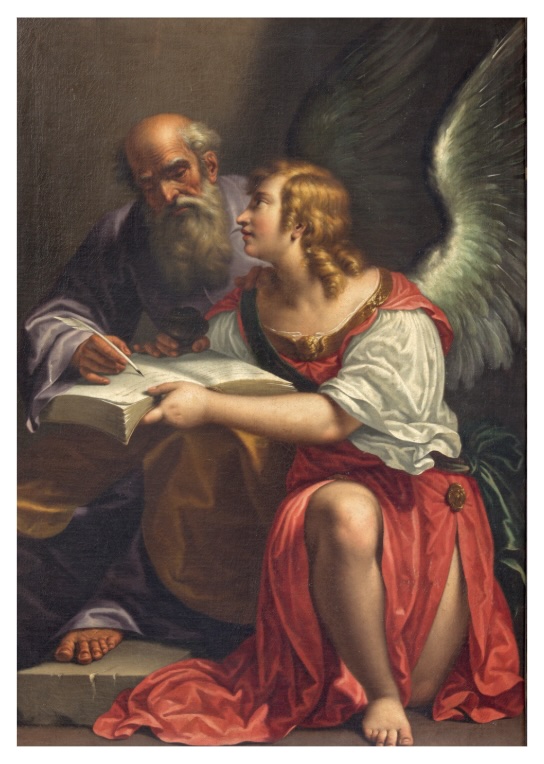
Second, this saying can also be seen as reflecting Matthew himself. Matthew had been sitting at the tax booth collecting money. After learning about the Kingdom of heaven, he brought out from the treasury of his experience both the old and the new. He brought together the Old Testament and the new experience of Jesus and recorded the Gospel.
In today’s first reading, Paul tells the Church at Ephesus: “Live in a manner worthy of the calling you have received.” Matthew lives according to the call he received as an apostle in three ways.
First, he leaves the old and holds on to the new. Paul says, “When the perfect comes, the partial will pass away” (cf. 1 Cor 13:10). When Matthew encounters Jesus, the fullness, he leaves behind the partial life of a tax collector.
Second, Matthew has the courage to say before Jesus, “This is who I am.” Immediately after being called, Matthew invites Jesus to a meal in his house. A meal is a sign of relationship. At that table, without worrying about the labels and accusations placed upon him by others, Matthew shows Jesus who he is and who his friends and companions are.
Matthew becomes one of those biblical persons who offers hospitality to God. There is something noble in the willingness to share one’s food with another. Hunger, one of our most basic instincts, normally pushes us to keep things for ourselves. Sharing food therefore becomes a sign that relationship is greater than possession.
Third, Matthew gives us the Gospel of “God with us.” One of the great messages of Matthew’s Gospel is Emmanuel: God is with us. In Matthew’s Gospel, Jesus does not disappear from His disciples at the end. He remains with them through His promise: “I am with you always, until the end of the age.”
Matthew belongs deeply to this vision. He understands that humanity must hold firmly to the God who chooses to remain with us.
There are many other beautiful elements in Matthew’s Gospel: the genealogy of Jesus; Joseph, the incomparable head of the Holy Family, whom Matthew calls “righteous”; the Magi from the East; the Sermon on the Mount; Peter walking on the sea; the remorse of Judas; the dream of Pilate’s wife; the parable of the ten virgins; the workers in the vineyard; and the final judgment.
Today, we can make an effort to read at least some passages from Matthew’s Gospel.
When Matthew hears the voice of Jesus saying, “Follow me,” he gets up and leaves everything behind. He does not say, “Let me finish my accounts and then I will come.” He does not say, “Perhaps tomorrow.” He is ready. Immediately.
The name “Matthew” means “gift of God.” Matthew, who receives this name as a gift, gives himself back as a gift to God.
The man who once kept accounts of money later wrote the account of salvation. The one who once recorded what was received and paid now gives us the Gospel through which Christ continues to speak to us.
Jesus still says, “Follow me.”
The question is whether we are ready to get up.
Fr. Yesu Karunanidhi
Archdiocese of Madurai
A Yesni Prays Initiative
 Yesu Karunanidhi
Leave a comment