Daily Catholic Lectio
Sun, 7 June 2026
Most Holy Body and Blood of Christ (Corpus Christi)
Deut 8:2-3, 14-16. 1 Cor 10:16-17. Jn 6:51-58
He Gave You Hunger
Today the Church celebrates the Solemnity of the Body and Blood of Christ, commonly known as Corpus Christi. It is the feast of the Eucharist, the sacrament that stands at the heart of Catholic life.
Let us take as the central theme of our reflection a striking phrase from the first reading: “He gave you hunger.”
At first, these words may sound strange. Why would God give hunger to His people? Should He not remove hunger rather than create it? Yet Moses reminds Israel that God allowed them to experience hunger in the desert so that they might learn a deeper truth: human beings do not live by bread alone but by every word that comes from the mouth of God.
Hunger is the most basic instinct shared by all living creatures. When hunger comes, many other concerns disappear. Hunger reminds us of our weakness. Hunger reveals our dependence. Hunger teaches us that we cannot sustain ourselves alone.
Today’s readings teach us that human hunger is satisfied not only by food but also by communion and by God Himself.
(A) Theological Reflection
The Church teaches that the Eucharist is the source, center, and summit of Christian life. Catholic theology traditionally understands the Eucharist through three key dimensions.
(1) Food (Meal)
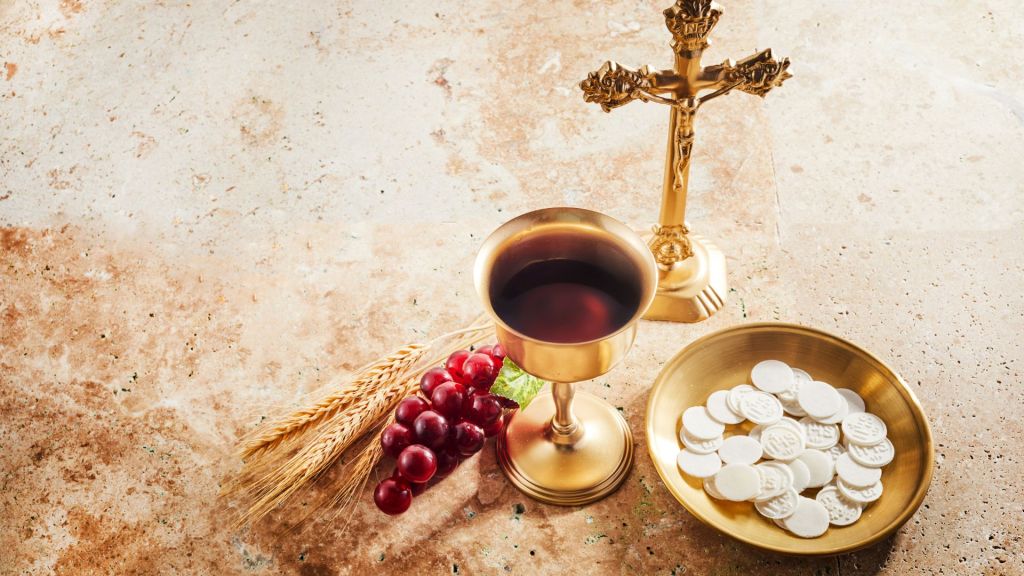
The Eucharist is food or meal. Jesus declares in today’s Gospel: “I am the living bread that came down from heaven.” At the Last Supper He takes bread and says, “This is my body.” It is striking that Jesus, born in Bethlehem, whose name means “House of Bread,” becomes bread for the life of the world. Every living being experiences hunger. Jesus responds to that universal hunger by offering Himself as food. He does not merely give bread. He becomes bread.
(2) Sacrifice
The Eucharist is sacrifice. Every Mass makes present the one sacrifice of Christ on Calvary. We do not repeat the sacrifice of the Cross. Christ’s sacrifice was offered once and for all. Yet in the Eucharist we enter into that saving event and receive its fruits. For this reason the Eucharistic celebration is not simply a meal. It is also a memorial of Christ’s self-giving love. Every Mass reminds us that love always involves sacrifice.
(3) Presence
The Eucharist is presence. Jesus remains with us in the Eucharist. His presence does not end when the Mass concludes. He continues to dwell among His people.
Pope Benedict XVI often spoke about the joy that flows from Christ’s Eucharistic presence. Just as the presence of a king brings confidence and joy to a city, the presence of Christ brings strength and hope to His people.
Pope Francis has called the Eucharist a “sacrament of wonder.” The infinite God humbles Himself and becomes present under the appearance of bread.
Pope Leo XIV reminds us that the Eucharist also sends us out to satisfy the hunger of others. We cannot receive the Bread of Life and remain indifferent to those who lack bread, dignity, or hope.
(B) Reflection on the Readings
(1) Food That Satisfies Hunger (First Reading)
In the first reading, Moses reminds Israel of the desert journey: “He gave you hunger, and then fed you with manna.” God first allows His people to experience need. Why? So that they may learn dependence on Him. Bread is the result of human labour. Manna was a gift from heaven. Through manna, Israel learned that life is not sustained merely by human effort but by God’s providence.
The hunger of the desert was a lesson in humility. It taught the people that they were not self-sufficient. Their existence depended entirely upon God. Thus, the first reading teaches us that food satisfies our physical hunger, but it also points beyond itself to the God who provides.
(2) Communion That Satisfies Hunger (Second Reading)
In the second reading, Saint Paul speaks about the breaking of bread. “The bread that we break, is it not a participation in the body of Christ?” For Paul, participation in Christ means more than receiving a sacred object. It means entering into communion with Christ Himself.
Then Paul adds: “Though we are many, we are one body.” Those who share one bread become one family. Food creates fellowship. Meals create relationships. The Eucharist creates communion. Many people today suffer not only from physical hunger but also from loneliness, isolation, and broken relationships. The Eucharist responds to this hunger by drawing us into communion with Christ and with one another. Thus, the second reading teaches us that relationships and communion can satisfy a deeper hunger within the human heart.
(3) God Who Satisfies Hunger (Gospel)
In today’s Gospel, Jesus goes even further. After feeding the crowd with loaves, He declares: “I am the living bread that came down from heaven.” This is the first great “I am” statement in John’s Gospel. Jesus does not merely point toward God. He presents Himself as God’s answer to humanity’s deepest hunger. “The bread that I will give is my flesh for the life of the world.” These words find their fulfillment both in the Eucharist and on the Cross. In the Eucharist Christ gives His body as food. On Calvary He gives His body as sacrifice.
Jesus then promises that whoever eats His flesh and drinks His blood remains in Him and He in them. Here lies the deepest truth of today’s feast. The greatest hunger of the human person is ultimately a hunger for God. We may try to satisfy it through success, possessions, achievements, or relationships. Yet the human heart remains restless until it rests in Him.
Only God can satisfy the deepest hunger of the human soul.
(C) Practical Reflection
(1) Called to Satisfy One Another’s Hunger
If the Eucharist reminds us of our own hunger, it also calls us to respond to the hunger of others. There is physical hunger that needs food. There is intellectual hunger that needs truth. There is emotional hunger that needs love. There is spiritual hunger that needs God. The Eucharist sends us into the world as servants of all these forms of hunger.
(2) The Eucharist as Medicine for the Weak
Pope Francis frequently reminds us that the Eucharist is not a reward for the perfect but medicine for the weak. All of us come to the altar carrying wounds, struggles, failures, and weaknesses. We do not receive the Eucharist because we are worthy. We receive it because we are needy. The Bread of Life strengthens us on our journey and heals the wounds of our hearts.
(3) The Visible Sign of the Invisible God
At every Mass, after the words of consecration, we proclaim: “The mystery of faith.” The Eucharist reminds us that reality is deeper than what our eyes can see. Under the appearance of bread and wine, Christ Himself becomes present.
Faith enables us to see beyond appearances and recognize God’s hidden presence among us. The Eucharist teaches us that there is always more than meets the eye. Behind the visible stands the invisible God who continually nourishes His people.
Today’s Psalm invites us to praise the Lord because He “fills you with the finest wheat.”
The God who gave Israel hunger in the desert also gave them manna. The God who allows us to experience hunger today also provides the food that truly satisfies.
May the Lord who gave us hunger also satisfy our hunger—with food for our bodies, communion for our hearts, and His own presence for our souls.
Fr. Yesu Karunanidhi
Archdiocese of Madurai
A Yesni Prays Initiative


Leave a Reply