Daily Catholic Lectio
Fri, 1 May 2026
Saint Joseph the Worker, Memorial
Gen 1:26-2:3 or Col 3:14-15, 17, 23-24. Mt 13:54-58
Son of the Carpenter
There is a simple phrase in today’s Gospel that carries a quiet weight: “Is this not the son of the carpenter?” (Mt 13:55). It is spoken not with faith, but with hesitation. The people of Nazareth see Jesus, they hear His wisdom, they witness His presence—and yet, they cannot move beyond what they already know. For them, He is only “the carpenter’s son.” A label becomes a limit. Familiarity becomes a barrier to faith.
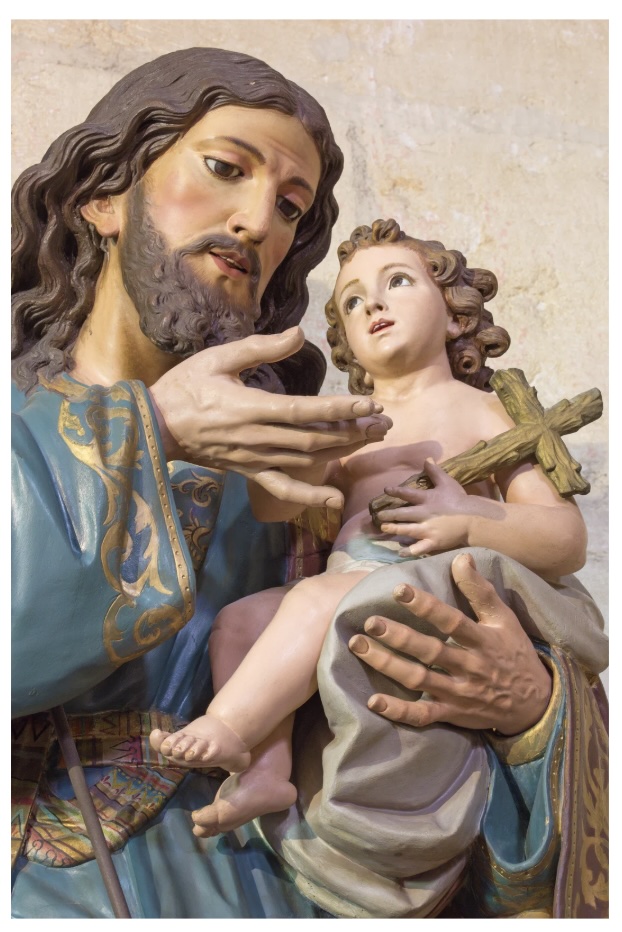
Today, on the memorial of Saint Joseph the Worker, this phrase opens a deeper path for reflection. The Son of God chooses to be known as the son of a carpenter. Not a king, not a scholar, not a priest—but the son of one who works with his hands. In this quiet choice, God reveals something essential about human life, about work, and about dignity.
The first reading from Genesis presents God Himself as a worker. The Bible begins not with a theory, but with an action: God creates, shapes, orders, and beautifies the world. Day after day, He labours. And when His work is complete, He rests. Work and rest are woven into the rhythm of creation itself. To work, then, is not a burden imposed from outside; it is a participation in the very life of God.
Yet, as human history unfolds, work often becomes heavy. It feels like a burden, a struggle, even a crown of thorns placed upon us. But the mystery of Saint Joseph transforms this understanding. In the hidden life of Nazareth, work becomes a crown of dignity. Through his daily labour, Joseph provides for Mary and Jesus. His work is not simply economic; it is relational, responsible, and deeply spiritual.
The Gospel uses the Greek word “tekton” to describe Joseph—a craftsman, a builder, one who works with both hands and mind. His work requires skill, patience, and attention. It is not only manual effort; it is intelligent care. In Joseph, we see that true work is never mechanical. It engages the whole person—body, mind, and heart.
Saint Joseph teaches us that work is responsibility. He feeds his family through his labour. Work is obedience. In every situation, he sets aside his own plans and listens to the will of God. Work is sanctification. His ordinary tasks become prayer, his workshop becomes a place of communion with God.
In our own time, the meaning of work is changing rapidly. From tools to machines, from machines to digital systems, from human effort to artificial intelligence—many forms of work no longer require human presence in the same way. There is progress, but also a quiet fear: What is the place of the human person? When work disappears, dignity is threatened. As Pope Francis reminds us, work is not only about productivity; it is about human dignity. To be deprived of work is often to feel deprived of worth.
This is why Saint Joseph remains so relevant. He reminds us that the value of work does not lie in its status, but in its spirit. There is no high or low in work. Some labour with their hands, others with their minds, others with specialized skills—but all contribute. Even the hidden work at home, often unnoticed, carries immense dignity. At the same time, those who cannot work—the elderly, children, the sick—are not without value. Their dignity does not depend on productivity, but on their being.
The people of Nazareth could not see beyond the label: “son of the carpenter.” They judged Jesus based on His background. We often do the same. We place people into categories, measure them by their work, and create invisible walls. But Jesus does not try to prove Himself. He simply continues His path. Truth does not need to argue; it reveals itself in time.
There is also a quiet irony here. The one they call “the carpenter’s son” is the very Word through whom all things were made. The Creator stands among them as a craftsman’s child. God does not distance Himself from human labour; He enters into it.
And so, today, we are invited to see our work differently. Every task—whether small or great—can be a participation in God’s creative work. To organize, to build, to care, to improve—these are not just human activities; they are reflections of the Creator.
Genesis also reminds us of something essential: God rests. Work without rest becomes slavery. Rest renews our strength and restores our vision. In a restless world, learning to rest is also a form of faith.
Finally, Saint Joseph offers us three simple lessons. First, his primary work was to care for Jesus—to nurture life. Second, through his craft, he sustained his family. Third, even now, he continues his work—interceding for us before God. The saints do not retire; they continue their mission in another way.
Today, as we honour Saint Joseph the Worker, we remember: we too are, in a sense, “children of the carpenter.” Our dignity does not come from what we achieve, but from the One with whom we work.
And perhaps the question for us today is simple:
In my work—whatever it may be—do I see only effort, or do I see a participation in God’s own work?
Saint Joseph, worker and guardian, teach us to work with humility, to rest with trust, and to live with dignity.
Fr. Yesu Karunanidhi
Archdiocese of Madurai
A ‘Yesni Prays’ Initiative


Leave a Reply