Daily Catholic Lectio
Fri, 24 April 2026
Third Week of Easter
Ac 9:1-20. Jn 6:52-59
Saul was without sight
There is a striking phrase in today’s first reading: “For three days Saul was without sight, and neither ate nor drank.” It is a simple statement, but it carries a deep spiritual weight. Saul was blind. Not only physically, but inwardly. And yet, in that blindness, something new was beginning.
Saul begins his journey with certainty and speed. He is determined, focused, and convinced that he is doing the right thing. With authority in hand, he sets out for Damascus to stop what he calls “the new Way.” He is moving forward with clarity—but it is a dangerous clarity. Because he sees, but does not truly see. He knows, but does not truly understand.
And so, the Lord intervenes.
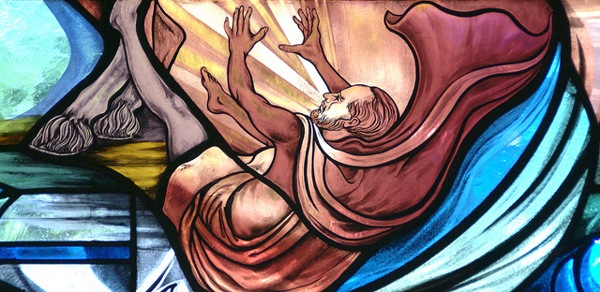
On the road, Saul is suddenly stopped. The one who was moving quickly can no longer move. The one who thought he saw clearly is now blind. This is not punishment. It is grace. God interrupts him—not to destroy him, but to redirect him.
Sometimes in our own lives, we experience something similar. We are moving forward with our plans, our ideas, our convictions. And suddenly, something stops us—a failure, a confusion, a moment of darkness. We feel disoriented. We feel as if we have lost direction. But perhaps, in those moments, God is not abandoning us. He is inviting us to see differently.
Saul’s blindness lasts three days. The intensity of the light he encountered is so strong that his eyes can no longer function. Like someone who steps from bright sunlight into darkness, he cannot see. But in losing his outer sight, something else begins to open—his inner sight.
He begins to ask questions: Who are you, Lord? Why is this happening? These are not intellectual questions. They are existential. They arise from within a broken and humbled heart. For the first time, Saul begins to listen.
There is also another detail: he neither eats nor drinks. This is not simply fasting. It is the expression of an inner turmoil. Saul may be experiencing confusion, guilt, even fear. What will happen now? What will he say to those who sent him? Everything he believed in is shaken. It is a kind of inner collapse—a small death within.
We see something similar in the experience of the prophet Elijah. After a great victory, he falls into fear and despair, even wishing to die. When our certainties collapse, we can feel lost, even undone. Saul too enters that space. A space where the old self begins to die.
But this is not the end.
The turning point comes through a simple disciple: Ananias. Not a leader, not a powerful figure—just an ordinary believer. God sends him to Saul. And what is beautiful is Saul’s openness. The man who came with authority now listens to a simple disciple. This is the beginning of true conversion: the humility to receive.
Through Ananias, Saul receives sight again. More than that, he receives the Holy Spirit. Quietly, without noise, without spectacle, grace enters his life. The one who came to destroy the Way is now entrusted with proclaiming it—especially to the Gentiles.
And immediately, he eats. Life returns. Strength returns. Purpose returns.
This is the journey: from blindness to sight, from control to surrender, from certainty to faith.
In the Gospel, Jesus says, “Whoever eats my flesh and drinks my blood has life in me… and I live because of the Father.”Life is not something we produce. It is something we receive. Saul discovers this truth in a radical way. The one who thought he was serving God now learns to live from God.
“My life comes from him.” This becomes his new identity.
There is a gentle but firm message for us today. We may not be as dramatic as Saul, but we too can be blind in subtle ways—blind in our judgments, in our habits, in our certainties. We move forward, convinced that we are right. And yet, God may need to stop us, to lead us into a moment of darkness—not to harm us, but to transform us.
Image courtesy: ThinkingFaith
Fr. Yesu Karunanidhi
Archdiocese of Madurai
A ‘Yesni Prays’ Initiative


Leave a Reply