Daily Catholic Lectio
Thu, 23 April 2026
Third Week of Easter
Ac 8:26–40. Jn 6:44–51
Led by the Holy Spirit
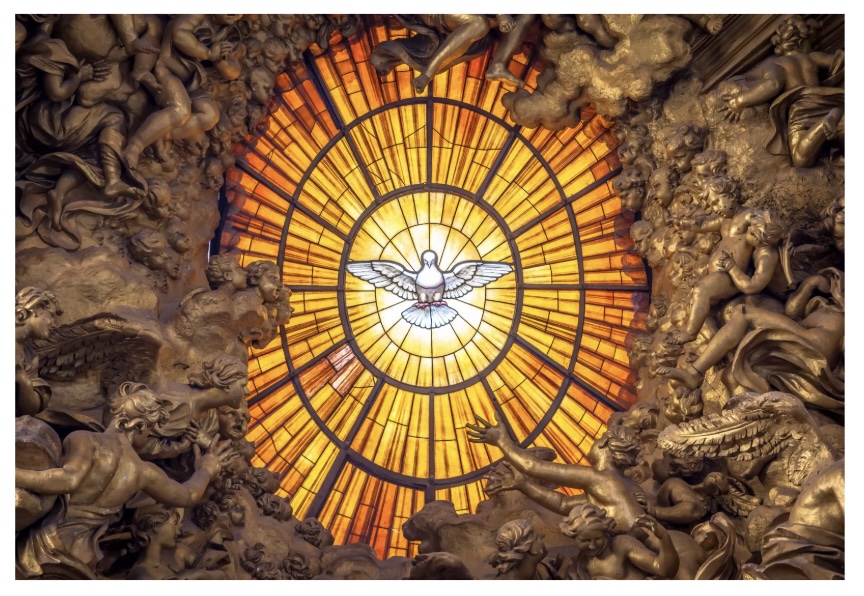
Today, the Word of God gently draws us into a deep and living reality: to be led by the Holy Spirit. The Acts of the Apostles presents a simple yet powerful scene—Philip is told, “Get up and go toward the south.” It is not a detailed plan. It is a direction. And Philip obeys.
The road mentioned—“from Jerusalem to Gaza”—can stir uneasy feelings even today. It is a path that has seen conflict, division, and suffering. Violence, loss, and uncertainty often mark such roads. Yet it is precisely on such a road that God begins a work of grace. This reminds us of a quiet truth: the Holy Spirit does not wait for perfect places. He enters broken roads, difficult histories, and human struggles—and transforms them into paths of salvation.
Recognizing the Path
In the first reading, Philip does not choose his own mission; he receives it. He is guided by “the angel of the Lord” and by the Holy Spirit. But how does he recognize this guidance? There is no loud voice, no dramatic sign described. Rather, it flows from a life already attuned to God.
A person who lives in communion with the Spirit learns to recognize His movements. Discernment becomes natural. What appears uncertain to others becomes clear within. Philip knows the path because he walks with God.
This invites us to ask: how do we make our decisions? Often, we rely only on logic, comfort, or personal preference. But the Christian life is not self-directed—it is Spirit-led. When we remain close to God in prayer, in the Word, and in silence, the Spirit quietly shows us the way.
Opportunity for Proclamation
On that road, Philip encounters an Ethiopian official, a man of importance, yet a seeker at heart. He is reading Scripture but does not understand it. Philip runs alongside the chariot and asks a simple question: “Do you understand what you are reading?”
It is a striking image. Amid noise, movement, and distraction, a moment of grace opens. Philip does not wait for a perfect setting. He transforms an ordinary journey into a moment of proclamation.
This teaches us something essential. Every situation can become a place of encounter. Our daily life—our travel, conversations, duties—can become spaces where the Gospel is shared. We often think evangelization requires special conditions. But the Spirit works in the ordinary, in the unexpected, in the passing moment.
The question Philip asks is also important. He does not impose; he invites. He listens. He accompanies. True proclamation begins not with speaking, but with walking alongside.
Immediate Conversion
What follows is even more remarkable. As Philip explains the Scripture, the heart of the Ethiopian is opened. In a short time, understanding leads to faith, and faith leads to decision. When they come across water, he says, “Look, here is water! What is to prevent me from being baptized?”
This immediacy surprises us. We often delay, hesitate, and postpone. But when the Spirit touches the heart, clarity comes. Conversion is not forced; it is awakened.
Baptism becomes the sign of this transformation. It is not just a ritual—it is a turning point, a new beginning, a visible response to an inner grace.
And then, just as suddenly, the Spirit carries Philip away. The mission is complete, and he is sent elsewhere. This too is important. The Spirit does not allow us to become comfortable or stagnant.
He moves us forward. The joy of one mission is not a place to settle, but a strength for the next.
In this entire event, the true protagonist is the Holy Spirit. Philip acts, the Ethiopian responds—but it is the Spirit who leads, opens, and transforms.
Yet in our daily life, how often do we think of the Holy Spirit? Jesus promised: “I will send you a Helper to be with you.” The Spirit is not distant. He is present in every moment—guiding, prompting, strengthening. When we become aware of His presence, we begin to live differently. We are no longer led by impulse or fear, but by grace.
The Gospel today deepens this understanding. Jesus says, “No one can come to me unless drawn by the Father.” Faith itself is a gift. We do not reach God by our own strength alone; we are drawn, attracted, gently led.
And Jesus reveals Himself as “the bread of life.” The one who is led by the Spirit is also nourished by Christ. The journey and the nourishment belong together. The Spirit leads us to Christ, and Christ sustains us for the journey.
Fr. Yesu Karunanidhi
Archdiocese of Madurai
A ‘Yesni Prays’ Initiative


Leave a Reply