Daily Catholic Lectio
Sun, 16 Aug 2026
XX Sunday in Ordinary Time
Isa 56:1, 6-7. Rom 11:13-15, 29-32. Mt 15:21-28
Great Is Your Faith
The single word “faith” can become the reason for many turning points in our life. Sometimes faith becomes distorted as lack of faith, blind confidence, or misplaced trust. But true faith in God, trust in others, and self-confidence can lift up our life and lead us forward.
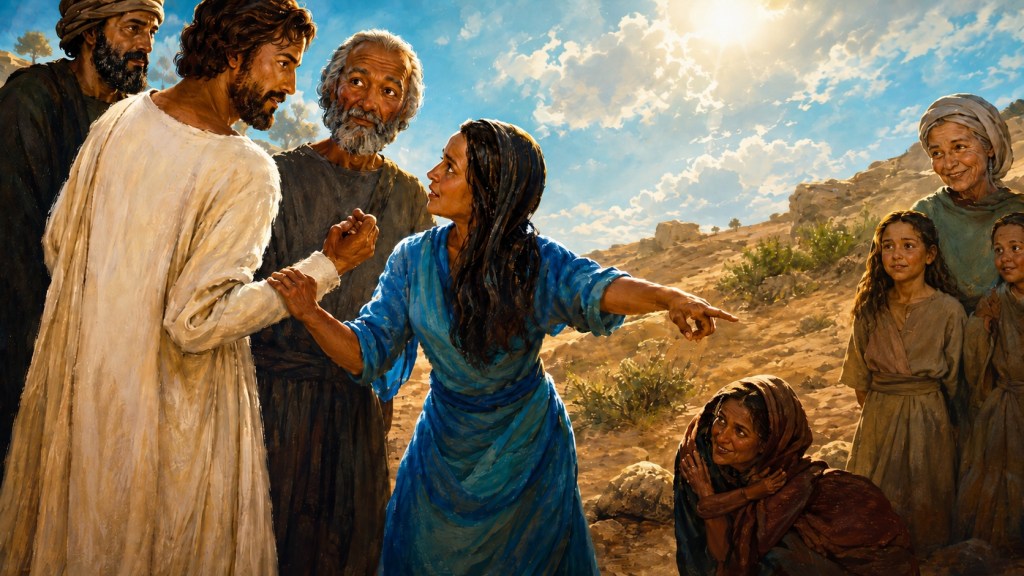
In today’s Gospel, we meet a Canaanite woman. She is vulnerable in three ways. She is a woman. She is a Gentile woman. She is the mother of a daughter tormented by a demon. Her faith is placed before us in contrast to the little faith of Peter. Jesus first does not answer her. Then He seems to reject her. Finally, He performs the miracle and says, “Woman, great is your faith!”
The woman comes from the region of Tyre and Sidon, a Gentile territory. Yet she calls Jesus, “Lord, Son of David.” Matthew begins his Gospel by presenting Jesus as “the son of David, the son of Abraham.” This woman, though outside the covenant people, recognises Jesus with the language of faith.
Jesus says, “It is not right to take the food of the children and throw it to the dogs.” In the Jewish world of that time, Israel considered itself the children of the covenant, while Gentiles were sometimes called dogs. The dog was also considered an unclean animal. Yet some people kept dogs as household animals. The woman does not argue with anger. She does not go away in shame. She answers with wisdom: “Yes, Lord, yet even the dogs eat the crumbs that fall from their masters’ table.”
Here we see the greatness of her faith. She is at the edge of life, in deep brokenness, because of the suffering of her daughter. But she does not give up. She teaches us that grace often comes to those who act. She stands firm in faith. She moves beyond the double world of “right” and “not right” and sees life as one. For her, children and little dogs are different, but the bread is the same. Hunger is the same. Need is the same. Mercy is the same.
The first reading from Isaiah gives the same wider vision. After the Babylonian exile, Israel begins to understand that God’s salvation is not only for one people. The Jerusalem Temple, which had been a sign of covenant and also a place of purity boundaries, becomes “a house of prayer for all peoples.” Foreigners too will come to the Lord, love His name, serve Him, and worship Him. God’s house is not a closed house. It is a house open to all.
In the second reading, Paul grieves because Israel has not accepted Jesus as the Messiah. Yet he also says that “the gifts and the call of God are irrevocable.” God does not take back His gifts. God does not withdraw His calling. Here we see the generous heart and mercy of God. God includes, waits, and gathers.
The responsorial psalm also praises the God of all peoples. The Lord of Israel is proclaimed as the God of all nations. Thus, all three readings lead us to the same truth: God’s mercy is wider than human boundaries.
Today’s readings give us three lessons.
First, we must grow in faith in God and in true confidence. Jesus says to Peter, “O you of little faith!” But to the Canaanite woman He says, “Great is your faith!” Faith is the assurance of what we hope for and the conviction of what we do not see. This woman believes fully that Jesus can heal her daughter. Faith is this inner certainty about the movement of our life when God is present. It is not the absence of struggle. It is the courage to hold on to God in the middle of struggle.
Second, we must move from emotional reaction to thoughtful response. The woman cannot control what happens to her. She cannot control the sickness of her daughter. She cannot control the silence of Jesus. She cannot control the words of rejection. But she controls her response. She does not answer with rage. She does not collapse in self-pity. She responds with intelligence, humility, courage, and faith. She teaches us that faith is not merely emotional excitement. Faith is a discerning and wise action.
Third, we must protect the vulnerable. This woman is ready to bear any humiliation and pain for the sake of her weak daughter. She stands between her daughter and destruction. She becomes the voice of the one who cannot speak for herself. This is faith in action. Jesus first speaks of children and little dogs as different. But the woman sees the connection: in the stomach of the children and in the stomach of the little dogs, there is the same piece of bread. When we see our shared hunger, shared dignity, and shared dependence on mercy, we begin to protect the vulnerable.
Today, the Canaanite woman stands before us as a teacher of faith. She teaches us to grow in trust, to respond with wisdom, and to stand with the weak. Her faith crosses boundaries. Her love breaks silence. Her humility receives grace.
May the Lord say of us too: “Great is your faith!”
Fr. Yesu Karunanidhi
Archdiocese of Madurai
A Yesni Prays Initiative


Leave a comment