Daily Catholic Lectio
Sun, 31 May 2026
Most Holy Trinity, Solemnity
Exod 34:4-6, 8-9. 2 Cor 13:11-13. Jn 3:16-18
Our Image and Metaphor
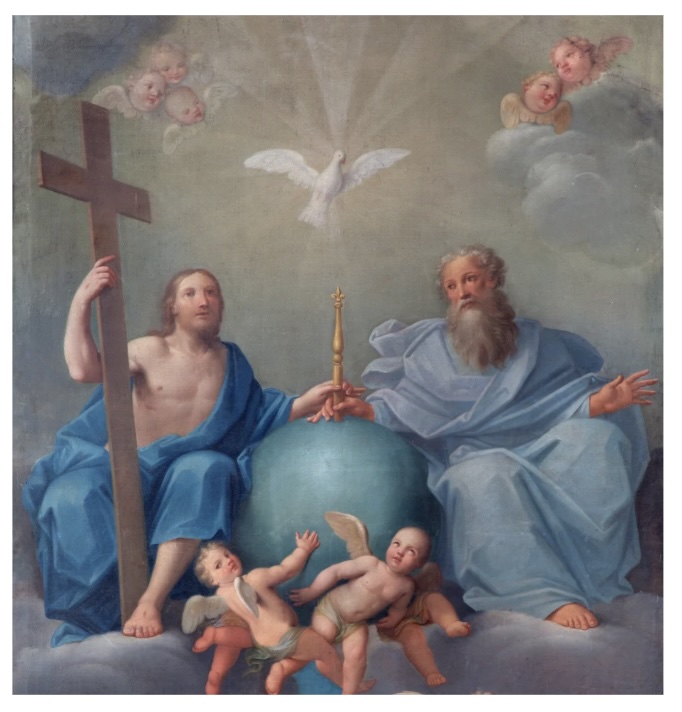
Every time we begin our prayer and every time we conclude it, we make the sign of the Cross: “In the name of the Father, and of the Son, and of the Holy Spirit.” Every blessing in the Church is given in the name of the Trinity. Yet, the mystery we invoke so often remains one of the most profound mysteries of our faith.
Today, let us approach the mystery of the Most Holy Trinity in three steps: first, a theological reflection; second, a reflection on the readings; and third, a reflection for life.
(a) Theological Reflection
The Preface of today’s liturgy describes the Trinity as “distinct in Persons, one in Being, equal in Majesty.” The Father, the Son, and the Holy Spirit are three distinct Persons. Each possesses a unique personal identity. Yet they share one divine nature. Their unity is not merely cooperation; it is communion. Their equality is not negotiated; it belongs to the very mystery of who God is.
Christianity was born within Judaism, which firmly professed belief in one God. Israel confessed: “Hear, O Israel, the Lord our God, the Lord is One.” Yet within the Old Testament itself we find hints of a richer divine self-revelation: God Himself (Lord), the Angel of the Lord, and the Spirit of God. When the fullness of revelation comes in Jesus Christ, these strands converge into the Christian confession of the Father, the Son, and the Holy Spirit.
The New Testament preserves several Trinitarian formulas. Jesus commands His disciples to baptize “in the name of the Father and of the Son and of the Holy Spirit.” Saint Paul blesses the Corinthians with the words, “The grace of the Lord Jesus Christ, the love of God, and the fellowship of the Holy Spirit be with all of you.” Saint John proclaims, “In the beginning was the Word, and the Word was with God, and the Word was God.” These texts became the foundation for the Church’s faith in the Triune God.
The early Church reflected deeply on these truths. Around AD 200, Tertullian first used the Latin word Trinitas, from which we derive the word “Trinity.” Before him, Theophilus of Antioch had used the Greek term Trias. Later, the Cappadocian Fathers and Saint Augustine gave the Church some of its most profound reflections on the mystery. The Cappadocian Fathers spoke of perichoresis, the mutual indwelling of the three divine Persons. Saint Augustine, using the language of ousia and hypostasis, sought to explain how the three are distinct and yet one.
Saint Augustine also searched for images within human experience. He spoke of memory, understanding, and will: three distinct operations, yet one human mind. He also proposed another beautiful image: the lover, the beloved, and the love that unites them. Love is never solitary. Love naturally moves toward communion. These images do not explain the Trinity fully, because no image can contain God. But they help us approach the mystery with humility.
Throughout history, misunderstandings arose. Some said that God is one Person wearing three masks. This is modalism. Others taught that the Son came later and is inferior to the Father. This is Arianism. Some imagined three separate gods. This is tritheism. Others placed the Son and the Spirit below the Father. This is subordinationism. Some compared the Trinity to three parts of a cake, as if the three Persons together make one God. Others said that Jesus was merely adopted as Son at His baptism. The Church rejected these distortions because they do not preserve the revealed truth of God.
The Councils of Nicaea in 325 and Constantinople in 381 clarified the faith of the Church. We believe in one God, the Father Almighty; in one Lord Jesus Christ, true God from true God; and in the Holy Spirit, the Lord and giver of life. The Trinity is therefore not three gods, not three roles, not three parts, and not three levels of divinity. The Trinity is one God in three Persons: distinct in Persons, one in Being, equal in Majesty.
(b) Reflection on the Readings
In the first reading, Moses ascends Mount Sinai, and God renews the covenant with him. Moses has already experienced the weakness of the people and the breaking of the covenant. Yet God does not abandon them. God passes before Moses and reveals His own heart: “The Lord, the Lord, a merciful and gracious God, slow to anger and rich in kindness and faithfulness.” Moses does not first receive a definition of God. He receives an experience of God. He encounters a God who is merciful, patient, faithful, and ready to renew the covenant.
This is very important for us. Faith begins not merely with concepts, but with encounter. Moses knows God because he has experienced God’s mercy. Theology comes after experience. Before we speak about God, we must allow ourselves to be touched by God. Before we define God, we must stand before Him in worship.
In the second reading, Saint Paul concludes his letter with one of the earliest Trinitarian blessings in Christian history: “The grace of the Lord Jesus Christ, the love of God, and the fellowship of the Holy Spirit be with you all.” Interestingly, Paul begins with Christ, moves to the Father, and concludes with the Spirit. Grace, love, and fellowship become windows into the inner life of God. The Son brings grace. The Father is the source of love. The Holy Spirit creates communion.
This blessing is not simply a beautiful ending to a letter. It is a summary of Christian life. To be Christian is to live in the grace of Christ, to remain in the love of the Father, and to be united in the fellowship of the Holy Spirit. Every Eucharistic celebration, every Christian community, every family, and every disciple is called to become a space where grace, love, and communion are visible.
In the Gospel, Jesus speaks to Nicodemus and reveals the heart of salvation: “God so loved the world that He gave His only Son.” Three words stand at the center of this Gospel: God, Son, and love. The Father loves. The Son is given. The Spirit, though not explicitly named in this verse, is the divine life through whom believers are reborn and enter communion with God. The Trinity is not closed in itself. Divine love overflows toward the world.
The Gospel also teaches us that God did not send His Son to condemn the world, but to save the world. This is the deepest movement of the Trinity: not condemnation, but salvation; not distance, but nearness; not rejection, but love. Creation is the fruit of divine love. Redemption is the expression of divine love. Eternal life is participation in divine love.
(c) Reflection for Life
(1) Today I would like to leave you with a simple but profound thought: the Trinity is both our image and our metaphor. We are created in the image of the Triune God. Therefore, traces of the Trinity are found within us. Every human person is composed of body, mind, and spirit. These are not three persons, but they help us glimpse something of the divine mystery.
The Son may remind us of the body, because the eternal Word became flesh and took our human body. The Father may remind us of the mind, because He is the source of all wisdom, thought, and purpose, and our mind must be united with His holy will. The Holy Spirit may remind us of the spirit, the breath of life within us, the same breath of God that gave life at the beginning of creation.
Although body, mind, and spirit are distinct, they work together in unity. They do not compete with one another. They do not exist in isolation. When the body suffers, the mind is affected. When the mind is disturbed, the spirit becomes weak. When the spirit is alive, the whole person receives strength. In the same way, the Trinity teaches us that distinction need not become division. Difference can exist within communion.
May the Triune God rule our body, mind, and spirit. May the body become an instrument of service. May the mind become a place of truth and discernment. May the spirit become a dwelling place of prayer and holiness. When our whole person is united in God, we become a living image of the Trinity.
(2) Today’s world often emphasizes individualism. It tells us to think only of ourselves, to protect only our own interests, to promote only our own success. But our God is a God of communion. God is not loneliness. God is relationship. God is not selfishness. God is self-giving love. Therefore, the mystery of the Trinity challenges every form of selfishness, isolation, domination, and division.
At the same time, the thought of God is slowly disappearing from many hearts. The sense of mystery is fading. Everything must be measured, explained, controlled, and mastered. But the Trinity reminds us that mystery is not darkness. Mystery is depth. Every person is also a mystery. Every human being carries a sacred depth that cannot be reduced to usefulness, appearance, success, or failure. To recognize the mystery in another person is already to begin loving that person.
The Trinity calls us to see mystery in one another and to live in communion with one another. In families, this means patience, forgiveness, and mutual respect. In communities, it means listening, sharing, and walking together. In the Church, it means communion, participation, and mission. In society, it means refusing hatred and building relationships rooted in human dignity.
(3) Finally, the Trinity becomes visible whenever the virtues revealed in today’s readings become visible in us. When the mercy of the Father lives in our hearts, when the love brought into the world by the Son shapes our actions, and when the friendship and communion of the Holy Spirit guide our relationships, then we reflect the Trinity in the world.
People may never read a book on Trinitarian theology. They may never study Tertullian, Augustine, the Cappadocian Fathers, Nicaea, or Constantinople. But they can encounter the Trinity through a Christian who lives with mercy, love, and communion. A forgiving heart reflects the Father. A self-giving life reflects the Son. A peaceful and unifying presence reflects the Holy Spirit.
The Most Holy Trinity is not merely a doctrine we profess. The Trinity is our origin, our image, and our metaphor. We come from communion. We are made for communion. We are sent to build communion. And one day, we hope to enter eternal communion with the Father, the Son, and the Holy Spirit.
May the mercy of the Father, the love of the Son, and the fellowship of the Holy Spirit dwell in our hearts, our homes, our relationships, and our Church. May our lives become a living icon of the Triune God. Amen.
Fr. Yesu Karunanidhi
Archdiocese of Madurai
A Yesni Prays Initiative


Leave a Reply