Daily Catholic Lectio
Wed, 15 April 2026
Second Week of Easter
Ac 5:17–26. Jn 3:16–21
They Come to the Light
The conversation between Jesus and Nicodemus reaches its quiet but profound conclusion in today’s Gospel. What began as a dialogue now becomes a discourse. Jesus speaks in the language of light and darkness—simple images, yet carrying the depth of the human heart.
At the centre of this passage stands one of the most beautiful affirmations of faith: “God so loved the world that He gave His only Son, so that whoever believes in Him may not perish but may have eternal life.” Love expresses itself in self-gift. God does not remain distant; He gives Himself. And the purpose of this love is not condemnation, but life—life that begins now and reaches into eternity.
Nicodemus comes to Jesus by night. He is not without faith; in fact, he recognizes something divine in Jesus. Yet his faith remains hidden, cautious, incomplete. Night, in John’s Gospel, is not only a time of day—it is a condition of the heart. It is the space where we hesitate, where we believe but do not yet dare to stand in the open. Jesus gently invites him—and us—not simply to understand the light, but to come into it.
“Light has come into the world,” Jesus says. Yet the tragedy is this: people preferred darkness to light. Why? Because light reveals. And often, we fear what might be revealed.
Light, in the Gospel of John, performs three quiet but powerful actions.
First, light reveals truth. In the darkness, we mistake things. A rope appears like a snake. But when light enters, things are seen as they truly are. So too in our lives: the light of Christ reveals us to ourselves—not to shame us, but to place us in truth. To live in the light is to live without illusion.
Second, light brings freedom. In darkness, every step is hesitant. We move carefully, almost fearfully, unsure of what lies ahead. But in the light, we walk with confidence. The path becomes clear. The same life, the same room, the same circumstances—but seen in the light, everything changes. Freedom is not the absence of limits; it is the clarity to walk rightly within them.
Third, light gives life. Life may begin in hiddenness—in the womb, beneath the soil—but it cannot grow without light. In the biblical imagination, “to be born” is “to see the light.” Growth, maturity, fruitfulness—all depend on light. Without it, life withers.
And yet, this light is never forced upon us. It is given, but it must be chosen. We must come to it. We must allow ourselves to be seen.
Those who come to the light discover something beautiful: their lives are not their own work alone, but are carried out in God. “It becomes clear that their deeds have been done in God.” To live in the light is to live in communion—with God who is Himself light.
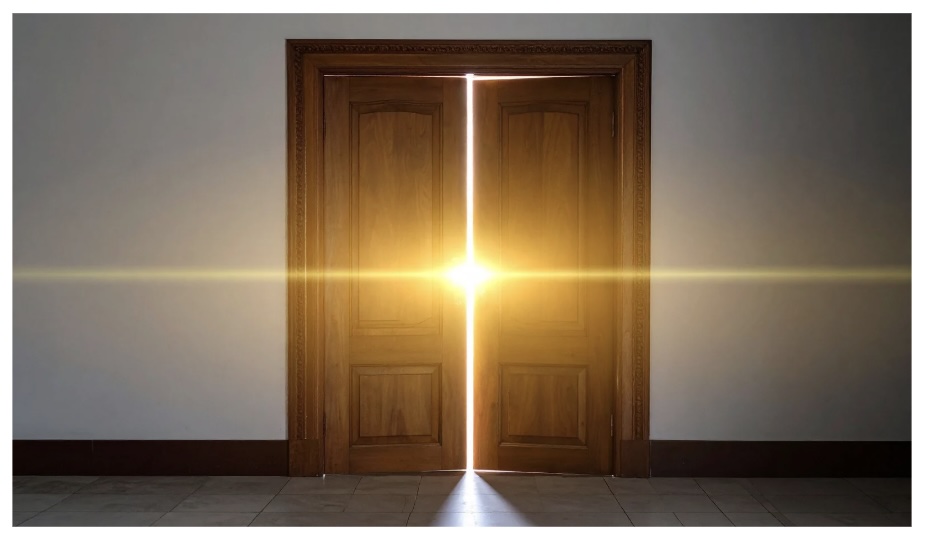
The first reading offers a striking image of this movement. The apostles are in prison, enclosed in darkness, bound by chains. Human power believes it can confine the Gospel. But in the night, God acts. The doors are opened. They are led out—not into hiding, but into the temple, into the open, into the light. Those who tried to silence them are left in confusion. Darkness cannot hold what God brings into the light.
This is the quiet strength of divine light: it does not struggle against darkness; it simply enters, and darkness gives way.
Darkness, in our lives, often feels natural. It can be comfortable. It hides our fears, our inconsistencies, our wounds. But the Gospel invites us to something more—not to remain in darkness, but to move, step by step, toward the light.
Each moment offers a choice: to conceal or to reveal, to withdraw or to come forward, to remain in fear or to walk in truth.
“They come to the light.” Not because they are already perfect, but because they are willing. Not because they have no darkness, but because they desire truth more than concealment.
And in that simple movement—coming to the light—they discover that God is already there, waiting, working, and giving life.
Fr. Yesu Karunanidhi
Archdiocese of Madurai
A ‘Yesni Prays’ Initiative


Leave a Reply