Daily Catholic Lectio
Tue, 7 April 2026
Easter Octave – Tuesday
Acts 2:36–41. John 20:11–18
I have Seen the Lord
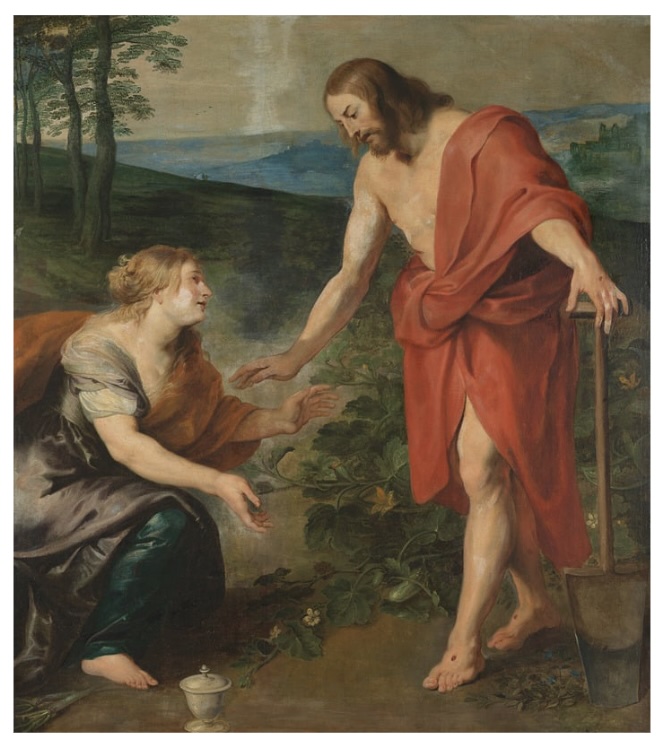
Today’s Gospel presents a deeply human and tender scene. Mary Magdalene stands outside the tomb, weeping. She looks into the tomb, speaks with the angels, and then turns back. There stands Jesus—but she does not recognize Him. To her eyes, He appears as a gardener. A conversation begins. And at the end of that conversation, Jesus calls her by name: “Mary!”
Immediately she responds, “Rabboni!”—my teacher. And the Gospel adds a striking detail: “Mary turned.”
But had she not already turned?
Saint Augustine offers a beautiful insight: Mary does not turn physically; she turns inwardly. Her heart turns. Until this moment, her face may have been directed toward Jesus, but her heart was still fixed on the tomb—on loss, on absence, on what had ended. Now, for the first time, her heart turns toward the living Lord.
If our face is turned toward Jesus but our heart remains fixed on the tomb, He will appear to us only as a stranger, perhaps even as a gardener. But when both face and heart turn toward Him, then we recognize Him as Lord.
Four Movements of Seeing
Mary’s journey is a journey of seeing—a journey that unfolds in four stages. First, she does not see Him at all. Second, she sees Him, but mistakes Him for the gardener. Third, she recognizes Him as Rabboni—teacher. Finally, she proclaims Him as Lord.
This is not just Mary’s journey; it is ours. Faith is not a single moment. It is a gradual awakening. There are times when we do not see Him. Times when we misunderstand Him. Times when we know Him only partially. And then, moments of grace when we truly recognize Him.
In the Gospel of John, “seeing” is never just physical sight. It is the doorway to faith. When some Greeks approach Philip and say, “Sir, we wish to see Jesus,” they are expressing more than curiosity—they are expressing a desire to believe. Seeing leads to believing.
And so Mary’s proclamation becomes the first confession of Easter faith: “I have seen the Lord.”
The Message and the Messenger
Jesus entrusts Mary with a message: “Go to my brothers and say to them, I am ascending to my Father and your Father, to my God and your God.” It is a profound message—one that speaks of relationship, of communion, of a new bond between God and humanity. And yet, when Mary goes to the disciples, her first words are not the message itself. She says simply:
“I have seen the Lord.” Everything else comes later.
This is important. Christianity begins not with a doctrine, not with an idea, but with an encounter. Before speaking about God, we are called to meet Him. Before proclaiming a message, we are called to witness an experience.
Mary becomes the first apostle of the Resurrection—not because she understands everything, but because she has encountered Someone.
Turning from the Tomb
There is a quiet invitation in this Gospel for each one of us. How often do we stand facing the tomb? The tomb of past failures, of grief, of unanswered questions, of broken hopes. Our eyes are fixed there. Our hearts remain there. And yet, the risen Lord stands behind us. Sometimes we do not recognize Him. Sometimes He appears in unexpected forms—like a gardener, in the ordinary moments of life. Sometimes He comes as a teacher, gently guiding us. And sometimes, when grace touches us deeply, we recognize Him as Lord. All that is needed is a turning—not merely of the body, but of the heart.
“What Must We Do?”
In the first reading, the people who hear Peter’s proclamation are deeply moved. They ask a simple and urgent question: “Brothers, what must we do?” It is the question of a heart that has begun to turn. It is the question of someone who has seen, and now wants to respond.
Faith always seeks a response. To encounter Christ is not enough; we must ask, What now? What must I do?
Peter’s answer is immediate: conversion, repentance, a new life.
Our Easter Confession
Today, the Church invites us to make Mary’s words our own: “I have seen the Lord.” Not necessarily with our eyes, but in the quiet movements of grace. In the Scriptures. In the Eucharist. In moments of forgiveness. In unexpected encounters.
The Resurrection is not something we explain; it is something we witness. Let us not remain facing the tomb. Let us turn—our minds, our hearts, our lives—toward the living Christ. And then, like Mary Magdalene, let us go and proclaim—not first an idea, but an encounter: “I have seen the Lord.”
Fr. Yesu Karunanidhi
Archdiocese of Madurai
Missionary of Mercy

 Yesu Karunanidhi
Leave a reply to candelinejoseph9 Cancel reply