Daily Catholic Lectio
Thu, 5 February ‘26
Fourth Week in Ordinary Time, Thursday
1 Kgs 2:1-4, 10-12. Mk 6:7-13
Two by Two
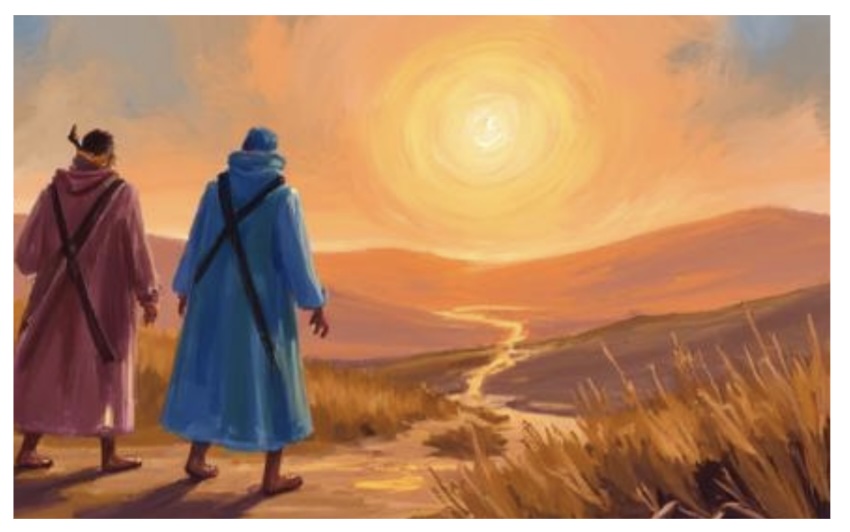
The Word of God today places before us a simple but demanding image: Jesus sends his disciples two by two (Mk 6:7). This is not a practical detail. It is a theology of mission.
Jesus does not treat the disciples merely as followers who admire him from a distance. He takes them as partners in his mission. He shares with them his authority, his message, and even his vulnerability. This is deeply significant. Jesus knows his time is short. Yet he does not cling to the mission as something that belongs only to him. He entrusts it to others. Mission, for Jesus, is always shared.
This is a powerful lesson for the Church today. We often speak of synodality—walking together. But Jesus already lived it. He sends them together, not alone. The Gospel reminds us that the Church is not built by lone heroes but by companions on the road.
Very often, however, we identify ourselves too closely with our work—whether it is teaching, administration, ministry, or leadership. Our work becomes our identity. When that happens, we hesitate to share responsibility. Sometimes we think others are incapable. At other times, we fear they may do better than us and outshine us. Both attitudes reveal insecurity.
Only the person who can say, “I am not everything”, can truly share mission.
Jesus has no fear of comparison. The disciples preach as he preaches. They heal as he heals. Yet there is no jealousy in him, no anxiety about being replaced. True leadership empowers others.
From Jesus sending the disciples two by two, we learn three lessons.
First: learning to co-exist.
The book of Ecclesiastes says, “Two are better than one… If one falls, the other will lift him up” (Eccl 4:9–10). Today’s world trains us to work alone, to be efficient, independent, self-sufficient. While solitude has its value, isolation slowly drains our joy and strength. Mission is sustained not by efficiency alone but by companionship. The presence of another corrects us, supports us, and restores us. Walking together is not a weakness; it is wisdom.
Second: minimalism in words.
Jesus does not give the disciples long speeches or detailed scripts. Their message is simple: “Repent.” Few words, but words with weight. Our world is flooded with words—spoken, written, broadcast, uploaded. Yet meaning is often lost. The Gospel invites us to say less, but live more. When words are fewer, life itself becomes the message.
Third: essentialist living.
Jesus forbids bag, food, money, and extra clothing. This is not romantic poverty; it is radical trust. The disciples must depend on God and on the hospitality of others. Self-sufficiency is a subtle temptation. When all our needs are secured, we slowly drift away from God and from one another. By choosing simplicity, Jesus teaches us to remain connected—to God who provides and to people who receive us.
The first reading deepens this message. King David, at the end of his life, says: “I am going the way of all the earth.” On his deathbed, David would have remembered everything—his days as a shepherd, his anointing by Samuel, Goliath, Saul’s jealousy, Bathsheba and Uriah, Absalom’s rebellion, his friendships and failures. Now Solomon takes his place.
Remembering that we all “go the way of the world” makes us humble. It frees us from clinging—to power, to position, to control. Those who keep this truth before their eyes live more simply, love more gently, and share more generously.
Today’s Word invites us to ask: Am I walking alone, or am I willing to walk with others? Do I speak too much, or do I witness through my life? Do I live with excess, or with trust?
Jesus sends us two by two—to walk together, to depend on God, and to make the Kingdom visible through simplicity and communion.
Fr. Yesu Karunanidhi
Archdiocese of Madurai
Missionary of Mercy
 Yesu Karunanidhi
Leave a comment