Daily Catholic Lectio
Sat, 31 January ‘26
Third Week in Ordinary Time, Saturday
2 Sam 12:1-7, 10-17. Mk 4:35-41
Let us cross to the other side
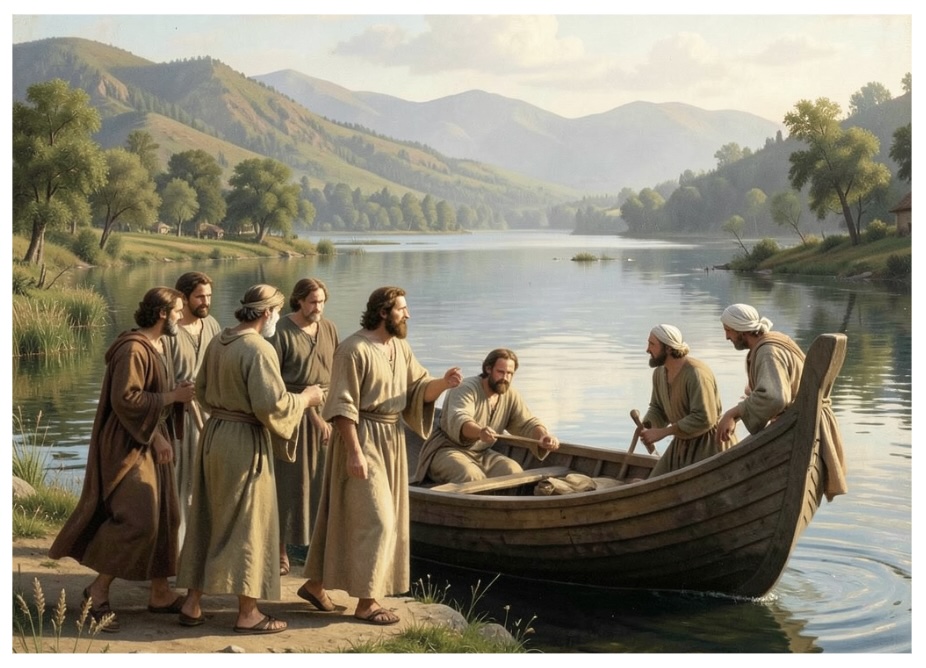
“Let us go across to the other side” – with these simple words, Jesus sets the disciples—and the Gospel itself—in motion. After teaching the crowds from the shore, Jesus does not allow his disciples to remain where they are. He invites them to cross. With God, there is no stagnation. Faith is always a journey, always a movement—from safety to trust, from familiarity to surrender, from one shore to another.
The disciples accept the invitation, but the crossing is not smooth. A violent storm arises. Waves beat against the boat. Fear overwhelms them. And Jesus—who invited them in the first place—is asleep. In panic they cry out, “Teacher, do you not care that we are perishing?”
At Jesus’ word, the storm ceases. A deep calm follows. Yet strangely, this stillness frightens them even more than the storm. And they ask the question that Mark wants every reader to ask: “Who then is this, that even the wind and the sea obey him?”
From this dramatic scene, three deep spiritual lessons emerge.
(a) Life is on the other side: God calls us to move
“Let us go to the other side” – This is not only a geographical crossing; it is a spiritual one. Jesus draws the disciples away from the shore of comfort and certainty. Remaining on the same side may feel safe, but it leads to stagnation. With God, life always unfolds through movement—movement in faith, in growth, in conversion.
Many times, we prefer the familiar shore: familiar habits, familiar fears, familiar sins even. But Jesus does not say, “Stay where you are.” He says, “Let us go.” The other side represents change, risk, and newness. It is where faith matures.
In the first reading, David is also taken to “the other side.” Through the prophet Nathan, God confronts him with his sin. David had crossed into darkness—abuse of power, injustice, and violence. But Nathan’s words become a bridge. David does not defend himself. He does not deny. He simply says, “I have sinned against the Lord.” That confession is his crossing. Repentance becomes the path from guilt to grace, from pride to humility.
Life with God always involves such crossings. Without them, faith remains shallow.
(b) They cry to the giver of life: “We are going to die”
In the storm, the disciples shout to Jesus, “We are perishing!” The irony is striking. They cry out to the very one who gives life, as if he were absent or powerless. Fear blinds them to his presence. They see the waves, not the sleeping Lord. They focus on what is outside the boat, not who is inside it.
This is a deeply human reaction. In moments of crisis, we forget our past experiences of God’s faithfulness. We forget the promises. We forget the invitation that began the journey: “Let us go to the other side.” The one who called them to cross never intended to abandon them midway.
How often do we do the same? We panic before uncertainty. We fear the future. We cry out to God, not in trust, but in accusation: “Do you not care?” The storm outside seems louder than the presence of Christ within.
David, too, experiences this anguish. After his sin, when the child falls ill, David fasts, weeps, and lies on the ground before the Lord. His tears show us something important: true repentance is not despair, but vulnerability before God. David no longer controls; he pleads. He places his brokenness in God’s hands.
Faith does not mean storms will not come. It means we learn where to cry and to whom.
(c) In the silence, we must answer: “Who is he?”
When Jesus calms the storm, a great silence descends. And that silence disturbs the disciples more than the storm itself. Why? Because silence leaves no distractions. It forces a question to the surface: Who is he?
Noise can hide our doubts. Activity can postpone conversion. But silence reveals truth. In the stillness of our hearts, we are confronted with the identity of Jesus—and with our own.
Who is he for me? A teacher? A miracle worker? Or truly Lord?
Who is he when the storm ends and the answers are no longer easy?
David answers this question not with words, but with surrender. He accepts God’s judgment. He weeps. He prays. And in that humility, he encounters mercy. The crossing is complete—not because the consequences disappear, but because David’s heart changes.
“Let us go to the other side” – This is Jesus’ invitation today. It is an invitation to movement, not comfort; to trust, not control; to silence, not fear.
Today we remember Saint John Bosco, who helped many young people to go across to the other side – from doubt to faith, from fear to courage.
Fr. Yesu Karunanidhi
Archdiocese of Madurai
Missionary of Mercy
 Yesu Karunanidhi
Leave a comment