Daily Catholic Lectio
Wed, 31 July 2024
Seventeenth Week in Ordinary Time – Wednesday
Saint Ignatius of Loyola, Memorial
1 Corinthians 10:31-11:1. Luke 14:25-33
Greater glory of God!
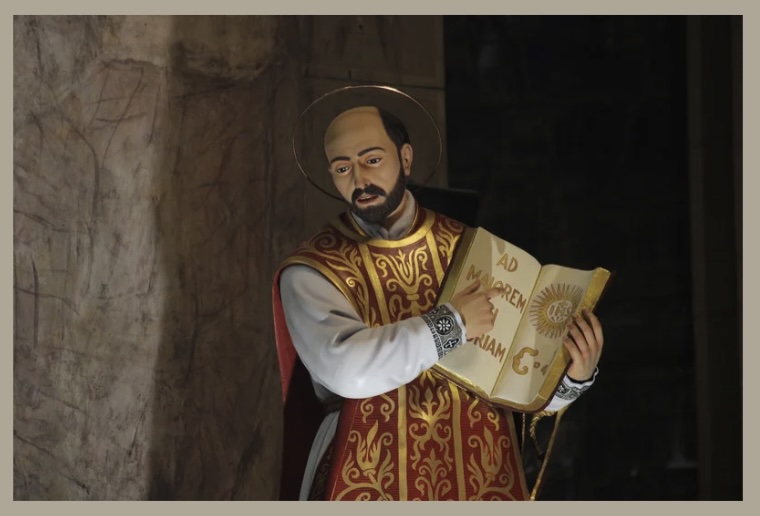
Today we commemorate Saint Ignatius of Loyola, Founder of the Society of Jesus (Jesuits) and the author of ‘The Spiritual Exercises.’ I share here some random reflections on this great saint.
1. You can’t rule others unless you rule yourself
Leadership begins from within. A leader, first and foremost, leads himself. Self-victory, or winning of self, is one of the key themes in the writings of Saint Ignatius. As he was a soldier himself, he knew what it meant to ‘win’ and ‘to be victorious.’ Anything that is beyond my control takes my energy away. It takes away my energy and distracts my mind. What is that area that I need to win over within? And where does my energy leak?
2. Haste makes waste
Saint Ignatius was never carried by feelings or emotions. He put everything into an intellectual examination. That made his vision clear, broad, and strong. ‘Why do I do this?’ – this is the starting point for arriving at divine patience. What puts me in haste?
3. Contacts matter
Saint Ignatius, a soldier by profession, challenges Saint Francis Xavier, a professor. How? Because of his relationship, friendship, or contact. Saint Ignatius knew that contacts through proper communication keep life going. Wherever he was, he was in touch with his collaborators through letters. This shows how he valued contacts. How do I prioritise my contacts today?
4. Self-examen
A life that is not evaluated daily is not worth living. One of the key tenets of the Spiritual Exercises is ‘examen of conscience.’ Each day I must examine my body, mind, heart, thought, feeling, emotion, and impact. I just don’t travel along time, but stop and think back. The moment of ‘self-examen’ is the moment of self-renewal. Do I examine myself constantly?
5. Discernment
Discernment is another exercise. Saint Paul describes ‘discernment’ as follows: “But test them all; hold on to what is good; reject every kind of evil” (1 Thes 5:21-22). Each moment of my life must be accelerated through the process of discernment. When I don’t discern, I just take whatever comes my way.
6. Use your time
Anyone who loves life will not squander time; for, life is painted on the canvas of time. Saint Ignatius was already occupied with learning, reading, studying, praying, writing letters, and meeting people. His actions renewed his life and that of others. It is not our rest, but our work, that reveals to others who we are. How do I manage my time?
7. For the greater glory of God
Saint Paul writes to the Corinthians, “Whether you eat or drink, or whatever you do, do everything for the glory of God” (cf. Second Reading). When we live glorifying God, we let go our our ‘sense of entitlement,’ ‘selfishness,’ ‘self-centredness,’ ‘self-reliance,’ and ‘self-sufficiency.’ We move towards God and others, and we let go of competitions, comparisons, and jealousy.
8. Planning and identifying capacities
In today’s gospel reading, through the metaphors of ‘tower building person’ and ‘warring king’, Jesus explains the requirements of discipleship. Discipleship is not only spiritual, but also managerial.
#
The pilgrims of hope will know that the pilgrimage of life is not a journey without, but a journey within. (Jubilee 2025 AD, bite 161).
Our fond wishes to our Jesuit Pope, Holy Father Francis, and to all the Jesuits!
Fr. Yesu Karunanidhi
Archdiocese of Madurai
Missionary of Mercy
 Yesu Karunanidhi
Leave a comment