Daily Catholic Lectio
Sun, 16 June 2024
Eleventh Sunday in Ordinary Time
Ezekiel 17:22-24. 2 Corinthians 5:6-10. Mark 4:26-34
Walking by faith!
A village was starving. The monsoon failed, and the lakes and ponds dried up. Groundwater also went down day by day. As the time for sowing drew near, the people of the town gathered together and discussed the next course of action.
“We can’t stay in this village anymore! We have to migrate to another place so that we can survive,” said one.
“How can we leave our land, house, and property and go? We have invested in them. We can protect them only if we stay here!” said another.
An elderly woman, Lakshmi by name, who was standing at the edge of the crowd, said, “Our present condition is pitiable indeed! But let us not be discouraged. We will exchange our savings and buy seeds. We will sow them as usual. Maybe let’s share groundwater. The monsoon will not fail this year, for we walk by faith, not by sight.”
His words gave hope and reassurance to the villagers. Within a few days of sowing, the monsoon arrived. The seeds began to grow well. The drought disappeared. Prosperity blossomed.
#
“We walk by faith, not by sight,” says Saint Paul (cf. second reading). Paul’s second letter to Corinth is known as ‘the letter of tears.’ For the people of Corinth clung to the good news of a false group than the one preached by Paul. They questioned Paul’s authenticity and took offence at his apostolic identity and vocation. In writing to them about his work, Paul proposes that his life is beyond these; he goes beyond what he sees, hears, and feels. His mind is set on the eternal world.
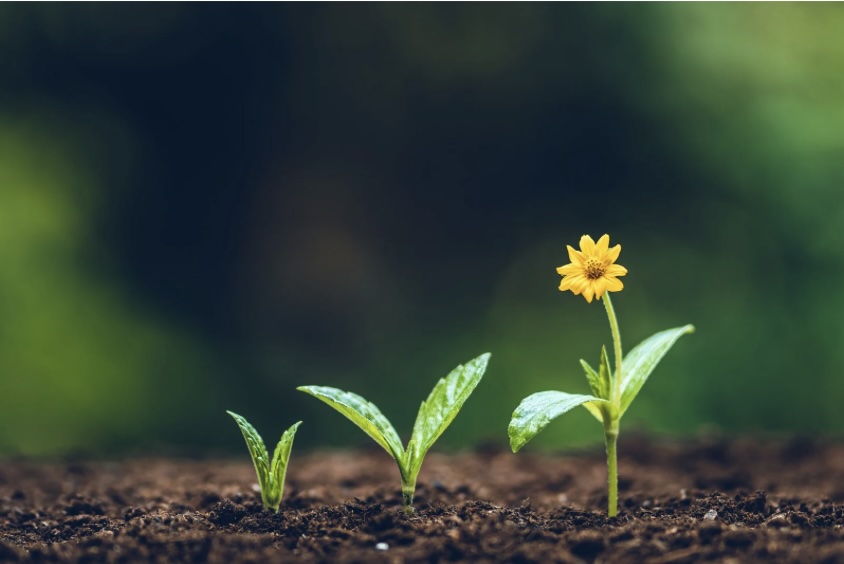
In the gospel reading, Jesus presents the mystery of the ‘kingdom of God’ in the form of metaphors (word pictures) according to the understanding capacity of his disciples. Here we see two metaphors: ‘a seed that grows by itself,’ and ‘a mustard seed.’
These two metaphors convey four meanings:
(a) The seed has potential within, and that potential is invisible to the eyes.
(b) The growth of the seed cannot be stopped, obstructed, or delayed (as is the case with leaven or yeast). Seed will continue to grow, even if external factors stop it.
(c) The difference that the seed, by growing, makes is enormous.
(d) Even if no one notices the seed, it will continue to grow until it reaches its full nature.
In the light of these four meanings, the kingdom of God could be understood as:
(a) The kingdom of God has an invisible, inner potential.
(b) No one can stop, obstruct, or delay the growth of the kingdom. Although it is opposed from without, it will continue to grow.
(c) The kingdom of God will begin small but will have an enormous impact.
(d) Even if no one notices the kingdom of God, it will continue to grow until it reaches its full potential.
What does Jesus say to his disciples (and Mark to his group) through these two metaphors – the seed that grows by itself and the mustard seed? They instruct that the disciples or community members should not be discouraged, even if the kingdom of God is opposed or ignored by their contemporaries. They must stand firm in anticipation of the development of the kingdom and its full nature. In other words, they must realise that they ‘walk by faith, not by sight.’
In today’s first reading, the prophet Ezekiel uses a metaphor: ‘a tender shoot or twig turning to a big cedar tree.’ The tender shoot is weak and fragile. But, as soon as God touches (plants) it, it grows to become a big tree.
The metaphor refers to the people of Israel in Babylonian captivity. The Lord God will call the Israelites again and make them into a great nation. Therefore, they must live not based on the slavery they see with their own eyes but on the basis of faith – the free life that God would provide.
How can we live based on faith like Paul, Jesus’ disciples, and the people of Israel?
(a) Perspective change
If you are able to count the seeds in a papaya, you are knowledgeable, but if you are able to count the papayas in a seed, you are wise. Seeing numerous papayas in a seed implies a vision of hope. When we have such a vision or perspective, life unfolds for us. The Magi who came to see the baby Jesus had the same perspective. That is why they saw the king of the Jews in a child. But Herod saw only the child in the child. We need to have a perspective that sees the hidden potential in everyone.
(b) Value comes from becoming
When the seed, the mustard seed, and the tender twig become a tree, they become valuable, powerful, and strong. We become valuable when we reach our full potential. Leonardo da Vinci used to lament, “All the flowering plants I see in the field reach their full potential and bloom. Lo, human beings die without knowing their potential and without fully realising it!” We must keep moving until we reach our full potential. No plant stops saying, ‘This growth is enough!’ It grows and sprouts, even when it is cut. In the same way, we must continue to grow despite opposition and hurdles.
(c) Giving faith vision
Our husband, wife, children, friends, colleagues, and strangers all have inner energy or potential. Only we need to help them realise it. When we feel discouraged, frustrated, or pessimistic, we need to give the message of hope to others: “Life is not over!” Our words and actions must empower others. Each of us has the power of the kingdom of God. It is through us that the kingdom of God blossoms in the world. We are the kingdom of God. Our prosperity, growth, and strength are the hallmarks of the kingdom of God amidst us.
“Those who are planted in the house of the Lord will flourish; they will be fruitful and green,” says the Psalmist (cf. Ps 92) (responsorial psalm). The world in which we live today is the house of the Lord. We are all planted here!
Fr. Yesu Karunanidhi
Archdiocese of Madurai
Missionary of Mercy
 Yesu Karunanidhi
Leave a comment