Daily Catholic Lectio
Thu, 13 June 2024
Tenth week in Ordinary Time – Thursday
Saint Anthony of Padua – Memorial
Isaiah 61:1-3. Luke 10:1-9
Servant of the Gospel
(The readings and the reflection are for the memorial of Saint Anthony of Paduva)
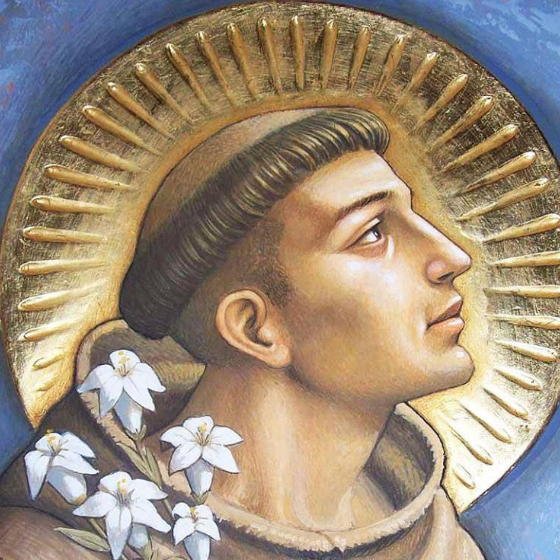
We are familiar with many miracle narratives that occurred in the life of Saint Anthony of Paduva, a ‘wonder-worker.’ Fish are said to have listened to his preaching; a donkey knelt when he carried the Eucharist; infant Jesus was playing with him. He is known as the ‘finder of lost articles.’ Let us reflect on his life story and draw some lessons for our lives:
(a) Changes in paths define the journey
A journey involves a change of paths. Fernando Bulhom (original name Anthony), when fifteen, chose to join the Augustinian monks. After 8 years, he was ordained a priest. In 1220, the bodies of five Franciscans martyred in Morocco were brought to be honoured at Santa Cruz. The story of these men moved Fernando profoundly, and he began to have a desire to lay down his life for Christ. He realised, however, that he was unlikely to fulfil this dream as an Augustinian monk. After receiving the required permission of his prior, Fernando moved from the Augustinian to the Franciscan order and took the name Anthony in honour of the great monastic patriarch, Anthony of the Desert.
We need to change our paths according to the call we receive.
(b) Owning our vulnerabilities
Jesus says, ‘Spirit is weak, but flesh is strong.’ Anthony’s body was not as strong as his spirit. Though he went towards Morocco, he could not reach there because of his ill health. Being very sick, on the way to Portugal, he was taken to Sicily. He participated in the “Chapter of Mats” in Assisi, where three thousand friars gathered with their founder, Francis. At the close of the meeting, Anthony was assigned to the hermitage of San Paolo near Arezzo, where he served his brothers by celebrating Mass for them, washing dishes, and sweeping the floor. He enjoyed the simplicity of his new life. He was happy that he could spend more time in prayer.
We must accept and own our vulnerabilities
(c) Seize the opportunity
His companions did not know of his linguistic, intellectual, and exegetical skills until 1222, when, in an ordination ceremony, he was asked to preach impromptu. And he did it. All were attracted by his flow of thoughts and words. Saint Anthony insisted that a preacher must practice what he preaches. Saint Anthony was patient until the right moment came. And when the moment came, he seized it.
Seizing the day is a skill.
(d) ‘I see my Lord’
Saint Anthony exercised the role of prior of friars; he was strongly objecting to the heresies of his time; above all, he was the servant of the gospel. He breathed his last on 13 June 1231, when he was thirty-six. ‘I see my Lord’ – these were his last words. These words were the words of Hagar in the desert as well: “I have seen the one who sees me” (cf. Gen 16). Anthony was canonised by Pope Gregory IX. Pope Pius XII called him the doctor of the church. Saint Anthony made others experience the mercy and goodness of God.
Do we see our Lord every day?
#
The first reading brings before us the prophet who proclaims his mission statement; in the gospel reading, Jesus appoints the seventy-two to carry on his mission. The mission of the Lord continues. (Jubilee 2025 AD, bite 123).
Fr. Yesu Karunanidhi
Archdiocese of Madurai
Missionary of Mercy

 Yesu Karunanidhi
Leave a reply to candelinejoseph070494a5569e8 Cancel reply