Daily Catholic Lectio
Sun, 26 May 2024
Most Holy Trinity, Solemnity
Deut 4:32-34, 39-40. Romans 8:14-17. Matthew 28:16-20
Revelation, Life, and Guidance
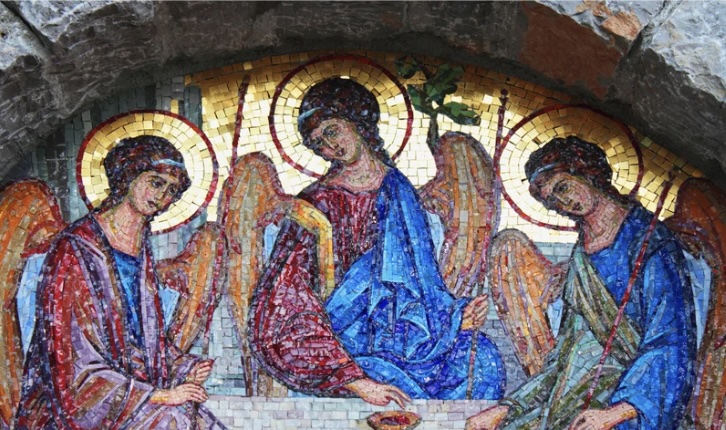
Today we celebrate the solemnity of the Most Holy Trinity. When we meet someone, we ask, ‘How are you?’ What if I ask someone, ‘Why are you?’ In the human realm, the ‘how are’ questions make sense, while the ‘why are’ questions turn off a relationship. But, in the divine realm, the ‘why’ questions have more meaning than the ‘how’ questions. Therefore, it is apt to ask, ‘Why is the Holy Trinity?’, not ‘How is the Holy Trinity?’
Saint Augustine has attempted to understand and explain the Trinity with different metaphors. For Augustine, love has three dimensions: (a) one who loves, (b) one who is loved, and (c) love that is shared. All these three elements, though unique, are united by love.
Three persons in the Holy Trinity are unique but united.
Reflecting on the baptism of Jesus at the river Jordan, Saint Augustine says, “In this narrative, all three persons stand distinct from each other. The Son is in the waters of Jordan; the Father’s voice is heard from the clouds; and the Holy Spirit descends in the form of a dove.”
Another metaphor he uses is that of the human mind, which has three dimensions: remembering, understanding, and being willing. Though the mind has three functions, they are all the same.
These three metaphors help us understand that the three persons of the Holy Trinity are distinct but one.
The Catechism of the Catholic Church (nn. 267, 255) says, “The Holy Trinity are united to each other ontologically, and they are distinct from each other functionally.”
In the gospels, Jesus helps us understand the Holy Trinity:
(a) Father reveals: “The Father in heaven has revealed this to you” (cf. Mt 16:17)
(b) The Son liberates: “When the Son sets you free, you will be truly free” (cf. Jn 8:36)
(c) The Holy Spirit guides: “When the Holy Spirit comes, he will guide you to the full truth” (cf. Jn 16:13)
In the first reading, Moses narrates the closeness of God to the people of Israel. The second reading reminds us about the indwelling of the Holy Spirit. In the gospel reading, Jesus gives the name of God: ‘Father, Son, and Holy Spirit.’
What do we learn from the solemnity?
Jacob, who flees from Esau, at Bethel has a dream; at the end of the dream, he says, “Truly, the Lord is here. I did not know it” (cf. Gen 29:16). Later, in the narrative of reconciliation with Esau, Jacob says, “Seeing your face is like seeing the face of God” (cf. Gen 33:10). On the one hand, at times, we don’t realise the presence of God; on the other, we see God in the faces of our brothers and sisters. God is an experience.
Secondly, how do we perceive God? How do we name him?
Thirdly, the Trinitarian God of relationships invites us to establish a family or community that is characterised by love, unity, and respect.
Fourthly, how do we recognise the sense of sacredness in our lives?
The Trinity is the mystery where we participate in God’s image and likeness.
#
Today, our Mother Church, at the invitation of the Holy Father, celebrates the First World Day of Children with the theme, ‘You are precious’ (cf. Isa 43:4).
The Holy Trinity sanctified childhood through the incarnation of the Son. We must celebrate children every day.
The Psalmist sings (cf. Ps 33), “We trust in the Lord; since we trust you, may your love be on us.”
Fr. Yesu Karunanidhi
Archdiocese of Madurai
Missionary of Mercy
# Be M.er.cy.Fool

 Yesu Karunanidhi
Leave a reply to Candeline Joseph Cancel reply