Daily Catholic Lectio
Thu, 2 April 2026
Maundy Thursday – Mass of the Lord’s Supper
Exod 12:1–8, 11–14; 1 Cor 11:23–26; Jn 13:1–15
Blood, Bread, Water
Three Signs
Today is significant in four ways: (a) On this night, Jesus institutes the Eucharist, saying, “This is my body… this is my blood.” (b) He establishes the ministerial priesthood with the command, “Do this in memory of me.” (c) By washing the feet of His disciples, He teaches a leadership of love: “I have given you an example.” (d) He gives a new commandment: “Love one another as I have loved you.”
On this day, we celebrate three signs: blood, bread, and water. Let us reflect on these signs and the lessons they offer us.
1. The First Passover of Israel – Blood
The first reading presents the first Passover of Israel. God gives instructions through Moses as the people prepare to move from slavery in Egypt to the Promised Land. It is both a moment of liberation and a sign of the final plague—the death of the firstborn. God gives clear instructions: the day, the lamb, the number of people, and the manner of eating.
But two commands stand out:
First, “Take some of the blood and put it on the doorposts and the lintel.” This blood becomes a sign. “When I see the blood, I will pass over you.” The blood protects, saves, and marks them as God’s people.
Second, “You shall celebrate this as a memorial feast for all generations.” Jesus fulfils this command. He gathers His disciples in Jerusalem for the Passover. But that night becomes the night of betrayal. In the midst of the Passover meal, He institutes the Eucharist. Like the Paschal Lamb, He is sacrificed. The wine becomes His blood. And through His blood, we are delivered—not from Egypt, but from death.
Blood becomes the sign of election, protection, liberation, and victory.
2. The Eucharistic Celebration – Bread
In the early Church, the “breaking of the bread” was one of the four marks of Christian life (Acts 2:42), along with the teaching of the apostles, fellowship, and prayer. Over time, however, this sacred act began to lose its meaning. In Corinth, the Eucharist had become a social meal marked by division between rich and poor.
In this context, Saint Paul reminds them of its true meaning: “Whenever you eat this bread and drink this cup, you proclaim the death of the Lord until He comes.”
In the Eucharist, three dimensions meet:
- Past: remembering what Jesus has done
- Present: celebrating it now
- Future: awaiting His coming
The Corinthians had reduced it to a present moment of eating and drinking. Paul calls them back to its deeper meaning.
The bread we receive proclaims the death of Christ—His emptiness, humility, loneliness, and brokenness.
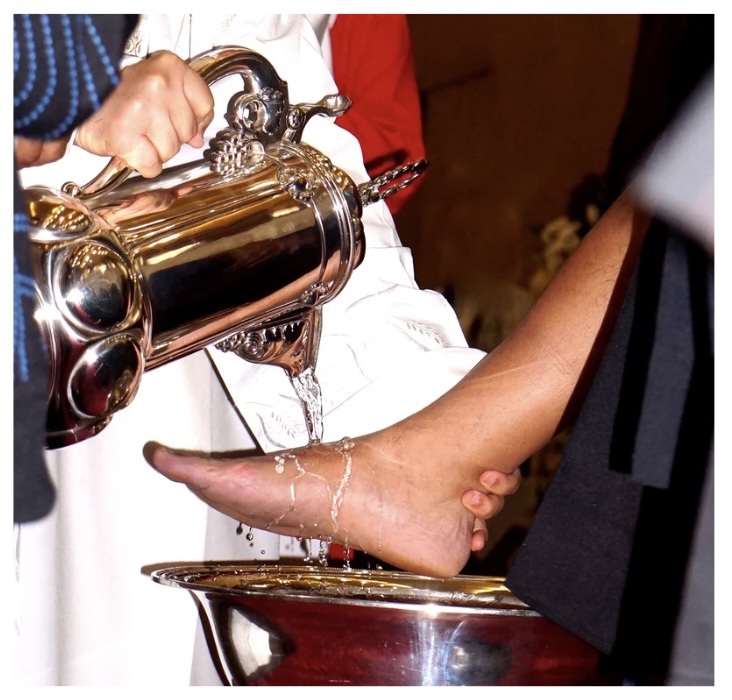
3. The Washing of Feet – Water
The washing of feet carries rich meaning in Scripture and culture:
(a) Ritual purification – preparing to enter the presence of God
(b) Personal cleanliness – hygiene after a journey
(c) Hospitality – welcoming and honouring a guest
It could be done by oneself or by a servant. To wash another’s feet was to take the place of a servant.
In the Greco-Roman world, it was considered a noble act of charity. The Fathers of the Church also emphasized it: Christ is both the one who shares the table and the one who washes feet.
How do we understand Jesus washing the disciples’ feet? It is not ritual purification. It is not mere cleanliness. It is not simple hospitality. It is a sign—a sign of humility, self-emptying, and total self-gift.
The Lord and Master becomes a servant. He teaches not with words alone, but with action. And He commands: “You also must do as I have done.”
The washing of feet also points to: preparation for the Eucharist; a symbol of baptism; a sign of forgiveness; a deeper sacramental reality; priestly identity; and the Incarnation itself.
Through this act, Jesus teaches humility and service.
What Do These Signs Teach Us?
The signs of blood, bread, and water are not mere rituals. Their meaning depends on how we receive and live them.
(a) Our Eucharistic Celebration
The Eucharist is the source, centre, and summit of the Church. It gathers God’s people into one. Those who are ordained are consecrated for this celebration. But the Eucharist is not only about receiving Christ—it calls us to become Christ for others. If we truly receive the Body of Christ, we must become presence for others, especially the weak. If we share in this bread, we must share our bread. If we drink His blood, we are freed from death and called to give life.
(b) The Priesthood of Service – Washing of Feet
Jesus says, “I have called you friends.” Yet He kneels as a servant. Each gesture becomes a lesson:
- He rises from the table → the priest rises from comfort
- He removes His garment → he removes separation from the people
- He ties a towel → he accepts human weakness
- He pours water and washes → he serves
Priesthood is not about authority, but service. One who freely accepts this calling must strive, in every moment, to become like Christ.
(c) Love That Blossoms in Humility
“Love one another as I have loved you.” The washing of feet becomes the model of this love. In every relationship—family, community, society—love grows only when we lower ourselves for the other.
Conclusion
The three signs we celebrate today—blood, bread, and water—lead us to three realities:
presence, self-gift, and love. They invite us not only to celebrate, but to become what we celebrate. On this holy night, let us receive the Blood, partake of the Bread, and learn from the Water— so that our lives may become Eucharist: given, broken, and shared in love.
Fr. Yesu Karunanidhi
Archdiocese of Madurai
 Yesu Karunanidhi
Leave a comment