Daily Catholic Lectio
Wed, 25 March 2026
Annunciation of the Lord, Solemnity
Isa 7:10–14; 8:10. Heb 10:4–10. Lk 1:26–38
“Let It Be Done”
The Solemnity of the Annunciation, in older traditions, has been known by many names: the Feast of the Incarnation, the Feast of the Conception of Christ the Redeemer, and the Feast of the Lord’s Announcement. In some Eastern Churches, it is even celebrated on a different date. Historically, its celebration gained clarity after the Council of Ephesus (431), affirming Mary as the Mother of God. Early Christian reflection connected this day, 25 March, with the mystery of Christ’s death, seeing in it a profound unity: the beginning and the fulfilment of redemption. Some ancient traditions even associated this date with the creation of Adam, the crossing of the Red Sea, and the offering of Isaac. Today, we recognize this feast as marking the moment when the Word became flesh—nine months before Christmas—a mystery at the heart of our faith.
At the beginning of creation, God said, “Let there be light,” and there was light. In God, word and action are one. What He speaks comes into being.
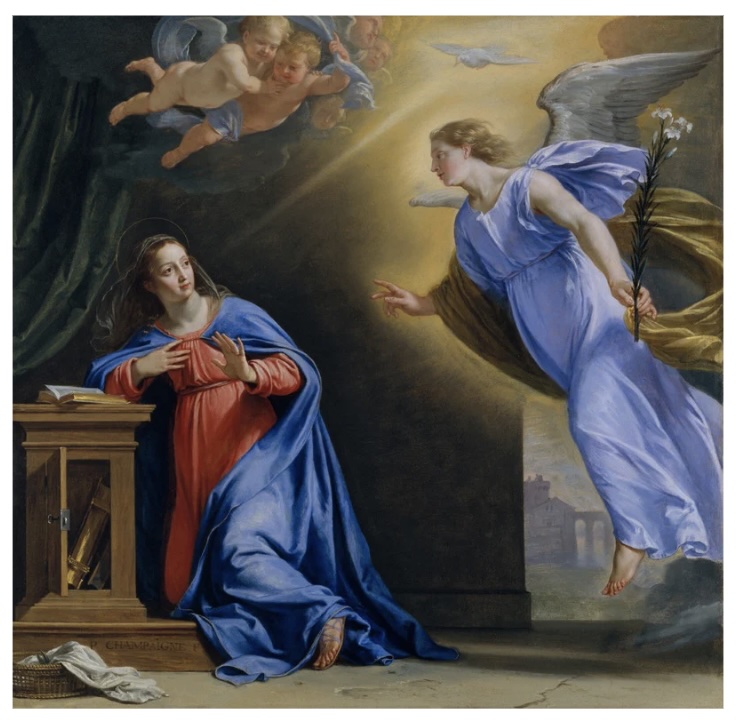
In the Gospel, the angel says to Mary, “You will conceive and bear a son.” And in that very moment, the Word begins to take flesh. God’s word becomes reality in her. That is why Mary responds with those simple yet profound words: “Let it be done to me according to your word.” In her, word and event meet. Her consent allows God’s promise to become history.
What does this solemnity say to us?
(a) The Nearness of God
The God who transcends time and space chooses to enter into time and space. He does not remain distant. He comes close—so close that He becomes one of us. The first reading presents the promise of Emmanuel—“God with us.” What was spoken as a promise to Ahaz becomes reality in Mary. The virgin conceives; God keeps His word. This feast assures us: God is not far from our lives. He enters our history, our struggles, our uncertainties. He is with us.
(b) Self-Surrender
Jesus enters the world saying, “Here I am.” He offers Himself for the salvation of humanity. His whole life is an act of surrender to the Father’s will. Mary mirrors this same disposition. Her “Let it be done” is not passive resignation; it is active surrender. She allows God to act in her life without resistance. In both Jesus and Mary, we see readiness—an openness to God’s plan. The question before us is simple: Are we available? Can we allow God to work through us, even when we do not fully understand?
(c) A New Creation
Adam was the head of the first creation. Christ becomes the head of the new creation. When the angel says, “Nothing will be impossible with God,” Mary begins to see reality through God’s eyes. What seems humanly impossible becomes divinely possible. This new creation is not only about Christ—it is about us. In Him, we too are made new. Every “yes” to God allows something new to begin in our lives. This feast, often called the “Good News,” invites us to reflect on our own words. Words are not empty. They have the power to become reality. Let us speak words that give life—words that become actions.
Just as God called Mary to a new mission, He calls each one of us today. May we have the courage to respond with the same trust, the same openness, the same faith: “Let it be done.”
Fr. Yesu Karunanidhi
Archdiocese of Madurai
Missionary of Mercy
 Yesu Karunanidhi
Leave a comment