Daily Catholic Lectio
Sun, 22 March 2026
Fifth Sunday of Lent
Eze 37:12–14. Rom 8:8–11. Jn 11:1–45
“If You Had Been Here…”
As we stand at the threshold of Holy Week, the Word of God today speaks to us about life—life in the midst of death, hope in the midst of despair, and faith in the midst of confusion. At the heart of the Gospel is a deeply human cry, spoken by both Martha and Mary: “Lord, if you had been here, my brother would not have died.” This is not just their voice; it is our voice too.
1. The Cry of the Human Heart
“Lord, if you had been here…”—how often we say the same in different ways. When suffering comes, when loss touches us, when things do not go as we hoped, we feel this deep question rising within us. It is not a rejection of God, but a wounded faith searching for meaning. Martha believes, but only partially. Mary believes, yet she is overwhelmed by grief. And Jesus does not reject their cry. He receives it, listens to it, and enters into it.
2. A World of Tombs
In the Gospel, Lazarus is in the tomb. But in a deeper sense, almost everyone in the story is in a tomb. The disciples are in the tomb of misunderstanding. The Jews are in the tomb of unbelief. Martha is in the tomb of partial faith. Mary is in the tomb of grief that cannot yet see hope. Lazarus is in the tomb of death itself. And we too carry our own tombs—fear, doubt, sin, disappointment, and loss. The question is not whether we have a tomb, but whether we believe that God can open it.
3. The God Who Opens Tombs
The first reading gives us a powerful promise: “I will open your graves and bring you back to life.” For Israel in exile, everything felt finished. Their loss was total. Yet God speaks a word of hope into that situation. He is the God who opens what we think is closed forever. This promise is not only about physical resurrection. It is about every situation in our life that feels sealed, buried, and beyond recovery. God is able to bring life even there.
4. The Delay of God
One of the most difficult parts of the Gospel is that Jesus does not go immediately when He hears about Lazarus. He waits. This delay troubles us, because we expect God to act quickly. But Jesus does not come only to prevent death; He comes to transform it. If He had gone earlier, Lazarus would not have died. But now something greater will happen—the glory of God will be revealed. What we see as a delay is often God’s deeper plan. His silence is not absence; it is preparation. What we see as a problem, He sees as an opportunity for faith.
5. “Come and See”
When Jesus arrives, they say to Him, “Come and see.” Come and see our pain, our tears, our loss. And Jesus comes. He does not remain distant. He draws near, step by step, until He stands before the tomb. There, we see something deeply moving: Jesus weeps. He is not untouched by our suffering. He shares in it. He feels the pain of death, the weight of loss, and even the struggle of human unbelief. God is not far from our wounds; He enters into them.
6. “Take Away the Stone”
Standing before the tomb, Jesus says, “Take away the stone.” Martha hesitates: “Lord, there will be a smell… it is the fourth day.” This is the voice of our fear. We often feel that certain situations are too far gone, too broken, too late. Yet Jesus insists. Before He works the miracle, He asks for human cooperation. There is always a stone that we must remove—fear, unforgiveness, resistance, lack of trust. Unless the stone is moved, new life cannot emerge. God’s grace invites our response.
7. “Lazarus, Come Out!”
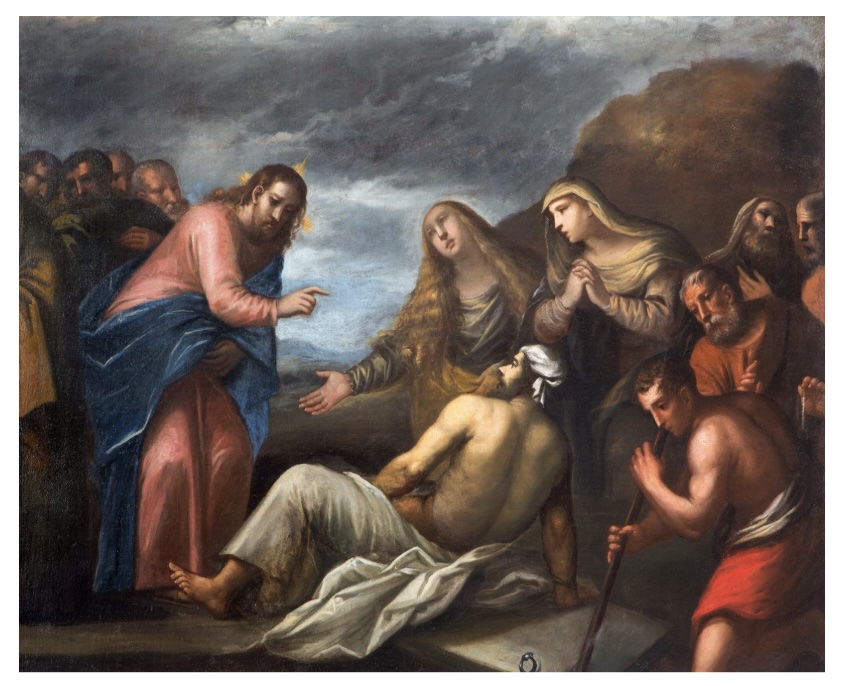
Then Jesus cries out, “Lazarus, come out!” This is not only a call to Lazarus; it is a call to each of us. Come out from whatever holds you captive—from sin, from fear, from despair, from spiritual death. Lazarus comes out, still bound. And Jesus says, “Unbind him, and let him go.” Life is God’s gift, but freedom unfolds in relationship, in community, in the help we give one another.
8. Life in the Spirit
Saint Paul reminds us that there are two ways of living: according to the flesh, which leads to death, and according to the Spirit, which leads to life. The Spirit who raised Jesus from the dead lives in us. This means that resurrection is not only a future promise; it is already at work within us. When we live in the Spirit, we carry within us the power of new life.
9. From “If You Had Been Here” to “You Are Here”
At the beginning of the Gospel, the words are: “Lord, if you had been here…” At the end, many begin to believe. This is the journey of faith—from feeling that God is absent to recognizing that He is present. Jesus was not late. He was there in a deeper way. He is here even now, in our struggles, in our waiting, in our pain.
Conclusion
We all have moments when we say, “Lord, if you had been here…” Today, Jesus invites us to move beyond that cry. He is here. He stands before our tombs. He calls us to trust. The One who opens graves is near. The One who gives life is with us. Let us not remain in our tombs. Let us hear His voice and come out into the life He offers.
Fr. Yesu Karunanidhi
Archdiocese of Madurai
Missionary of Mercy
 Yesu Karunanidhi
Leave a comment