Daily Catholic Lectio
Thu, 19 March 2026
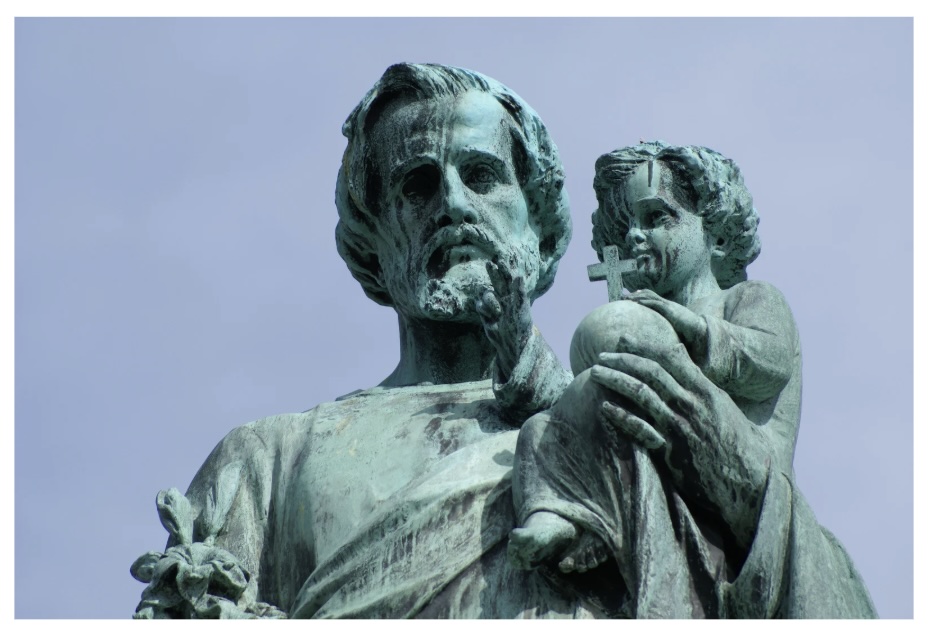
Saint Joseph, Husband of Mary, Solemnity
2 Sam 7:4-5, 12-14, 16. Rom 4:13, 16-18, 22. Mt 1:16, 18-21, 24
Her Husband Joseph
Today we celebrate Saint Joseph with a simple yet profound title: “Joseph, Husband of Mary.” The Gospels present him always in relation—to Mary and to Jesus. He does not stand in the foreground, yet his presence is essential. His life reminds us that what truly sustains us is not status or success, but relationship.
As we reflect today, we also recognize two great dimensions of human life: family and work. Through family we take root in this world; through work we extend ourselves, like branches that grow outward. Every married person belongs to two families—the one they come from and the one they build. And if we sit quietly and reflect, we realize: what we truly need in life is our family and our work. Everything else, in the end, matters much less.
Yet today both these areas are under strain. Families experience misunderstanding, tension, jealousy, and division. Work often brings insecurity, fatigue, competition, and even exploitation. Into this fragile reality, Joseph speaks—not with words, but through his life.
Let us reflect on four dimensions of Joseph.
1. A Just Man — Compassionate Righteousness
The Gospel introduces Joseph as a “just man.” At first, this can sound severe. When he discovers that Mary is with child, the law and social custom offer him clear options. He could withdraw. He could protect his own reputation. He even considers separating from her quietly.
But Joseph’s justice is not merely legal; it is rooted in compassion. He does not cling to law or custom when they risk hurting a person. Instead, he allows God’s will to reshape his response. He accepts Mary.
Here we see a deep truth. Laws and social norms often regulate life, but they do not always heal relationships. They can speak about separation, but they rarely help people to stay together. Joseph shows us a higher justice—a justice that goes beyond calculation, beyond “give and take,” into mercy and responsibility.
In our own families, how often we hold on to being right, instead of choosing to be loving! Joseph invites us to a justice that protects relationships, not just rules.
2. A Man of Silence
Joseph is a man of silence. The Gospels do not record his speeches. The only word associated with him is an action: he gives the child the name “Jesus.” Even when the angel speaks to him in dreams, even when life changes suddenly, Joseph remains silent.
Yet his silence is not weakness. It is a powerful way of speaking. Through silence, he listens, discerns, and obeys.
In today’s world, filled with noise and constant expression, silence has become rare. But Joseph teaches us that when life does not unfold as expected—when everything seems to turn in a different direction—silence becomes wisdom.
Many problems in families and workplaces arise from words spoken without patience—words of anger, hurt, or pride. Such words can wound deeply and leave scars that last for years. We learn to speak when we are young; but as we grow, we must learn when to remain silent.
Joseph’s silence is not emptiness—it is a space where God can speak.
3. A Man of Action
Though silent, Joseph is never passive. He is always on the move. Once he understands God’s will, he acts without delay.
He takes Mary into his home. He journeys to Bethlehem. When there is no place in the inn, he finds another way. He rises in the night and flees to Egypt. He returns and settles in Nazareth. Step by step, his life is marked by action. Joseph teaches us a simple but demanding truth: good intentions are not enough. Thinking and planning are important—but if they do not become action, they remain only dreams.
We may say, “My home should be better,” or “I must change something in my life.” But unless we act, nothing changes. The distance between thought and action is small—but that distance decides everything.
Often we fail not because we lack ideas, but because the gap between what we think and what we do is too wide. Joseph closes that gap. And in doing so, he shows us the path to faithful living.
4. A Man Who Knows How to Wonder
There are moments in Joseph’s life when he does not fully understand. One such moment is when Jesus, at the age of twelve, is found in the temple. Mary speaks; Jesus responds. Joseph remains silent.
He could have questioned, argued, or demanded explanation. Instead, he chooses another response: he wonders.
There are two ways to respond when we do not understand life. One is silence; the other is wonder. Joseph moves from confusion to contemplation.
Instead of asking, “Why is this happening?” in frustration, he allows himself to stand in awe: “What is God doing here?” This is a sign of maturity—to move from a life full of question marks to a life open to exclamation marks. Not everything needs to be solved; some things are to be received.
In our lives too, many situations remain unclear—within our families, our work, our vocation. Joseph teaches us not to react with fear or control, but to remain open, attentive, and receptive to God’s mystery.
The Foundation: Faith, Hope, and Love
Where does Joseph receive this depth?
Today’s readings point us clearly: faith, hope, and love. Like David in the first reading, Joseph learns to trust God’s promise beyond his own plans. Like Abraham in the second reading, he hopes even when there seems to be no reason to hope. And in the Gospel, he accepts Mary in love—a love that unites divine purpose and human relationship. Joseph lives by faith, he walks in hope, and he acts in love.
Fr. Yesu Karunanidhi
Archdiocese of Madurai
Missionary of Mercy
 Yesu Karunanidhi
Leave a comment