Daily Catholic Lectio
Sat, 7 March ‘26
Second Week of Lent, Saturday
Micah 7:14–15, 18–20. Luke 15:1–3, 11–32
“He Came to His Senses”
One short sentence in today’s Gospel changes everything: “He came to his senses.”
The younger son had left his father’s house in search of freedom. He believed that happiness lay far away—away from the father, away from home, away from responsibility. But the journey that promised freedom slowly became a path toward emptiness. His wealth disappeared, his friends vanished, and finally he found himself feeding pigs and longing to eat their food.
It is at that lowest point that something happens within him: he comes to his senses.
Conversion often begins not with strength, but with hunger. When everything is comfortable, we rarely ask deep questions. But when we feel the emptiness of life, when we experience failure or loneliness, a door opens within us. The younger son’s hunger awakens memory. He remembers his father’s house. He remembers that even the servants there live better than he does now.
This is the first step of conversion: remembering where we belong.
The Gospel shows us three movements in the younger son’s journey: hunger, awakening, and returning.
First, hunger.
“He would gladly have filled himself with the pods that the pigs were eating” (Lk 15:16). Physical hunger becomes a symbol of spiritual hunger. Every human heart carries this hunger—for love, dignity, meaning, and God.
Second, awakening.
“He came to himself” (Lk 15:17). Before returning to the father, he first returns to himself. Sin often means losing ourselves—living outside our true identity. Conversion begins when we rediscover who we are and where our true home is.
Third, returning.
The son does not remain sitting in regret. He says, “I will arise and go to my father.” Repentance is feeling sorry. It is the courage to stand up and move in a new direction.
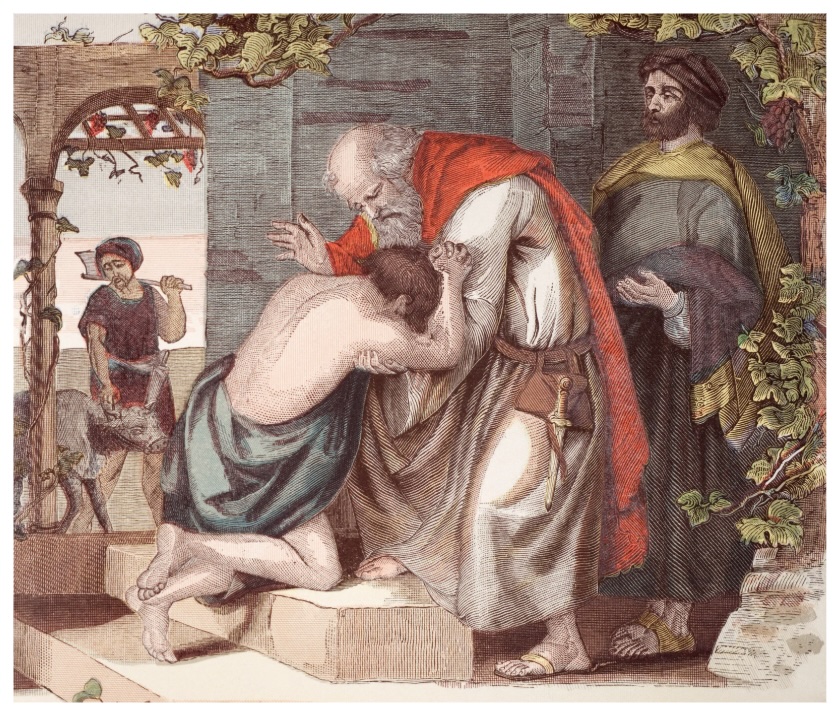
And then comes the most beautiful part of the story. While the son is still far away, the father sees him. The father runs, embraces him, and restores him—without interrogation, without punishment, without conditions. The son comes with a prepared speech of repentance, but the father interrupts it with love.
This reveals the heart of God. The first reading from the prophet Micah asks a powerful question: “Who is a God like you, pardoning iniquity and passing over transgression?” (Mi 7:18).
God does not delight in punishment. God delights in mercy. Micah says that God casts our sins into the depths of the sea. The father in the Gospel does the same: he does not reopen the past. He restores the son’s dignity immediately—with a robe, a ring, and a feast. But the parable does not end there. It introduces the elder son.
Externally, the elder son never left home. Yet inwardly he is just as distant from the father. He is angry, resentful, and unable to rejoice. The younger son was lost through rebellion; the elder son is lost through pride.
One left the house physically. The other left the father’s heart spiritually. Lent invites us to ask a simple question: Which son am I today? Sometimes we are like the younger son—far away, wounded by our mistakes, discovering our hunger for God. Sometimes we are like the elder son—faithful in appearance, but with a closed heart, unable to rejoice in mercy.
But the most important figure in the story is not either of the sons. It is the father. The father waits. The father watches the road. The father runs.
God is always the first to move toward us. The younger son was hungry. He awakened to his true self. And he rose and set out toward his father.
This is the journey of Lent: fasting, prayer, and works of love. Fasting reminds us of our hunger. Prayer awakens our hearts. Charity leads us back into communion with others and with God.
The Gospel tells us that the father says: “This son of mine was dead and is alive again; he was lost and is found” (Lk 15:24). Every confession, every act of repentance, every sincere return to God repeats this moment.
Today’s Gospel invites us to do one simple thing: come to our senses. To recognize our hunger.
To awaken to the truth of our lives. And to rise and return to the Father—who is already waiting, already watching, already running toward us with mercy.
Fr Yesu Karunanidhi
Archdiocese of Madurai
Missionary of Mercy
 Yesu Karunanidhi
Leave a comment