Daily Catholic Lectio
Sun, 22 February ‘26
First Sunday of Lent
Gen 2:7-9, 3:1-7. Rom 5:12-19. Mt 4:1-11
Inner Freedom
On this First Sunday of Lent, the Word of God invites us to cherish and protect a precious gift: inner freedom. Lent is not first about external discipline. It is about recovering freedom — the freedom to belong to God fully, the freedom to choose life, the freedom not to be enslaved by fear, desire, or pride.
An old and disturbing story from literature helps us frame this reflection. In The Brothers Karamazov, Fyodor Dostoevsky presents the parable of the Grand Inquisitor. Jesus returns to earth during the Spanish Inquisition. The people recognize him, and he performs acts of mercy. But the Grand Inquisitor arrests him and tells him, “You made a mistake in the desert. You rejected bread, power, and spectacle. Human beings do not want freedom; they want security. We corrected your mistake.” That night, Jesus says nothing. He responds only by kissing the old man. The Inquisitor, shaken, releases him. The story reveals a profound truth: the greatest temptation is not evil itself, but the surrender of freedom in exchange for comfort and control.
The first reading from the Book of Book of Genesis (2:7–9; 3:1–7) takes us to the very beginning. The human person is formed from the dust of the earth but receives the breath of God. We are fragile yet filled with divine life. This breath is the sign of our dependence on God. To live is to remain connected to Him. The text shows the threefold complementarity: complementarity of spirit and flesh; complementarity of man and woman; complementarity of God and humans.
In the garden, God gives everything necessary for life. But He also places a limit: the tree of the knowledge of good and evil. This command is not a restriction meant to suffocate. It is a boundary meant to protect. True freedom always lives within truth.
Yet the serpent suggests something else: “You will be like God.” The temptation is subtle. It shifts attention from gratitude to suspicion. From gift to prohibition. The first humans forget all the trees freely given to them. They focus only on the one that is forbidden. Disobedience is born from distrust.
When they eat the fruit, their eyes are opened — but not to glory. They become aware of their nakedness. Nakedness here is not only physical. It symbolizes vulnerability, brokenness, insecurity. The freedom they sought becomes fragmentation. They become strangers to God, to one another, even to themselves. Loss of obedience becomes loss of freedom.
In the second reading, from the Letter to the Letter to the Romans (5:12–19), Saint Paul presents a powerful contrast: Adam and Christ. Through one man’s disobedience came sin. Through one man’s obedience comes grace. Through Adam, alienation. Through Christ, reconciliation. Where Adam grasped, Christ surrendered. Where Adam distrusted, Christ trusted. Where Adam fell, Christ stood firm.
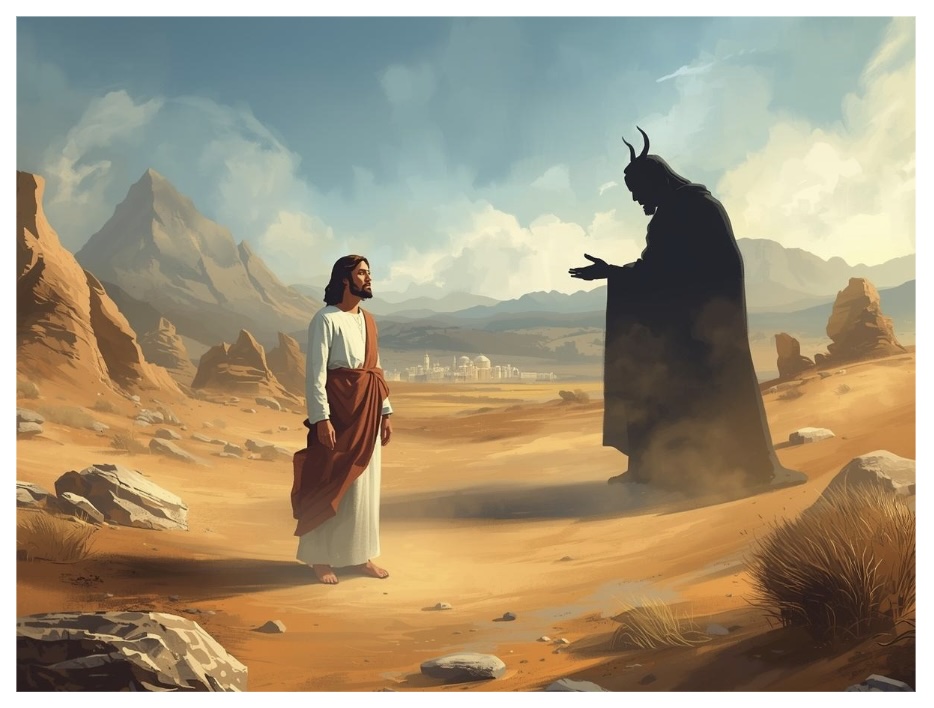
This contrast becomes concrete in today’s Gospel from the Gospel of Matthew (4:1–11). Immediately after His baptism — where He is declared the beloved Son — Jesus is led into the desert. For forty days He fasts. The number forty recalls Israel’s forty years in the wilderness. Just as Israel was tested, so is Jesus.
In the Bible, the number forty is a symbol of testing, purification, and preparation. Israel spent forty years in the desert after leaving Egypt — a time meant to form them as God’s people. During this journey, they faced three major failures. First, they murmured for bread and doubted God’s care (Exodus 16), longing for the security of Egypt rather than trusting divine providence. Second, they tested God at Massah and Meribah (Exodus 17:1–7), questioning, “Is the Lord among us or not?” Third, they worshiped the golden calf (Exodus 32), turning to idolatry when Moses delayed on the mountain. These three temptations — craving material security, demanding proof of God’s presence, and surrendering to false worship — reveal the struggle between trust and distrust. The forty years were not only a punishment but a school of freedom, teaching Israel to depend on God alone. But where Israel failed, Jesus remains faithful.
The first temptation: “Turn these stones into bread.” Jesus is hungry. Hunger is real. Fasting means freely accepting hunger. Hunger reminds us that we are dependent. The tempter invites Him to remove uncertainty. If stones become bread, hunger disappears. Security is guaranteed.
But Jesus answers: “Man does not live by bread alone.” Bread is necessary. But it is not everything. The human person is not only body, but also spirit. To reduce life to material satisfaction is to lose inner freedom. When we live only for comfort, pleasure, or consumption, we become slaves. Let stones remain stones. Let bread remain bread. Freedom is not the power to change everything. It is the strength to live rightly within limits.
The second temptation: “Throw yourself down.” Here the tempter even quotes Scripture. He suggests that God will protect Him. It is a temptation to test God, to demand proof, to turn faith into spectacle.
But Jesus replies: “You shall not put the Lord your God to the test.” At His baptism, the Father’s voice had already declared Him beloved. Jesus does not need to prove His identity. He does not need dramatic signs to confirm God’s presence. Inner freedom does not demand constant reassurance. It rests in trust.
The third temptation: “Fall down and worship me, and I will give you all the kingdoms of the world.” This is the temptation of power and domination. To gain everything quickly. To rule without the cross. To possess without obedience. But Jesus answers firmly: “You shall worship the Lord your God, and Him alone shall you serve.”
To fall at someone’s feet is to surrender freedom. In biblical times, prostration meant accepting someone as master. Jesus refuses to sell His freedom for power. “You cannot serve both God and wealth” (Matthew 6:24). True worship belongs to God alone.
In these three temptations — bread, spectacle, power — we see the same struggle that began in Genesis. Distrust versus trust. Grasping versus surrender. Self-assertion versus obedience. Jesus preserves His inner freedom because He remains obedient to the Father. Obedience here is not weakness. It is strength. It is alignment with truth.
Our first parents lost their freedom when they distrusted God. Jesus keeps His freedom because He trusts completely.
Lent invites us into this same battle. We too experience deserts: physical hunger, intellectual confusion, relational loneliness, spiritual emptiness. We are tempted to fill every emptiness immediately. To test God. To compromise for quick success.
But inner freedom grows when we choose obedience. When we accept limits. When we worship God alone.
The Responsorial Psalm today becomes our prayer: “Create in me a clean heart, O God, and renew a steadfast spirit within me” (Psalm 51:10).
Inner freedom is not the ability to do whatever we want. It is the capacity to choose what is true and good. It is the courage to remain faithful when tempted.
Jesus did not lose His freedom in the desert. He protected it. He cherished it. He lived it until the end.
May this Lent teach us to cherish ours.
Don Yesu Karunanidhi
Archdiocese of Madurai
Missionary of Mercy

 Yesu Karunanidhi
Leave a comment