Daily Catholic Lectio
Thu, 25 December ‘25
Nativity of the Lord – Midnight
Isaiah 9:1–6. Titus 2:11–14. Luke 2:1–14
A Few Cribs Last Forever
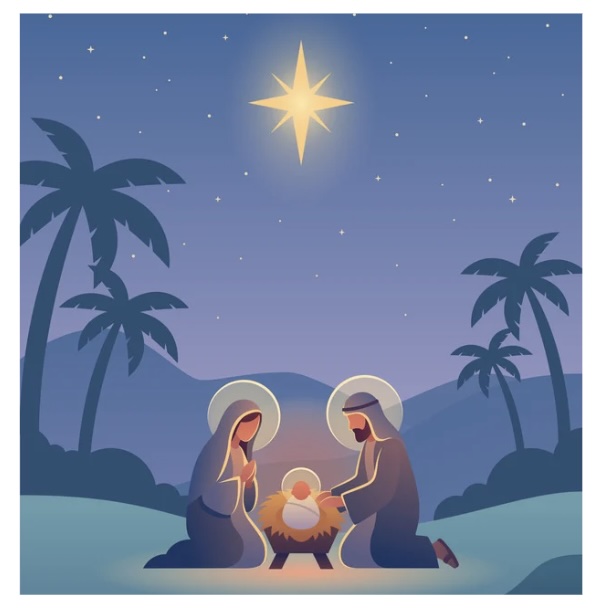
Tonight, we have set up a crib in our church. Saint Francis of Assisi was the first to do so. Saint Ignatius of Loyola, in his Spiritual Exercises, invites us to stand before the crib and contemplate the mystery. The crib is not decoration. It is catechesis. It is faith made visible. It is a point that draws us, through contemplation, to the very heart of God.
Just as human beings created by God are different from one another, so too are the cribs made by human hands. Every place builds it differently. We do not want to repeat last year’s design or copy another parish. With creativity, context, and current events in mind, we shape new cribs every year. At the Vatican, under the theme “100 Cribs,” cribs from different languages, cultures, and peoples are displayed annually.
In one parish, a priest set up a crib—but instead of placing the Child Jesus, he placed a mirror, with the words: “You are the Christ born here.” Thus, Christ is “born” every year in new forms and new insights. And yet, the cribs we build will be dismantled. In a few months, in the same place, we will place the Risen Lord. Cribs become tombs. What we build is taken apart and transformed.
But some cribs last forever. They never change.
Saint Luke writes about the very first crib. No crib was prepared. A journey begins. Joseph takes Mary and travels to his own town. From Nazareth in Galilee they come to Bethlehem in Judea—Joseph, Mary, and the Child in her womb. God comes to his own town. God comes to dwell among human beings. Saint John writes it simply: “He came to what was his own” (Jn 1:11). We all belong to him. He comes searching for us.
The first journey of Jesus is from Nazareth to Judea. His final journey will mirror it. The Child laid in a manger will be laid on the cross. Born in Bethlehem—the “house of bread”—he will give himself as food in Jerusalem, instituting the Eucharist. From Jerusalem he will return to the Father. The one who came as “God with us” will return as “God for us.”
Luke notes that Mary was with child, and that the time came for her to give birth. The census was so cruel that even pregnant women were forced to travel. From then until now, power has rarely cared for the weak.
Mary gives birth and lays her child in a manger, “because there was no place for them in the inn.” Archbishop Fulton Sheen explains: there was room for officials, their assistants, census officers, soldiers, and for those who could pay double—but no room for the couple from Nazareth. Humanity said, even then, “We do not want God.” John echoes it: “His own people did not accept him” (Jn 1:11).
Denied space, Joseph and Mary move on. They do not explain who they are, or who the child is. Joseph speaks nothing of his dream. Mary says nothing of the angel Gabriel.
“God makes everything beautiful in its time” (Eccl 3:11). God knows his time and his place. Human rejection cannot drive God away. He is born in a stable. A manger becomes his dwelling. Clothes are wrapped around him—clothes that entered the world through sin now embrace the one born to take sin away. The manger, the swaddling clothes, and the child become the sign given by the angel.
There was no room in the inn, but there was a manger and there were clothes. Christmas, then, is not a negative story. Human rejection never makes God a stranger. He finds a place for himself.
At the same moment, another scene unfolds.
Here: a stable.
There: an open field.
Here: Christ, the glory of God, lights up the crib.
There: the glory of the Lord shines around the shepherds.
Here: the Word is born.
There: the Word is proclaimed.
Here: Joseph and Mary keep watch.
There: the shepherds keep watch.
Shepherds—considered liars, thieves, unclean—receive the announcement: “I bring you good news of great joy for all the people. Today, in the city of David, a Saviour has been born for you; he is the Messiah, the Lord. This will be a sign for you: you will find a child wrapped in cloths and lying in a manger.”
In an age when the births of emperors like Augustus were proclaimed as good news, the birth of Jesus is announced as true joy. The child, a sign of weakness, is also a prince. The angel gives him three titles: Lord, Messiah, Saviour—and adds one phrase: “for you.”
Those who wait for the Messiah are the ones who hear of his birth. In today’s first reading, when Judah was weak and surrounded by fear, Isaiah proclaims: “A child has been born for us… and he shall be called Wonderful Counsellor, Mighty God, Everlasting Father, Prince of Peace.” Though it pointed first to King Hezekiah, in Christian faith it points fully to Jesus—because only the Eternal One can be Everlasting Father and Mighty God.
John continues: “To all who received him, he gave power to become children of God” (Jn 1:12). This is why the angels sing: “Glory to God in the highest, and on earth peace to those on whom his favour rests.”
Saint Augustine explains that “heaven” is not a place above, but a space within the heart. God is close to the broken-hearted (Ps 34:18). Only when we bend low in humility can we encounter him. That is why the entrance to the Church of the Nativity in Bethlehem is so small—only those willing to bow can enter.
All the lessons of Christmas are gathered by Saint Paul into one line: “The grace of God has appeared, bringing salvation to all” (Titus 2:11). We know God only because God reveals himself. And he reveals himself through human weakness.
What does Christmas teach us?
First: each one of us is a crib where God is born. The cribs we build will be dismantled. But the crib that remains is our life. In it are parents like Joseph and Mary, relatives like shepherds, teachers like the wise ones. Sometimes our crib smells. Yet it is there that God’s glory is revealed. Let us accept our life—the crib of our existence—fully.
Second: the person next to us is also a crib. God dwells there too. “The Word became flesh and dwelt among us” (Jn 1:14). Because God took on humanity, our humanity receives dignity and glory. In every child, we must see the Lord, the Messiah, the Saviour. In every person, we must celebrate Christ. “Born for you,” says the angel. Those around us are given for us. Let us accept one another, with weakness, smell, and wounds.
Third: the Jesus laid in the manger is the Jesus we receive in the Eucharist. The body placed in the manger is placed on the cross for our salvation. When we receive him as food, we must become like him. No matter how many cribs we build, Jesus is not reborn there—because he has already been born, lived, died, risen, and remains with us forever. We await his return as King. As we look at earthly cribs, let us turn our hearts to our eternal dwelling, where Christ sits at the right hand of the Father.
Some cribs last forever.
In government hospitals.
In orphanages.
In homes for the elderly.
In prisons.
In refugee camps.
At bus stands and railway stations.
Some cribs last forever.
Like Joseph, who owned nothing but a stable in his own town.
Like Mary, who moved on silently, carrying the Son of the Most High.
Like them, we too keep moving—towards our permanent dwelling.
Yes. Some cribs are never dismantled.
Fr. Yesu Karunanidhi
Archdiocese of Madurai
Missionary of Mercy
 Yesu Karunanidhi
Leave a comment