Daily Catholic Lectio
Sat, 20 December ‘25
Christmas Novena – Day 4
Isaiah 7:10–14. Luke 1:26–38
From Confusion to Clarity
As we continue the Christmas Novena, the Church places on our lips today a powerful cry: “O Key of David, come!” It is the fourth great messianic title. A key is a small object, yet it holds great power. Whoever holds the key has authority to open and to close. The antiphon proclaims: What you open, no one can shut; what you shut, no one can open. This is not only about doors; it is about destinies. The Key of David leads us from confusion to clarity, from fear to trust, from closed spaces to freedom.
In the first reading, we meet King Ahaz, surrounded by war, pressure, and political anxiety. He is confused and afraid. God offers him a sign, not to confuse him further, but to give him clarity: “The virgin shall conceive and bear a son, and shall name him Emmanuel.” In the midst of chaos, God does not give Ahaz a strategy or a weapon. He gives a promise. Emmanuel—God with us—is the key that unlocks fear. God’s presence, not human calculation, is the way forward.
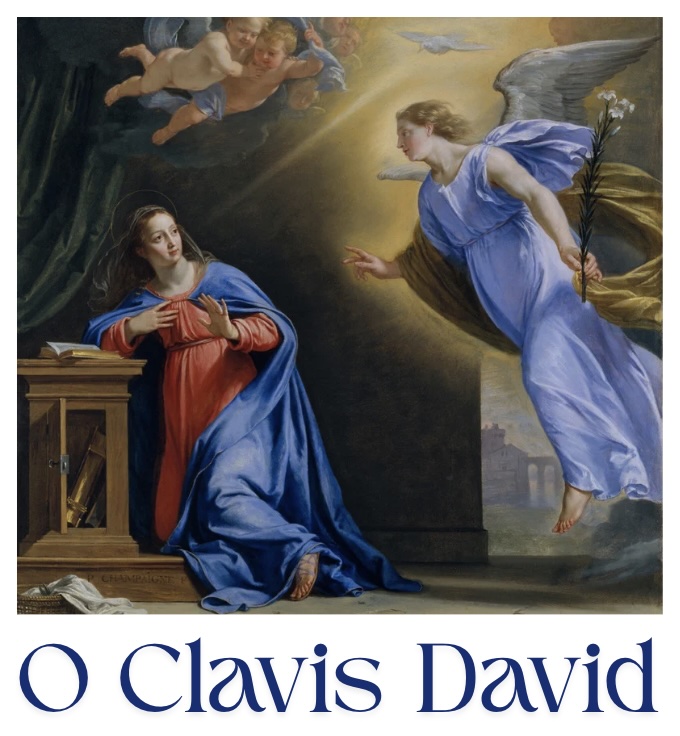
In the Gospel, we encounter another moment of confusion, but of a very different kind. Mary hears an announcement that overturns all logic: she will conceive without knowing a man. Her question is honest and human: “How can this be?” This is not disbelief; it is a search for clarity. The angel does not rebuke her. He explains. He reassures. And he offers the decisive key: “Nothing will be impossible for God.” At that moment, confusion gives way to clarity, and fear yields to faith. Mary responds with a sentence that opens the door of salvation history: “Let it be done to me according to your word.”
The title “Key of David” carries deep meaning in Israel’s faith. It signifies authority over the city—who may enter and who may leave. It signifies authority over the treasury—what is guarded and what is shared. It signifies authority over the Temple—especially the gate that only the Messiah could open. To call Jesus the Key of David is to confess that He alone has authority over life, meaning, and salvation. He opens what we cannot open. He closes what traps us. He releases those who dwell in darkness and in the shadow of death.
Both Ahaz and Mary stand before closed doors. One hesitates; the other entrusts herself. Yet in both cases, God remains faithful. This is our consolation. We too want our plans, timelines, and outcomes to remain under our control. But Advent teaches us peace comes when we step back and allow God to hold the key. When confusion, fear, hesitation, and inner turmoil surround us, we are invited not to force the door, but to wait—calmly, patiently—until God opens it.
To pray “O Key of David, come!” is to place our locked rooms—our doubts, wounds, relationships, decisions—into the hands of Christ. It is to say: Open what is closed in me. Close what harms me. Lead me from confusion to clarity.
May the Key of David unlock our lives. May He open paths where we see none. May He free us from the prisons of fear and uncertainty.
O Key of David, come—open our lives to God’s light.
Fr. Yesu Karunanidhi
Archdiocese of Madurai
Missionary of Mercy
 Yesu Karunanidhi
Leave a comment