Daily Catholic Lectio
Mon, 8 December ‘25
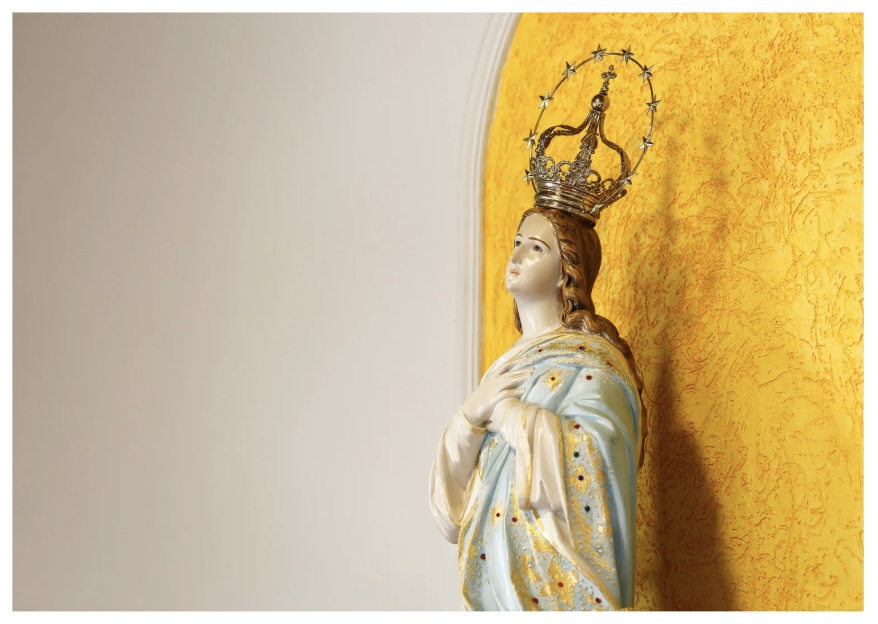
Immaculate Conception of BVM, Solemnity
Genesis 3:9–15, 20. Ephesians 1:3–6, 11–12. Luke 1:26–38
Stain Is Good!
The dogma of the Immaculate Conception — that Mary was conceived without original sin — was solemnly proclaimed by Pope Pius IX on 8 December 1854 through the document Ineffabilis Deus. It is fitting that this great feast is celebrated during Advent, the season of preparation for the birth of Christ, because the Immaculate Conception marks the very beginning of God’s plan for the Incarnation.
The Bible does not speak directly about Mary’s Immaculate Conception. Interestingly, the Qur’an, in Surah Maryam, affirms that Mary was born without the stain of sin. Since Jesus is regarded as a prophet in Islam — and prophets are believed to be born free from sin — the one who bore him is also understood to be without defilement.
Today, therefore, we praise Mary as the one who is sinless, pure, undefiled — immaculate. But we must ask honestly: does this understanding still speak meaningfully to our time?
There was a time when purity was considered next only to divinity – ‘Cleanliness is next to Godliness’. Today, however, we have grown comfortable saying, “Stain is good.” Even the disinfectants we use promise only 99.9% protection. We accept leaders with stains. We compromise with imperfection. In such a world, calling Mary “unstained” almost distances her from us, making her seem unreal and unreachable.
Moreover, purity cannot always be romanticised. For homeless women and nomadic women sleeping on the streets, dirt itself becomes protection. Cleanliness for them can mean danger. For such lives, “stain itself is beauty.”
So let us not reduce today’s feast to a moral slogan: “Mary is pure; therefore, we must be pure.” Instead, let us reflect on the purpose of her purity and the challenge it offers us.
1. Mary’s Purity Defines the Purpose of Her Life
Shakespeare once wrote: “Some are born great, some achieve greatness, and some have greatness thrust upon them.” Mary is born with grace, but she also grows into greatness through her surrender. In the game of chess, pawns become powerful only when they move steadily, step by step, to the other side of the board. Their perseverance transforms them. In today’s second reading, Paul writes: “God chose us in Christ before the foundation of the world, to be holy and blameless before him.” Our life, then, is not a historical accident. God has a purpose, a design, a calling for each one of us.
Mary learns her life’s purpose through the angel. We do not receive such clarity. For us, God’s will must be discerned through signs — inner promptings, external circumstances, quiet movements of grace. Yet one truth remains: we are all born for greatness. God has chosen and destined every one of us for fullness of life.
2. Not Our Being, but Our Becoming Gives Us Value
The first woman, simply “woman,” becomes “mother” — Eve. Humanity changes through a single act, the eating of the forbidden fruit. Eyes are opened; human life enters a new stage. What matters is not what we are, but what we become. As children, we are asked, “What will you become?” As adults, the question changes to, “What are you now?” Growth often ends in stagnation. But value increases only through transformation. Milk becomes curd, butter, ghee — and grows in worth. Iron becomes tungsten filament — and its value multiplies.
Mary, the young girl of Nazareth, becomes the Mother of God. Her Immaculate Conception prepares her for this transformation. Today’s feast calls us too to keep changing, growing, becoming — never remaining stagnant.
3. From Questioning to Total Surrender
The Gospel moves from Mary’s question — “How can this be?” — to the proclamation: “Nothing is impossible for God.” Hearing the angel’s assurance, Mary responds, “Let it be done to me according to your word.” She does not say, “I will do it.” She allows God to act.
Often, we burden ourselves by trying to control everything. Much of life remains beyond our grasp. Events move on their own course. Wisdom lies in stepping back and letting God work.
Mary’s purity is God’s gift. Her greatness lies in allowing that gift to bear fruit.
Conclusion
As we thank God today for the Immaculate Conception of the Blessed Virgin Mary, let us remember: her purity is not separation from humanity, but preparation for motherhood.
May we too prepare ourselves — to live life fully, to move steadily toward greatness, to keep transforming / becoming, and to live with hearts surrendered to God.
Fr. Yesu Karunanidhi
Archdiocese of Madurai
Missionary of Mercy

 Yesu Karunanidhi
Leave a comment