Daily Catholic Lectio
Thu, 20 November ‘25
Thirty-Third Week in Ordinary Time, Thursday
1 Maccabees 2:15–29. Luke 19:41–44
God who Cries
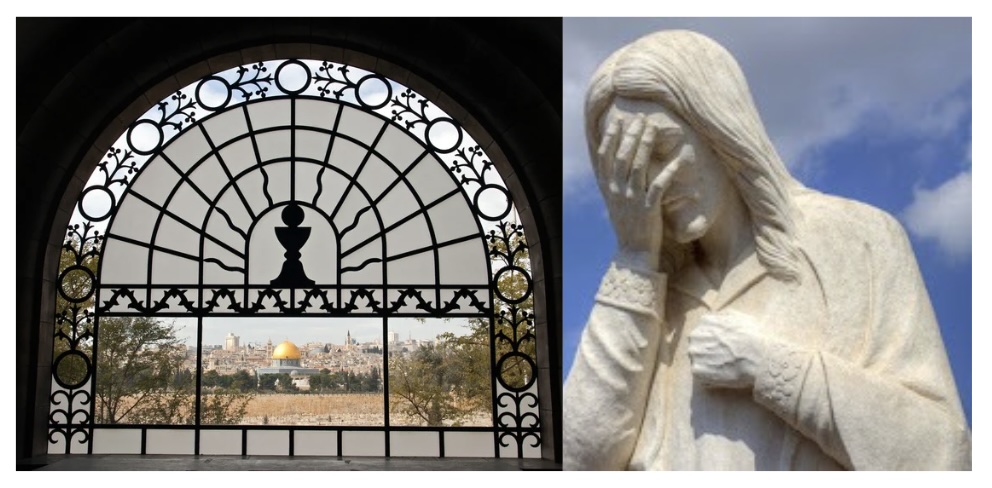
The Gospel opens today with a startling and tender revelation: God weeps. As Jesus draws near Jerusalem, He beholds the city and breaks into tears. The One who calms storms, raises the dead, and casts out demons stands helpless—not because His power is limited, but because love cannot force itself upon a heart that refuses to welcome it.
Scripture records three moments when Jesus weeps. At Bethany, He stands before the tomb of His friend Lazarus. His tears are more than grief; they arise from seeing how death crushes families, wounds communities, and haunts humanity. In Gethsemane, His prayer is soaked with tears as He embraces the full weight of His mission. Between these two moments stands today’s scene: Jesus weeping over a city that will not recognize the hour of its visitation.
Why does God cry? What do Jesus’ tears reveal?
1. Tears of Helpless Love
Jesus’ tears arise from a holy helplessness—not the helplessness of weakness, but the helplessness of love before human freedom. Standing before Jerusalem, He sees a people rejecting the very peace they have long prayed for. He has preached, healed, and invited. He has walked their streets and entered their homes. But like a loved one sitting at the bedside of someone slipping away, Jesus can do no more. Love cannot be imposed. His tears ask: “How I longed to gather you… but you would not have it.” They are tears shed for a heart that is closing in on itself. God is not distant. He cries with us. He cries for us.
2. Tears Calling for Conversion
There is another kind of crying we recognize—the tears of a family pleading for someone they love. A wife weeps when her husband returns home drunk; children cry hoping their father will change. Their tears are not signs of despair, but of yearning: “Look at what you are doing… come back.” Jesus’ tears over Jerusalem carry this same plea. He sees a city blind to the “way of peace.” He sees hearts that celebrate the temple but fail to recognize the Lord of the temple standing before them. He sees religious devotion without inner transformation. His tears become an invitation: Return. Wake up. Let your heart soften before grace passes by unnoticed.
3. Tears of Warning
Some tears carry a prophetic edge. The cry of the oppressed warns the oppressor: “What you do to me will return to you.” Tears speak truth without shouting. So too, Jesus’ tears unveil the future of Jerusalem—a city heading toward destruction, not because God willed it, but because it hardened itself to God’s peace. His sorrow-filled words stand as a mirror: “If you refuse the path of peace, the path of ruin will follow.” This is not a threat. It is the truth love speaks when it sees danger ahead.
God Weeps Beside Us Today
The first reading presents a father, Mattathias, grieving over the desecration of the temple. The people cherish the sanctuary where God’s name dwells, yet when the Lord Himself stands before them in Jesus, they fail to see Him. The contrast is painful: a zeal for rituals but blindness to the living God.
Today, “Dominus Flevit”—the little church on the Mount of Olives—stands as a reminder of this moment. Through its window, the whole city of Jerusalem is visible. But as one sits longer in prayer, the glass turns reflective. Suddenly, the city fades and one’s own face appears. This silent transformation whispers a profound truth: The Lord’s tears are not only for ancient Jerusalem—they fall for us. For every time we miss the moment of grace. For every time peace knocks and we choose conflict. For every time love reaches out and we pull away.
The God who cries is the God who cares. The God who warns is the God who waits. The God who stands helpless is the God who never gives up. If today we recognize His voice, if we welcome His peace, if we allow His tears to soften our hearts, then His sorrow becomes our salvation.
Fr. Yesu Karunanidhi
Archdiocese of Madurai
Missionary of Mercy

 Yesu Karunanidhi
Leave a comment