Daily Catholic Lectio
Tue, 18 November ‘25
Thirty-Third Week in Ordinary Time, Tuesday
Feast of the Dedication of the Basilicas of St Peter and St Paul, Rome
Acts 28:11–16, 30–31. Matthew 14:22–33
Connecting Dots
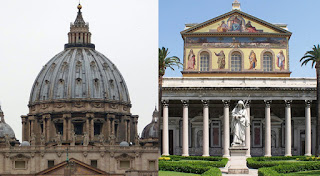
Today we celebrate two great stones of our faith—St Peter’s Basilica rising at the heart of the Vatican, and St Paul’s Basilica standing outside the ancient walls. Their locations themselves speak: one at the centre, the other at the margins. Yet both draw us to the same Christ. Today, these basilicas invite us to a spiritual exercise: connecting the dots—between our past and our present, between fear and faith, between our small lives and the great story of God.
1. Connecting the dot of destination with the dot of mission
Acts ends with Paul reaching Rome. The narrative stops, not because the story is over, but because the Gospel has reached what the ancient world considered “the ends of the earth.” Paul’s long journey—from Tarsus through countless dangers—meets its final dot in a rented house in Rome. That rented house becomes his true home because the Gospel made it so.
Paul’s life teaches us that what matters most is not where we begin, but where we allow God to lead us. His beginnings were harsh: a persecutor, a man of violence. Yet his ending is majestic: an apostle whose voice still shapes the Church. When God draws the line, the last dot is always grace. Rome shows us that every small step in faith—even the painful ones—forms part of God’s larger design.
2. Connecting the dot of fear with the dot of faith
In the Gospel, Peter steps onto the water. He takes a risk that makes no sense. He lets go of his strength, his swimming skill, his confidence. He “wastes” his abilities for the sake of the Master. When fear overwhelms him, he cries, “Lord, save me!”—a prayer born of trust more than panic. And Jesus lifts him.
Peter shows us that faith is not a perfect straight line. It is a dotted line—courage here, doubt there; love here, failure there. What connects the dots is the hand of Christ. The Basilica of St Peter stands today as a symbol that the man who sank in the sea became the rock of the Church. Grace does not erase weakness; it carries it.
3. Connecting apostles to the Church, and the Church to us
Peter and Paul are not simply towering figures of the past; they are our connecting lines to Christ. Their basilicas are not monuments—they are umbilical cords. Through them, we touch the living memory of the Church; through them, we enter the mother’s womb of faith.
Peter gives us the courage to lose ourselves for the Lord. Paul gives us the zeal to run until the very last mile. Together, they connect heaven and earth, Christ and believer, mission and destiny.
Conclusion: Drawing our own lines
This feast reminds us that God is still drawing in our lives. Some dots are bright—moments of joy, clarity, grace. Others are dark—failure, fatigue, fear. But when we stand back, God reveals the picture.
Peter and Paul teach us that the Master needs every dot. He needs our weakness, like Peter. He needs our passion, like Paul. He needs our willingness to be carried, to be corrected, to be sent.
May these two apostles help us see how our life—fragmented, unfinished, imperfect—is slowly becoming a basilica of grace.
Fr. Yesu Karunanidhi
Archdiocese of Madurai
Missionary of Mercy

 Yesu Karunanidhi
Leave a comment