Daily Catholic Lectio
Mon, 27 Oct ‘25
Twenty-Ninth Week in Ordinary Time, Monday
Romans 8:12–17; Luke 13:10–17
Abraham’s Daughter
(a) The woman who could not stand straight
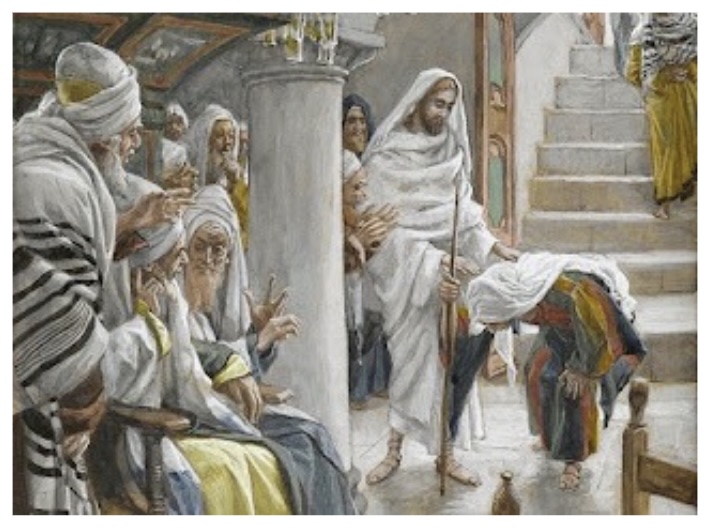
Today’s Gospel presents a woman who had been bent over for eighteen long years. Her back was curved, her eyes fixed on the ground — she could not look up to heaven. Her world had shrunk to dust. When Jesus sees her, He calls her forward and says, “Woman, you are set free from your ailment.” Then He lays His hands on her, and immediately she stands up straight and praises God. It is a beautiful image — a woman long oppressed now standing tall in dignity and joy. Yet this miracle, so full of compassion, becomes a cause for controversy.
(b) Three points of scandal
For the religious leaders of Jesus’ time, three things about this healing were unacceptable: It was done on the Sabbath — a day they believed should have no work, not even healing. It was done for a woman, and women were often seen as secondary in religious matters. Jesus called her “a daughter of Abraham.” Each of these details offended their rigid system. The Sabbath was meant to be a day of rest and renewal, a reminder that people belong to God, not to labour. But over time, the law of rest had turned into a law of restriction. The heart of the Sabbath — compassion — had been replaced by control. When Jesus heals on the Sabbath, He does not break the law — He fulfils it. For Him, to heal is not to destroy the Sabbath but to reveal its true purpose: restoring life, not limiting it.
(c) Abraham’s daughter
When Jesus calls her “a daughter of Abraham,” He gives her back more than her health — He gives her identity and belonging. In the Gospels, the title “son of Abraham” is used for Zacchaeus, the tax collector who repented (Luke 19:9). By calling this woman “a daughter of Abraham,” Jesus proclaims that she too shares in the covenant, in the promises, in God’s family. The synagogue leader saw her as a rule-breaker; Jesus saw her as a daughter.
Religion had excluded her; grace restored her. For eighteen years, she had been bound — not only by her illness but by society’s indifference. Yet Jesus saw her, spoke to her, touched her, and freed her.
How many people today live “bent over” — under the weight of shame, guilt, fear, or social judgment? How many are waiting for someone to notice, to call them by name, to remind them that they, too, are children of Abraham — beloved of God?
(d) The hypocrisy of the leader
The synagogue leader objects, saying, “There are six days for work; come and be healed on those days, not on the Sabbath.” It is a cruel irony. For eighteen years she has suffered, and no one has helped her — yet when Jesus acts, they suddenly remember the law. Jesus unmasks their hypocrisy: “You hypocrites! Don’t each of you untie your ox or donkey on the Sabbath and lead it to water? Then should not this woman, a daughter of Abraham, whom Satan has bound for eighteen years, be set free on the Sabbath?” They care for their animals but not for their sister. Their religion has become a system without soul. True faith always puts the human person above the rule, mercy above measure.
(e) Lessons for us
This Gospel gives us two strong calls for reflection.
(i) What binds me today? Like the woman, perhaps something in us has been bound for years — a habit, a resentment, a fear, an addiction, a sin. We may come to the temple every week, but still remain bent within. What do I need Jesus to touch and set free in me?
(ii) How do I respond to God’s work in others? When God blesses or heals someone near me, do I rejoice — or do I react with jealousy, like the synagogue leader? Do I celebrate grace, or do I criticize the timing? The true disciple rejoices whenever and wherever the Lord acts.
(f) The Spirit that frees
In the first reading, St. Paul says, “You did not receive a spirit of slavery to fall back into fear, but you have received the Spirit of adoption.” This Spirit enables us to cry out, “Abba, Father!”
This same Spirit that straightened the woman also straightens our hearts. It raises our eyes from the dust of despair to the hope of heaven. The healing of the “daughter of Abraham” is a sign of what God wants to do for each of us — to lift us up, free us from our chains, and teach us to stand tall again as His children.
Fr. Yesu Karunanidhi
Archdiocese of Madurai
Missionary of Mercy

 Yesu Karunanidhi
Leave a comment