Daily Catholic Lectio
Sun, 26 Oct ‘25
Thirtieth Week in Ordinary Time, Sunday
Sirach 35:12–14, 16–18. 2 Timothy 4:6–8, 16–18. Luke 18:9–14
Two Types of Prayer
(a) Two voices in the temple
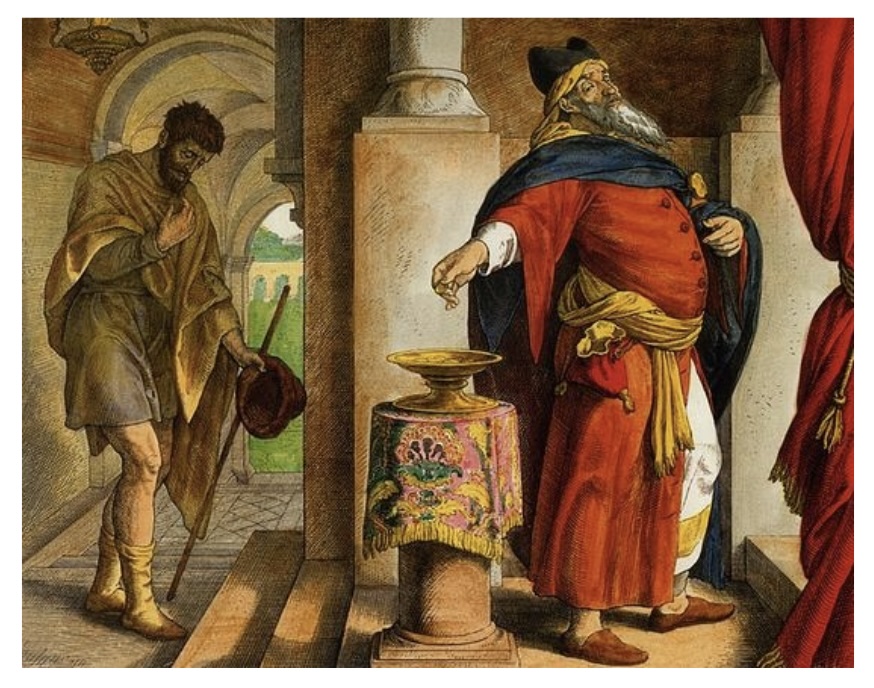
In today’s Gospel, Jesus tells a parable that unfolds like a mirror of our hearts. Two men go to the temple to pray — a Pharisee and a tax collector. Both stand before the same God, but they speak from two different hearts. The Pharisee’s prayer is filled with “I.” He uses that word five times: “I thank you, I fast, I give, I am not like others…” His prayer is not about God — it is about himself. He measures his holiness by comparing himself with others. The tax collector, standing far off, cannot even raise his eyes. He beats his chest and says only one line: “God, be merciful to me, a sinner.” He recognizes two truths — that he is broken and that God is merciful.
This humility, not eloquence, touches heaven.
(b) Forgetting who God is
When we forget who God is, we also forget who we are. Modern culture often pushes God to the margins — success becomes our saviour, power becomes our god. But when we lose sight of God’s holiness, our sense of right and wrong fades. Then, like the Pharisee, we build our worth by comparing ourselves with others. The Pharisee’s mistake wasn’t his fasting or giving — those were good acts. His failure was his attitude: he prayed not to God but to his own ego.
His heart was closed — too full of himself for grace to enter. True prayer begins not with what I have done but with who God is. The moment prayer becomes self-centred, it stops being prayer and turns into performance.
(c) The slow fall of the Pharisee
A conscience rarely dies in one night. It weakens little by little — through small justifications, gentle compromises, and spiritual pride. Like a frog in slowly heating water, we get used to the warmth of our self-righteousness until we no longer realize we are dying inside. The Pharisee’s fall wasn’t dramatic — it was gradual. He started by separating himself for holiness; he ended by separating himself from mercy. The word Pharisee means “separated one.” They were once devoted people who wanted to preserve God’s law — but devotion without humility becomes domination. Jesus doesn’t condemn their discipline, only their arrogance.
(d) The simplicity of the Tax Collector
The tax collector’s prayer is the shortest in Scripture — yet it becomes the doorway to salvation. He does not hide his guilt, nor does he justify his weakness. He stands before God in truth, and truth opens the heart of God. “God, be merciful to me, a sinner.” This prayer echoes through the centuries in the Jesus Prayer: “Lord Jesus Christ, Son of God, have mercy on me, a sinner.” Every time we say it sincerely, we place God at the centre again.
(e) The God who hears the humble
The first reading from Sirach reminds us that “The prayer of the humble pierces the clouds.” God listens not to status, but to sincerity. He stands close to the widow, the orphan, the poor — to those who have nothing left to boast about but faith. When we come to prayer empty, we are filled; when we come full of ourselves, we leave empty. The temple is not a stage for comparison but a place for communion. If our prayer divides us from others, it is not of God. If it unites us in mercy, it is true prayer.
(f) Paul’s prayer of surrender
In the second reading, St. Paul gives us the perfect example of a life that has become a living prayer. He says, “I have fought the good fight, I have finished the race, I have kept the faith.” Paul knows his time is ending, but he looks back with peace, not pride. He acknowledges that everything was grace — “The Lord stood by me and gave me strength.” Paul’s prayer is neither self-glorifying like the Pharisee’s nor self-condemning like the tax collector’s — it is balanced, grateful, and trusting. It is the mature fruit of a humble heart that has walked long with God.
(g) The two types of prayer today
These two men still stand before us today — within our own hearts. One prays with comparison, the other with contrition. One stands tall, the other kneels low. One goes home unchanged; the other goes home forgiven. Every day, we decide which prayer we will make. Will we tell God how good we are, or will we let Him tell us how loved we are? True prayer is not about impressing God but about being transformed by Him.
Pray with the Heart
The Pharisee prayed from pride; the tax collector prayed from pain. Only one found peace. Today, God invites us to pray like the tax collector — with honesty, humility, and hope. When we pray this way, we rediscover who God is — merciful and faithful — and who we are — beloved yet in need of grace. So let us stand in God’s temple with open hands and humble hearts and say: “Lord, have mercy on me, a sinner.” And we too shall go home justified, restored, and renewed in His love.
Fr. Yesu Karunanidhi
Archdiocese of Madurai
Missionary of Mercy

 Yesu Karunanidhi
Leave a comment