Daily Catholic Lectio
Mon, 15 September ‘25
Twenty-Fourth Week in Ordinary Time, Monday
Our Lady of Sorrows – Memorial
1 Timothy 2:1-8. John 19:25-27
Victorious Suffering
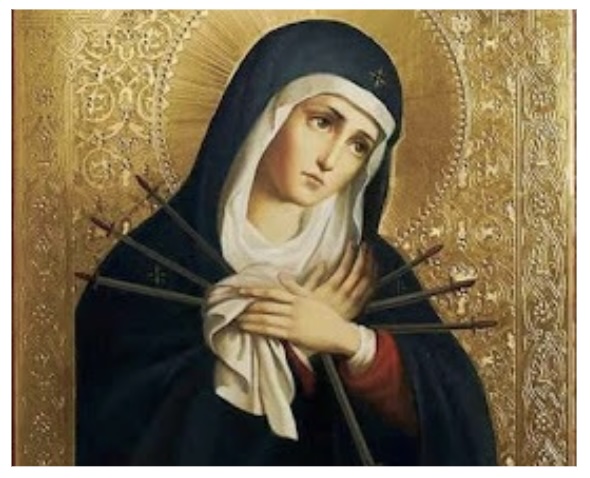
Today we remember the Sorrows of Our Blessed Mother Mary, standing faithfully at the foot of the Cross. This devotion took shape in the thirteenth century, when the Seven Holy Founders of the Servite Order (1232) placed their lives under the protection of the Sorrowful Mother. They promoted devotion to Mary’s Seven Sorrows through the Rosary of Sorrows, the Scapular, and novenas. Later, in 1913, Pope Pius X fixed this memorial on September 15, the day after the Feast of the Exaltation of the Holy Cross, so that Mary’s suffering heart might be remembered alongside her Son’s saving Cross.
1. The reality of suffering
Suffering is part of our human nature. Sometimes we try to spiritualize it (“If I suffer now, God will reward me later”), or to moralize it (“My suffering is punishment for sin”), but in truth suffering is also an existential reality. Just as we experience joy, so too we inevitably experience sorrow. Mary, though sinless, still shared in human pain—reminding us that suffering is not always the result of guilt, but the condition of being human.
Why do we suffer?
Sometimes through our own choices.
Sometimes because of our state of life—our place of birth, culture, or limitations.
Sometimes through social evils like injustice, corruption, or war.
Sometimes through natural disasters like floods, pandemics, or earthquakes.
Sometimes through human tragedies—death, loss, violence.
In short, suffering comes from many sources. But it cannot be avoided.
2. Three responses to suffering
How do we respond? There are three paths:
(a) Fight – trying to deny or resist it. Our culture often teaches us to fight even natural realities like aging, emptiness, or loss.
(b) Flight – running away, escaping into distractions or addictions, like endless entertainment, alcohol, or shallow pleasures. But escape is always temporary.
(c) Face – the true and healthy response. To accept suffering as part of life, to confront it with courage, and to allow it to shape us.
Mary faced her sufferings. Tradition remembers her Seven Sorrows, each one reflecting the pains we too carry:
Simeon’s prophecy – the suffering of waiting and foreboding.
Flight into Egypt – the suffering of uncertainty and exile.
Loss of the boy Jesus in the Temple – the suffering of loss.
Meeting Jesus on the way to Calvary – the suffering of helplessness.
Standing beneath the Cross – the suffering of shame and anguish.
Receiving Jesus’ body – the suffering of unbearable grief.
Placing Him in the tomb – the suffering of emptiness.
These are not abstract mysteries but real life-paths Mary walked, and they mirror our own struggles.
3. Three lessons for our life
From Mary’s sorrows, we draw three lessons:
(a) Suffering is a life reality. Like Mary, we cannot avoid it or explain it away. We must live through it.
(a) Suffering takes our life ahead. It opens us to growth, maturity, and new beginnings. Just as ploughing wounds the soil so that it may receive seed and bear fruit, suffering ploughs our hearts to make us more human.
(c) Suffering is our memory. What remains most in our lives are not pleasures but wounds. Joy fades, but pain etches itself into memory. Yet, these scars become signs of love, of bonds shared, of sacrifices endured.
Dear friends, Mary teaches us not to fight suffering in bitterness, nor to flee from it in denial, but to face it with faith. At the Cross, she shows us that pain embraced with love becomes redemptive, not destructive.
Let us then stand with Mary, our Mother of Sorrows. When life pierces us with its swords, may we remember: “My grace is sufficient for you, for power is made perfect in weakness” (2 Cor 12:9). Amen
Fr. Yesu Karunanidhi
Archdiocese of Madurai
Missionary of Mercy

 Yesu Karunanidhi
Leave a comment