Daily Catholic Lectio
Mon, 4 Aug ‘25
Eighteenth Week in Ordinary Time, Monday
Saint John Mary Vianney, Memorial
Numbers 11:4–15. Matthew 14:13–21
Vianney Empathy and Resilience
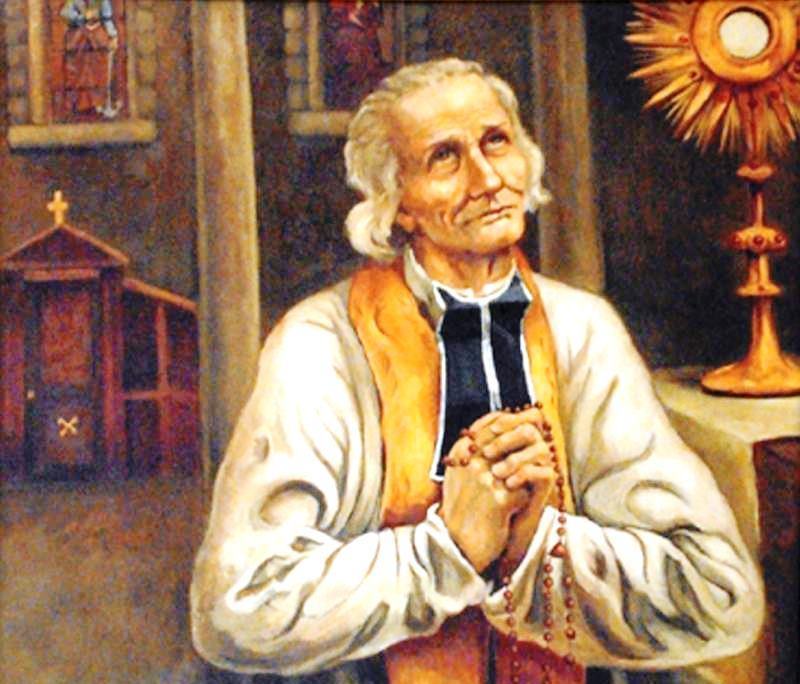
Today we celebrate the feast of Saint John Mary Vianney, the patron of diocesan priests, of all those serving in parish ministry, and indeed, of every priest.
John Mary Vianney
He had no attractive appearance to boast of.
He did not write any timeless book.
He did not present deep theological treatises like Augustine or Aquinas.
He did not found a great order as did Ignatius.
He did not travel across nations proclaiming the Gospel like Francis Xavier.
He did not shed blood for the faith like Sebastian or John de Britto.
He could not read Latin. He was said to be intellectually limited.
In fact, the English dictionary coined the term ‘Vianney Syndrome’ precisely for those with low intellectual abilities, stemming from similar examples.
One of his seminary teachers noted this about him. Among his peers in seminary, nine joined priestly formation together: one became a cardinal, two became bishops, three became professors, three became heads of institutions—but only one became a saint.
He teaches us: “Sanctity lies in simplicity.” “All that is truly beautiful in life is found in simplicity.”
It is a life lesson: whatever is lasting takes time to form. He entered the seminary at the age of twenty. Studies were not easy for him. A classmate, Matthias Loras (then only 12), had to give him personal lessons. Once, frustrated by Vianney’s inability to understand, Loras slapped him in front of everyone. But Vianney, showing no anger, knelt before his much younger peer and asked forgiveness. Loras, moved to tears, embraced him. Later, as Bishop of Dubuque in the United States, Loras remembered the apparent slowness of Vianney’s mind—but also its sanctity.
Even though others called him a “donkey”, Vianney held firm: “This donkey is needed by the Lord.” In a world fascinated by horses, lions, tigers, and elephants, he knew—only the donkey was needed by the Lord.
Lessons I Learn from Him
1. Closing the Ears: Just like the bumblebee, which technically shouldn’t be able to fly by aerodynamic theory—but it does—Vianney ignored all the negative voices. He closed his ears to what others said and opened his heart to the One who called him. He discovered his value beyond his performance.
2. “Priesthood” is Enough: His one identity was enough: “I am a priest, and that is enough for me.” Today, many seek double identities: priest-lawyer, priest-teacher, priest-social worker. But for Vianney, to be a priest—offering Mass, hearing confessions, meeting the people, caring for his health—was more than enough. He embraced and lived that identity fully.
3. Minimalist Thinking, Minimalist Living: His humility showed in his modest thoughts. His simplicity was reflected in his lifestyle. Simplicity, as I understand it, is reducing consumption. The more I consume, the farther I drift from God and others. By thinking less about himself, expecting less, owning less, Vianney built a fulfilled life.
4. Clear Pastoral Plan: His entire pastoral model had just three elements: celebrate the Eucharist, hear confessions, teach catechism. He discerned what people needed and organized himself accordingly. Today, we have many ministries—Masses, catechesis, visits, groups, pilgrimages—but often lack clarity. Vianney challenges us to regain that clarity.
5. Stability: He served in only one place—Ars. Even though the town didn’t welcome him at first, even though the climate didn’t suit him, even though it was far from home, he remained—faithfully—until the end.
6. Transformation Happens Before Our Eyes: He transformed a town addicted to wine, entertainment, and pleasure—with prayer, presence, and a simple life. People came by the trainloads. He saw transformation with his own eyes. He teaches us: when we do not see change, we become discouraged. But change is possible—right before our eyes.
7. Clarity of Purpose: He dreamt of the conversion of Ars. That single dream shaped all his prayers, liturgies, visits, and actions. His people were his only focus.
8. He Understood the Weak: Because he himself struggled, he understood the struggles of others—not just in words but in spirit. He listened not just to words, but to the silence of souls. His eyes pierced through people’s souls, giving them the confidence to say, “Someone is here for me.”
9. A Thorn in the Flesh: His physical ailments were like a thorn that constantly pained him. He neglected his health, didn’t eat well, and needed assistance for even short travel. Yet he deeply experienced the truth of God’s words: “My grace is sufficient for you.”
10. Resilience in Trials: Saint Vianney’s life was marked by unshakable resilience. Despite academic difficulties, frequent health problems, harsh criticism, and spiritual desolation, he persevered with unwavering faith. When temptations to abandon his parish came—especially when he felt unworthy or exhausted—he still returned to Ars, drawn by love for his people and his mission. His resilience was not rooted in self-confidence, but in deep trust that God could work even through his weakness. Vianney teaches us that true resilience lies in remaining faithful amid weariness, holding firm not to success, but to vocation.
In today’s first reading, Moses complains to God about the burden of leadership, as the people grumble. He questions why the entire responsibility is laid upon him. Yet soon, Moses learns: God’s compassion leads His people. In the Gospel, Jesus satisfies the hunger of thousands with five loaves and two fish. It is a miracle of tender care.
Saint Vianney was a sacrament of God’s empathy to His people.
We are proud to call him our patron as diocesan priests.
He is a challenge to us.
His intercession gives us hope.
His life is a model for us.
Fr. Yesu Karunanidhi
Archdiocese of Madurai
Missionary of Mercy
 Yesu Karunanidhi
Leave a comment