Daily Catholic Lectio
Thu, 3 July ‘25
Saint Apostle, Apostle to India – Solemnity
Isaiah 52:7–10. Ephesians 2:19–22. John 20:24–29
The Faith Hyphen
“Have you believed because you have seen me? Blessed are those who have not seen and yet have come to believe.”
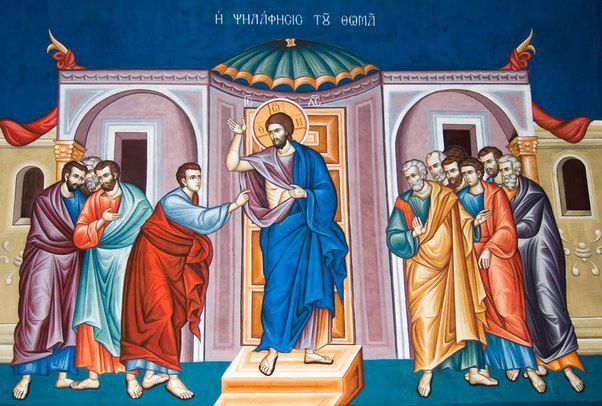
Today, with joy, we celebrate the solemnity of Saint Thomas the Apostle, known as the Apostle of India. It is a profound thought to consider that, through Thomas, our ancestors reached out their hands to touch the wounds of Christ—placing their fingers in His hands and their hands into His side. Saint Thomas is the living link between Jesus Christ and our Indian soil.
After Jesus’ death, the Apostles respond in three ways: Some remain behind locked doors, fearing the Jews, afraid of being punished themselves. Some return to Galilee, to their native places and former occupations, especially fishing. But Thomas chooses a third path: walking among the people, living as one with them.
St. John gives us the most detailed portrait of Thomas. At the news of Lazarus’ death, when the disciples hesitate to go with Jesus back into Judea, Thomas boldly declares, “Let us also go, that we may die with Him” (John 11:16). This is not just foreshadowing Jesus’ death, but it expresses Thomas’ deep desire to stay with Jesus even in death.
Again, after the Last Supper, during Jesus’ farewell discourse, it is Thomas who asks, “Lord, we do not know where You are going. How can we know the way?” (John 14:5). To this, Jesus replies with a powerful statement: “I am the Way, the Truth, and the Life.” The phrase “I am” echoes the divine name revealed to Moses: “I AM who I AM.”
In today’s Gospel reading, the focus is on the word “Lord.” The disciples tell Thomas, “We have seen the Lord.” Thomas, however, responds without even naming Jesus—simply “unless I see the mark of the nails…” But the moment Jesus appears and says, “See My hands,” Thomas surrenders. Without waiting, he confesses: “My Lord and my God!” This is the most personal and profound confession of faith in the Gospels.
Thomas’ journey teaches us that faith must be personal. We cannot live off others’ spiritual experiences—not even those of our parents. Like Thomas, we must encounter Christ ourselves. And that encounter, while not always sensible or visible, is no less real.
In the first reading, the prophet Isaiah proclaims: “How beautiful upon the mountains are the feet of the one who brings good news… who says to Zion, ‘Your God reigns!’”
This passage, often seen as foretelling the Messiah’s arrival, also applies to all those who proclaim peace and salvation. Saint Thomas came to India as such a herald of Good News. Today, Pope Francis invites us not only to preach but to become the Gospel through our lives.
In the second reading, St. Paul speaks of the Church as a building, with the apostles as the foundation. It is through their preaching that believers are joined to Christ the cornerstone. The unity and structure of the Church rest on this apostolic foundation.
In apocryphal writings like the Gospel of Thomas, which is not part of the canonical Bible but offers intriguing insights, Thomas is called Didymus Judas Thomas. The name Didymus means twin, and scholars have explored its possible meanings.
Two reflections arise from this:
(a) Inner Duality: Thomas appears to carry within himself both bold faith and deep doubt. He says, “Let us die with Him” in John 11, yet refuses to believe in Jesus’ resurrection without physical proof in John 20. Faith and doubt live side by side in him—like twins.
(b) Twin of Christ: Some interpretations of the Gospel of Thomas suggest a deeper spiritual metaphor—that Jesus and humanity are like twins. This points to the profound idea that Christ is like us, and we are called to become like Him. The issue is not that it’s untrue—but that we fail to realize it.
Thomas also teaches us:
(a) Asking Questions Is Good: In both John’s Gospel and the Gospel of Thomas, Thomas dares to ask what others might silently wonder. Questioning is part of deepening our faith. It is not lack of belief, but hunger for truth.
(b) Community Matters: When Jesus appeared after the resurrection, Thomas was not with the others. His absence is noted (John 20:24). The community of faith is essential—not only to witness Christ but to share Him.
(c) Be a Wayfarer: In verse 42 of the Gospel of Thomas, Jesus says: “Be passersby.” This means: carry nothing, cling to nothing, live lightly, walk purposefully. A traveller burdened with too much or distracted by many things will not reach the goal.
Let us remember that Saint Thomas entrusted us with the Gospel. We, in turn, are now entrusted with bearing witness to that Gospel in word and life.
Fr. Yesu Karunanidhi
Archdiocese of Madurai
Missionary of Mercy
 Yesu Karunanidhi
Leave a comment