Daily Catholic Lectio
Tue, 1 July ‘25
Thirteenth Week in Ordinary Time – Tuesday
Genesis 19:15–29. Matthew 8:23–27
By Him, We Shall Live!
“Lord, save us! We are perishing!”
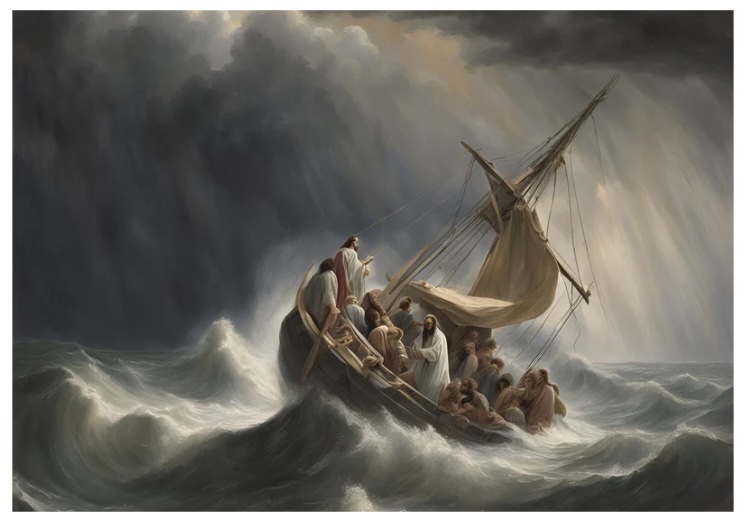
Today’s Gospel presents a miraculous event where Jesus exercises divine power over nature. Through this episode, His authority over wind and sea is vividly revealed. The sea is stormy, the disciples are terrified, and Jesus is asleep.
Symbolically, the boat may represent the Church, and the sea the trials faced by the early Church. Jesus’ sleep may be seen as His seeming absence in times of struggle. The disciples grow fearful and wake Him. Jesus rebukes both the sea and the disciples. Their fear gives way to awe: “Who is this man?” they ask.
They feared the waves, thinking they would die. But they didn’t rejoice in Jesus, through whom they were going to live. That was their struggle. Their focus was on the problem, not on the Lord. What about us? Do we fix our eyes on the storm or on the Savior?
In the first reading, Abraham’s hospitality brought him the gift of a son; in contrast, Lot’s hospitality to God’s messengers saved his family from destruction. Because of Sodom’s grave sin, God rains down fire and brimstone. Lot and his family are saved. But his wife, who turns back to look at the city, becomes a pillar of salt. Around the Dead Sea, many salt pillars exist, and some scholars believe this narrative reflects the origin of one such formation.
The message of the reading is this: even when destruction surrounds us, the Lord’s love will save those who trust in Him.
Anxiety—this is a sickness that afflicts many of us today. Its root is urgency. But where does this urgency come from—mind or body? Apart from physical needs like hunger or pain, urgency is often a matter of the heart and mind.
Anxiety, then, is the gap between the mind and the body. Imagine I must speak at a seminar at 11 a.m., but I feel anxious at 10 a.m. It means my mind is already at 11, while my body is still at 10. The mind pushes: “Hurry up!” But the body moves only second by second. This helplessness between the two creates anxiety.
The disciples and Jesus are in a boat—likely the Sea of Tiberias, known for its calm or gentle waves. Most disciples were fishermen, skilled in navigating such waters. Jesus, a carpenter, would seemingly be the least experienced. Yet He sleeps peacefully, while the fishermen panic.
Why? Their minds had already imagined death. Their bodies were still in the boat, but the mental leap to fear created a gap—anxiety—that shook them. They cried out, “Lord, save us! We are perishing!”
This cry during the storm reveals their spiritual immaturity. Fear exaggerated their reality.
Yet Jesus, calm and composed, simply asks, “Why are you afraid, O you of little faith?”
While the disciples experience urgency, fear, anxiety, and dread of death, Jesus alone remains at peace.
In the first reading (Genesis 19:15–29), after rescuing Lot’s family from Sodom, God sends fire and sulphur upon the city. He commands them: “Do not look back.” But Lot’s wife disobeys and is turned into a pillar of salt.
Why did she look back? Out of curiosity? To confirm if the destruction was real? To see if someone was following her?
We don’t know. Perhaps her panic, fear, or urgency made her turn. In anxiety, we often look back—physically and emotionally. Perhaps the disciples in the boat, too, turned back in fear, glancing toward the safety of the shore.
May we turn our gaze from the storm to the Saviour,
From panic to peace,
From fear to faith.
Fr. Yesu Karunanidhi
Archdiocese of Madurai
Missionary of Mercy
 Yesu Karunanidhi
Leave a comment