Daily Catholic Lectio
Sun, 15 June 2025
Solemnity of the Most Holy Trinity
Proverbs 8:22-31. Romans 5:1-5. John 16:12-15
Why God? My God!
When we meet someone, especially a friend, we usually ask, “How are you?” But imagine asking, “Why are you?”—such a question might startle or confuse. In science labs, we discover how things work. Ask, “How is water formed?” and you’ll get an answer: “Two parts hydrogen, one part oxygen.” But ask, “Why is water formed?” and we fall silent.
That’s the limit of human and physical sciences: they answer the “how,” but not the “why.”
When it comes to God and the divine realm, it’s the other way around. There are no clear answers to “how,” only responses to “why.”
You can ask: “Why the Ascension?” not “How?” “Why the Eucharist?” not “How?” “Why the Trinity?” not “How?”
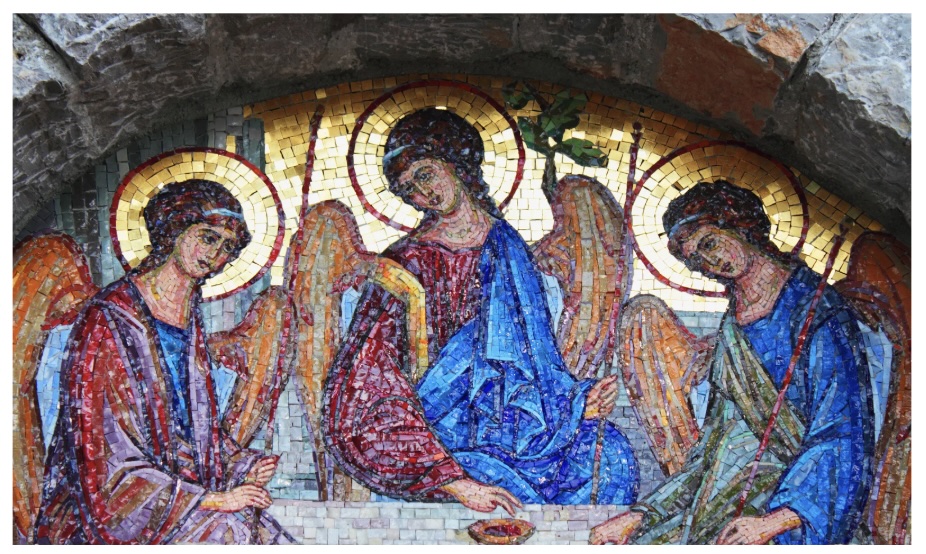
Today, we celebrate the Solemnity of the Most Holy Trinity.
The opening prayer of today’s Eucharist declares: “As we profess the true and eternal glory of the Trinity, and adore the unity of the three Persons, we acknowledge the equal majesty, undivided in splendour.”
Even such solemn liturgical declarations do not exhaust the depth of this mystery.
During my theology studies in Pune, a professor began explaining the Trinity. A student interrupted, “Father, the Trinity is something we can never truly understand. What difference does it make if God is three Persons or four? What does it matter?”
Indeed, our minds try to wriggle out of complexity with the same question: “What does it matter?”
The terms “Father, Son, and Holy Spirit” are themselves increasingly challenging in today’s world. They suggest masculine imagery. Can we really confine God within gender?
Furthermore, “Trinity” is best understood as a working model—a pointer, not the reality itself.
Just as students build a model mixer with a toy blade and motor, it looks impressive, but you can’t grind chutney with it!
Similarly, saying “The Father loves the Son” might be hard for someone whose own father never showed love. That person may not relate to God as a loving Father.
We use many images for the Trinity—clover leaf, water-ice-steam, father-mother-child, heat-light-radiation—but even with scriptural references, the Trinity remains a mystery.
So instead of asking “How is God three?”, let’s ask “Why is God?” or more personally, “Why is my God three?”
Do we need God today? Can we live without God?
We come to feel the need for God in three ways:
(a) Our Finite Experience: Say I can lift only 50 kilos, but am suddenly forced to lift 60. Instinctively, I cry for help—beyond my strength lies the need for God.
(b) Loneliness: Animals don’t fear being alone—they fear predators. But we humans feel lonely even in crowds. In Genesis, God says it is not good for man to be alone. Though Eve is created as a companion, God ultimately is the one who dispels our deepest loneliness.
(c) Memory: Our image of God is often shaped by memory—either personal or communal. Parents pass on what God meant to them. That memory creates and sustains our faith. Without memory, we would not even know ourselves—how then could we know God?
So, our experience of limitation, our ache of loneliness, and our shared memory all push us toward the mystery we call God.
The evangelist John says: “No one has ever seen God; it is God the only Son, who is close to the Father’s heart, who has made him known” (John 1:18).
Thus, we move from the visible Christ to the invisible God. But this brings more questions:
Was Christ crucified in his humanity or in his divinity? If in his humanity, was he not God?
If in his divinity, did one Person of the Trinity die? Or all three? These are not new questions—think of Arius and the early Church debates. So yes, knowing the Trinity through Jesus can also be challenging.
Today’s readings offer three key dimensions of the Trinity:
(a) Relational Interdependence (Proverbs 8:22–31)
“Lady Wisdom,” speaking of her origins, tells us she was there from the beginning. She shaped the world, bringing order to chaos. She was beside God as a master craftswoman. This is the creative aspect of the Father—God’s inner Wisdom co-creating. Just as a spider spins silk from within itself to make its web, so too God’s wisdom emerges from Godself. Wisdom is not separate from God—it is the very expression of God’s creative nature.
(b) Restorative Reconciliation (Romans 5:1–5)
Sin destroys the harmony of creation. Relationship with God breaks. Paul speaks of justification—being restored to favour. Through Jesus, we are reconciled to God and others. Jesus overcomes the estrangement sin causes, replacing fear with hope and hostility with peace. He re-establishes communion.
(c) Interior Illumination (John 16:12–15)
The Holy Spirit leads us into all truth. He glorifies Christ and indwells the human heart. The Spirit turns us inward—not to introspect endlessly, but to recognize the divine image within others and ourselves.
So what does the Trinity teach us for daily life?
(a) From Dominance to Mutuality: Many relationships today, especially among youth, are marked by possessiveness, anxiety, and control. In marriage, family, friendships—we tend to assert: “This is mine.” Trinity invites us to mutuality, not ownership.
(b) From Alienation to Communion: Technology brings us close, but often isolates us more. We need to rediscover nearness of the heart, not just the screen. Jesus removes barriers and restores communion.
(c) From External Judgments to Inner Seeing: Despite surface differences, the same God dwells within us all. “Tat Tvam Asi” says the Upanishad: That Thou Art. When I meet someone, the God in me greets the God in them.
Ultimately, the mystery of the Trinity is not about explaining God, but discovering ourselves. If I keep chasing myself around a tree, no matter how fast I run, I’ll never catch myself—because the one I chase is the one I am.
So too, every attempt to grasp the Trinity helps me understand who I am and how I relate to others.
The question “Why God?” slowly becomes “My God.” And in that discovery, we realize:
The Trinity is not just about God. It is about you and me.
Fr. Yesu Karunanidhi
Archdiocese of Madurai
Missionary of Mercy
 Yesu Karunanidhi
Leave a comment