Daily Catholic Lectio
Pentecost Sunday – Solemnity
Acts 2:1–11. Romans 8:8–17. John 14:15–16, 23–26
Life according to the Spirit
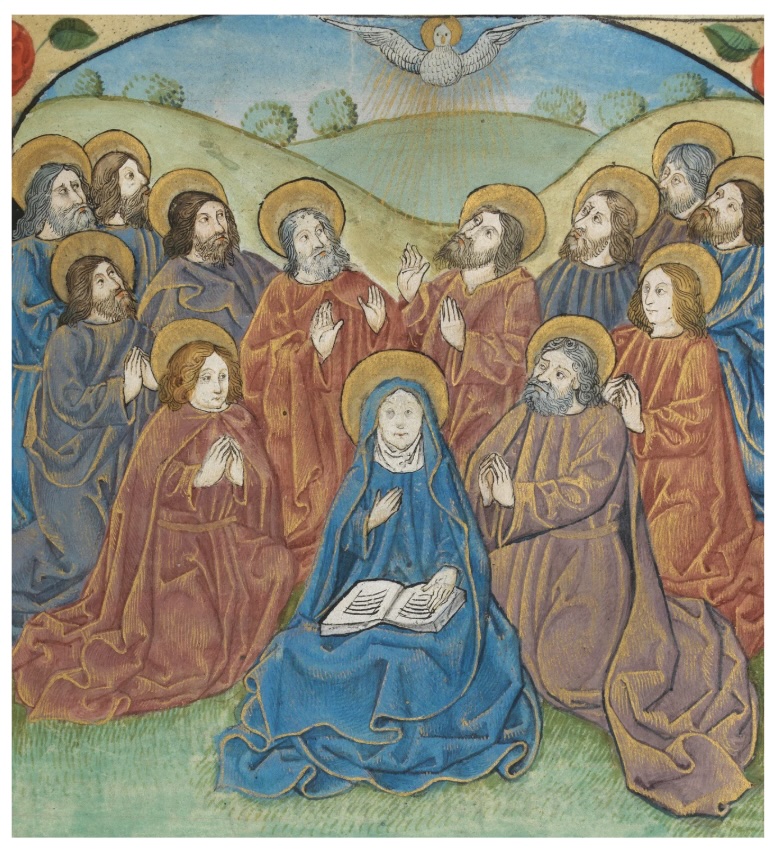
Today, our Holy Mother Church celebrates the solemnity of the Pentecost—her own birthday. On this day, the divided tongues came down to unite a divided humanity. Ironically, today, the very name of the Holy Spirit has become a cause for divisions within the Church and among separated communities.
The feast of the Holy Spirit raises many questions for us:
(1) How should we address Him—Holy Spirit, or the Holy Spirit of God?
(2) The Catholic Church teaches that the Holy Spirit is the bond of love between the Father and the Son, even likened to the relationship among husband, wife, and child. But does likening the Spirit to the “child” imply inferiority?
(3) Saying “The Father created, the Son redeemed, the Spirit sanctifies” is a helpful summary, but still insufficient to explain the fullness of the Spirit.
(4) Pentecostal groups today often reduce God to the Holy Spirit alone—wearing white, banning flowers or jewellery, asking intimidating questions like, “Have you received the baptism of fire?”
(5) A small segment within our Church, calling themselves charismatics, propose alternate forms of worship under the guise of renewal, which sometimes challenge our liturgical traditions.
We are reminded of the question Paul encountered in Ephesus: “We have not even heard that there is a Holy Spirit” (Acts 19:1–10). Before we understand the meaning of Pentecost, we must first understand who the Holy Spirit is. Scripture uses four broad understandings of the Spirit:
(1) The Spirit of the Lord: In Hebrew, Ruach is translated as ‘spirit’ or ‘breath.’ This is the same Spirit who hovered over the waters at creation (Gen 1:2), who was breathed into Adam, who came upon kings and prophets, who descended on Jesus at His baptism, and whom Jesus proclaimed in the synagogue, saying, “The Spirit of the Lord is upon me.”
(2) The Spirit of Jesus: After His resurrection, Jesus breathed on His disciples and said, “Receive the Holy Spirit” (John 20:22). Here, the Spirit is presented as the gift of the Risen Lord.
(3) The Third Person of the Trinity: During the Last Supper, Jesus promises to send the Advocate who will teach and remind His disciples (John 14–16). Paul concludes 2 Corinthians with the Trinitarian blessing (2 Cor 13:13), affirming the Spirit as a divine person alongside the Father and the Son.
(4) The Life in the Spirit: In Pauline theology, especially in Galatians 5:16–26, Paul contrasts life “according to the flesh” with life “in the Spirit,” presenting the Spirit not only as a divine person but as a mode of being—a spiritual disposition available to each believer.
To discern rightly between these theological models, we indeed need the guidance of the Holy Spirit!
Before reading today’s first reading (Acts 2:1–11), let us compare the Old and New Testament understandings of the Spirit:
In the Old Testament: (a) The Spirit was for a select few—mainly kings and prophets, not ordinary people. (b) The Spirit was conditional—it could be given or withdrawn, as with Samson or Saul. (c) The Spirit was understood as a force, not a person.
In contrast, today’s first reading reverses all three: (a) The Spirit is poured out on all, including Mary and the disciples, and later on all the believers. (b) The Spirit is unconditional and permanent, a seal that remains even in our weakness. (c) The Spirit is a person, not a mere power—one who enables us to cry out, “Abba, Father!”
Why did God choose Pentecost as the day of this outpouring? Five reasons from history:
Pentecost (Greek for “fiftieth”) was a Jewish harvest feast—giving thanks for the first fruits. The apostles, too, received the Spirit as first fruits of the new creation. It commemorated the giving of the Law to Moses on Sinai. While the old law was written on stone, the new law of the Spirit is written on hearts (cf. Jer 31:33). Just as Moses ascended the mountain, so now Jesus ascends to the Father and sends the Spirit. Rabbinic tradition (Tanchuma 26) says Moses’ words were heard in 70 languages. At Pentecost, each person hears the apostles in their own tongue. The Spirit reverses Babel (Gen 11:1–9)—where one language became many, Pentecost unites many into one.
The Spirit empowers the apostles in two ways: (a) Their tongues are loosed—they speak in new languages, no longer constrained by fear. (b) Their doors are opened—those who once hid in fear now step into the world with boldness.
In today’s second reading, Paul presents the inner contrast between flesh and spirit, calling us to live not by the flesh that leads to death, but by the Spirit that brings life.
In the Gospel, Jesus promises the Spirit as Teacher and Reminder—who will guide His followers into truth and remembrance.
How do we apply all this theological reflection to daily life?
Think of it simply: We are alive because of the breath within us. We cannot locate it precisely—is it in the lungs, the blood, the brain? But when breath departs, movement ceases. Likewise, the Holy Spirit is our breath—unseen but essential.
Just as we often forget we are breathing, we forget the Spirit’s presence in us.
Finally, Galatians 5 contrasts the works of the flesh—immorality, hatred, division, jealousy, drunkenness, deceit—with the fruits of the Spirit: love, joy, peace, patience, kindness, goodness, faithfulness, gentleness, self-control (Gal 5:22–23).
The Holy Spirit is alive wherever these are found. “If we live by the Spirit, let us also walk by the Spirit.” (Galatians 5:25)
Fr. Yesu Karunanidhi
Archdiocese of Madurai
Missionary of Mercy
 Yesu Karunanidhi
Leave a comment