Daily Catholic Lectio
Sun, 1 June ‘25
Solemnity of the Ascension of Our Lord
Acts 1:1–11. Hebrews 9:24–28, 10:19–23. Luke 24:46–53
God for Us!
“The Lord Jesus, King of Glory,
Victor over sin and death,
ascended to the heights of heaven,
leaving even the angels in awe.
Not to distance Himself from our lowliness,
but to give us the hope
that we, His members,
may follow where our Head has gone before.”
These words of Saint Augustine, found in today’s Preface, beautifully capture the essence of this feast.
Luke had already begun the narrative arc with this line: “As the time approached for Him to be taken up to heaven, Jesus resolutely set out for Jerusalem” (Luke 9:51). The culmination of Jesus’ life is His ascension.
Yet, three hurdles prevent us from fully embracing and understanding the mystery of the Ascension:
Obstacle 1: Jesus’ Body
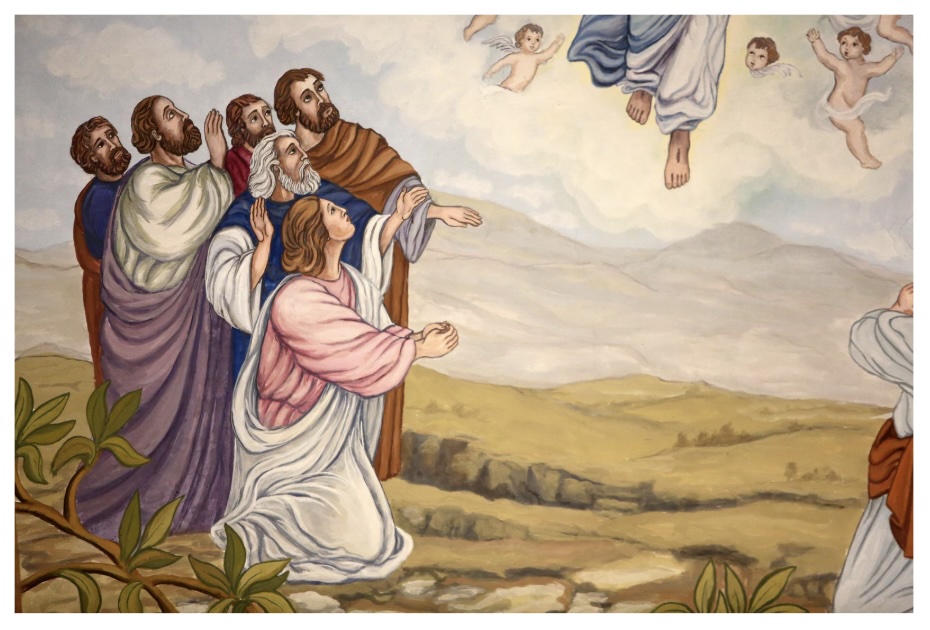
Jesus was born, grew, ate, was lost, was found, walked, spoke, laughed, wept, died, and rose again in a human body. Even after rising, He did not return merely as a spirit but in the same body. He told the disciples to touch Him, ate food, walked with them, and broke bread. But what happened when He ascended? Did He rise bodily into heaven? The Church of the Ascension in Jerusalem preserves two footprints said to be His. Did He defy gravity like a rocket and pass into outer space? What does a human body do in a realm where the Father and Spirit have no physical bodies? Does He still bear His wounds? These questions make Jesus’ body itself a stumbling block to our understanding of the Ascension.
Obstacle 2: Time and Space
Mark writes that Jesus “was taken up into heaven and sat at the right hand of God” (Mark 16:19) and immediately adds, “Then the disciples went out and preached everywhere, while the Lord worked with them” (16:20). How can the same Jesus who sits beyond time and space still accompany the disciples in real time? Is His presence with them literal or spiritual? Is it like the feeling of a deceased loved one’s continued presence? This paradox presents a second obstacle.
Obstacle 3: Those Who Saw Didn’t Write, Those Who Wrote Didn’t See
Only Mark and Luke record the Ascension. Matthew, whose Jesus is “Emmanuel—God with us,” keeps Him present with the disciples forever (Matt 28:20). John, the beloved disciple and likely eyewitness, makes no mention of the event. He records even the smallest post-resurrection dialogues, yet remains silent on this key moment. Moreover, Luke provides two different timelines: in the Gospel, Jesus ascends on the day of Resurrection (Luke 24:51); in Acts, 40 days later (Acts 1:9–11). These textual tensions raise questions about chronology and historicity.
Interestingly, Luke uses two different verbs for the same event—ἀναφέρω (to be lifted up) and ἐπαίρω (to be taken up)—suggesting a divine passivity rather than a self-willed ascent.
So, how do we make sense of this mystery with so many complexities?
By changing the question. Instead of asking, ‘how is ascension,’ let us ask, ‘why is ascension.’
Threefold Significance of the Ascension
(a) Jesus returns to the Father’s house after His earthly mission (cf. Phil 2:3–6).
(b) Jesus entrusts His mission to the disciples. Like the farewells of Jacob (Gen 49–50), Moses (Deut 33–34), and now Jesus (Acts 1:1–11), this farewell involves a final blessing, instruction, and transfer of mission.
(c) Jesus promises the Holy Spirit to empower their ministry (Acts 1:4–5).
The Ascension is a theological mystery, comprehensible only through faith. Without faith, this event stands disconnected from our lives.
So how do we live the meaning of the Ascension?
Lesson 1: To be divine is to be hidden
Just as Jesus needed a body to become man, He needed to ascend to be revealed as God. What is invisible is often most enduring. As Paul writes, “Now we see only a reflection as in a mirror; then we shall see face to face” (1 Cor 13:12). The moment Jesus ascends, the disciples bow down in worship—a gesture reserved only for God. His hiddenness reveals His divinity.
Lesson 2: The Mission of the Disciples
Today’s Gospel highlights two tasks for the disciples: repentance and forgiveness. And He says, “You are witnesses to these things” (Luke 24:48; Acts 1:8). A witness reflects the mind of the one they represent. Discipleship, then, means bearing witness to God’s mercy and compassion. Like a baton in a relay race or the Olympic torch, this mission now passes from Jesus’ hands to ours—a grace and a responsibility. “Anyone who competes as an athlete does not receive the victor’s crown except by competing according to the rules” (2 Tim 2:5).
Lesson 3: Hope
“This same Jesus will come back” (Acts 1:11). That hope should animate every choice and action in our lives. Every journey, study, job, vocation—all are shaped by an inner hope. Among all hopes, one reigns supreme: “He will return,” and “We will be with Him.” We are not made for dust but for heaven. So may our gaze always be lifted upward, and our thoughts noble (Col 3:1).
Lesson 4: Stop Looking Up into the Sky!
“Men of Galilee, why do you stand here looking into the sky?” (Acts 1:11). Spirituality is not found in idle stargazing. It’s found in faithful, grounded living.
Lesson 5: Joy
Luke ends his Gospel saying the disciples were “filled with great joy” (Luke 24:52)—the same phrase the angels used at His birth: “Good news of great joy” (Luke 2:10). Christ’s entire life—birth, ministry, resurrection, and ascension—offers one gift: joy. Let this joy fill our hearts and homes, that everything we do may reflect His glory.
“Out of love for us, He came down from heaven;
Today, though He ascends alone,
We ascend with Him in grace,
For we are united with Him.”
—Saint Augustine
Jesus who descended as “God with us” now ascends as “God for us.”
Fr. Yesu Karunanidhi
Archdiocese of Madurai
Missionary of Mercy
 Yesu Karunanidhi
Leave a comment