Daily Catholic Lectio
Sat, 31 May ‘25
Visitation of the Blessed Virgin Mary, Feast
Zephaniah 3:14–18. Luke 1:39–56
Joy
The Feast of the Visitation originated in the 13th century and was initially celebrated on July 2. It was later moved to May 31 to fall between the Annunciation (March 25) and the Nativity of John the Baptist (June 24), marking a fitting place in the liturgical rhythm.
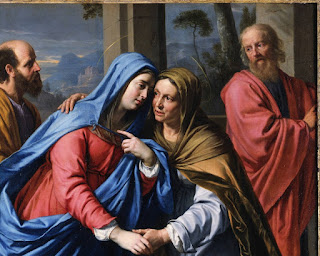
At the very moment the Angel departs from Mary after the Annunciation, Mary too departs—this time not inwardly but outwardly, stepping beyond her door with haste and purpose. Luke records: “Mary set out and travelled to the hill country in haste to a town in Judah.” From the instant Jesus begins to dwell in her womb, she begins to move—her life becomes one of mission. She does not run toward the Temple in Jerusalem or to the Sanhedrin, but to her kinswoman in need—Elizabeth.
The Annunciation radically transforms Mary: the humble young girl of Nazareth becomes the Mother of the Most High. Her desire is no longer to fulfill her own will, but the will of God. This leads her to action, to haste, to service—carrying the divine presence not for her own glory, but for the joy of others.
When Christ begins to take shape within us, we too cannot remain still. We are drawn out of our comfort zones, beyond our personal needs, into a life of service and giving.
Mary’s journey to Elizabeth becomes a symbol of her life’s journey: from Nazareth to Bethlehem, to Egypt, back to Nazareth, to the Temple in Jerusalem, to Cana, to Calvary—always moving, always bearing Christ, always responding to the needs of others. And it all begins with this journey to Elizabeth.
Though she is the Mother of God, Mary departs in humility. She goes not to be served, but to serve. Her humility and love propel her forward. St. Francis de Sales observed that it was Mary’s love and humility that compelled her to seek Elizabeth.
Mary shows remarkable clarity of purpose—without distraction or hesitation. Upon reaching Zechariah’s house, she greets Elizabeth with joy and sincerity. Her words are so authentic and grace-filled that they reach even the child in Elizabeth’s womb.
Luke notes that “Elizabeth was filled with the Holy Spirit.” Just as Mary was filled with the Holy Spirit at the moment of the Annunciation, she now becomes a bearer of that same Spirit, passing it on—like one candle lighting another.
Elizabeth blesses Mary, and Mary in turn glorifies God. When we are praised, if our gaze turns not to ourselves but to God, how beautiful that response would be! Mary’s entire life is a reflection of divine grace, and her faith-filled vision of reality is deeply inspiring.
Mary remains with Elizabeth for about three months before returning home—a subtle yet profound life lesson: all journeys begin with the intention to return. No destination becomes our home. There is always a place, a heart, a home to which we must return.
Above all, joy permeates the entire narrative—from the child leaping in the womb, to the inspired Magnificat. This joy is not shallow, but deep, contagious, and divine.
May this joy embrace each of us today!
Fr. Yesu Karunanidhi
Archdiocese of Madurai
Missionary of Mercy
 Yesu Karunanidhi
Leave a comment