Daily Catholic Lectio
Sun, 11 May ‘25
Fourth Sunday of Easter
Acts 13:14, 43–52. Revelation 7:9, 14–17. John 10:27–30
The Sheep and the Shepherd: He and I
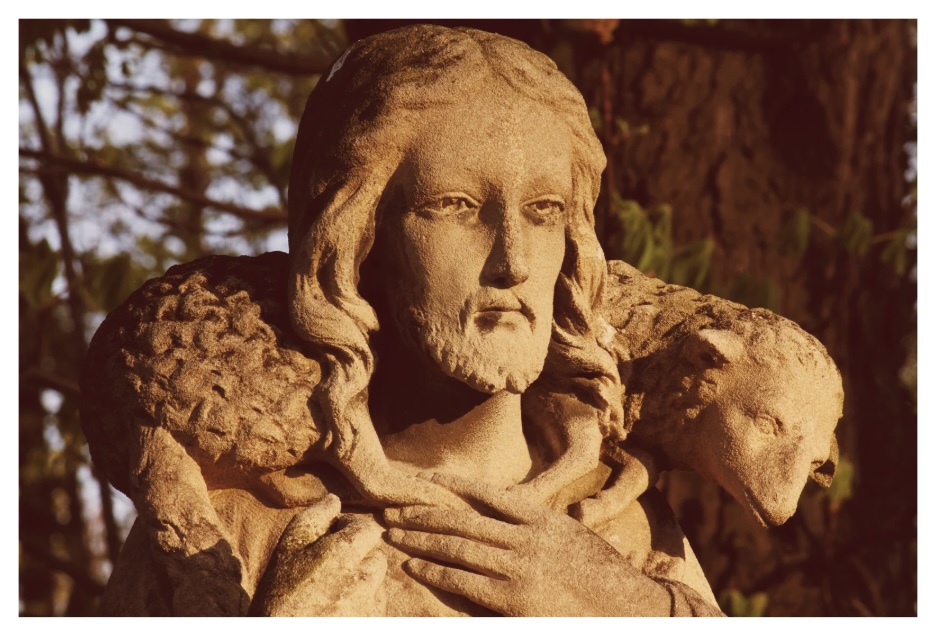
The Fourth Sunday of Easter is traditionally celebrated as Good Shepherd Sunday. It is also observed as the World Day of Prayer for Vocations—to priesthood and consecrated life. On this day, we especially pray that the Lord may raise up men and women after His own heart to shepherd His people, and that those already serving may draw strength from the Good Shepherd, Jesus Christ.
We thank God for the new universal shepherd of the Catholic Church, our Holy Father Pope Leo XIV. Let us continue to pray for his ministry, that in him the world may witness the importance of dialogue and peace.
Today’s three readings are bound together by three key words: knowing, listening, and following.
The Gospel passage today comes from the tenth chapter of the Gospel of John. In this discourse, Jesus uses two metaphors: the sheepfold (vv. 1–6) and the shepherd (vv. 1–18). These metaphors disturb His Jewish audience, especially the use of the term “shepherd,” traditionally reserved in Scripture only for Yahweh (cf. Psalm 23). Because of this discomfort, many resist Jesus’ self-revelation (John 10:19–21). Some, however, wonder: could this be the Messiah? (John 10:22–26). It is in this context that Jesus says: “You do not belong to my sheep… My sheep listen to my voice, I know them, and they follow me” (John 10:26–27).
1. Knowing
In Greek, the word ginōskō (“I know”) is used in the New Testament in different contexts. In the Old Testament, the Hebrew equivalent (yada) carries three meanings:
(a) To know intimately – as in conjugal union: “Adam knew Eve” (Genesis 4:1), or Mary’s words: “I do not know man” (Luke 1:34).
(b) To understand – Paul says, “I do not understand what I do” (Romans 7:15).
(c) To be familiar with, or to be near – especially in John 10, where Jesus’ knowing is about intimacy and belonging, not mere intellectual knowledge.
Languages like Italian distinguish between “to know a fact” (sapere) and “to know a person” (conoscere). The first is of the mind, the second is of the heart. For example, knowing where Zambia is located or who beat Sachin Tendulkar’s record does not change your life. But knowing where your mother is when you are crying as a child—that knowledge changes everything.
Thus, when Jesus says, “I know my sheep,” it’s not about knowing their names or behaviour but being profoundly close to them. Like a mother knows her child—not by fact, but by love.
2. Listening
In the biblical tradition, especially Deuteronomy 6:4—“Hear, O Israel!”—the word “listen” means both to hear and to obey. The Greek verb akouō is used in both senses.
Jesus says, “Whoever hears my word and believes in him who sent me has eternal life” (John 5:24). At the Transfiguration, the Father declares: “This is my beloved Son. Listen to Him!” (Matt 17:5).
Listening isn’t just about the ears; it’s about discerning, receiving, and responding. It’s more demanding than seeing because we can shut our eyes with ease, but to truly close our ears requires great effort. We must train our mind to choose what to listen to.
Sheep are known to rely more on hearing than sight. They recognize the shepherd’s voice even from a distance. Their safety depends on it.
3. Following
The Greek word akoloutheō (to follow) is central in John’s Gospel. The first disciples follow Jesus (John 1:40), and at the end, Jesus says to Peter, “Follow me” (John 21:19).
To follow is to become a disciple. In John’s language, knowing is the shepherd’s task. Listening and following are the sheep’s response.
And what happens to the sheep that listen and follow?
(a) They receive eternal life – which in John’s Gospel often means abundant, full, divine life even now.
(b) They will never perish – neither by their own weakness nor by external threats.
(c) No one can snatch them away – from Jesus’ hand, nor from the Father’s hand.
This double assurance—held by both Son and Father—is a powerful image of divine protection. The Shepherd guarantees the sheep’s needs: nourishment, healing, and safety.
In the second reading (Revelation 7), John sees the Lamb—a shepherd figure—and those who have washed their robes in His blood. They are protected from hunger, thirst, and harm. Again, nourishment, healing, and safety.
Jesus concludes, “The Father and I are one.” This oneness is not just similarity but unity. Not imitation, but integration. We are not asked to be like Jesus, but to be one with Him.
Practical Reflections
(a) If we stop listening, He may seek a new flock. Like Paul and Barnabas, who turn from the Jews to the Gentiles when their message is rejected. If we are God’s sheep but ignore His voice, we risk losing our Shepherd.
(b) Knowing, listening, and following have been replaced with Facebook, WhatsApp, and Twitter (X). We ‘know’ people by profiles, ‘hear’ them on status updates, and ‘follow’ them online. But are we spiritually connected with Christ? Do I know God beyond my childhood catechism? Do I hear His voice in life’s storms? Do I follow Him only in crisis—or every day?
(c) Jesus fulfils His promise of food, health, and safety. Do the ‘shepherds’ we choose in family, politics, or leadership do the same? When politicians come seeking our vote, can they truly say like Christ, “The Father and I are one”?
(d) Eternal life = lasting joy. After Paul and Barnabas preach, the people rejoice. Not all preaching brings joy. But the Good Shepherd’s voice plants joy deep in the soul.
(e) For those discerning priesthood or consecrated life, the voice we first heard on day one of discernment may fade. Many distractions surround us. We must nurture the voice that first called us, lest we lose our way.
Let us then listen carefully, follow willingly, and remain ever close to the Shepherd who knows us and never lets us go.
Fr. Yesu Karunanidhi
Archdiocese of Madurai
Missionary of Mercy
 Yesu Karunanidhi
Leave a comment