Daily Catholic Lectio
Tue, 25 March ‘25
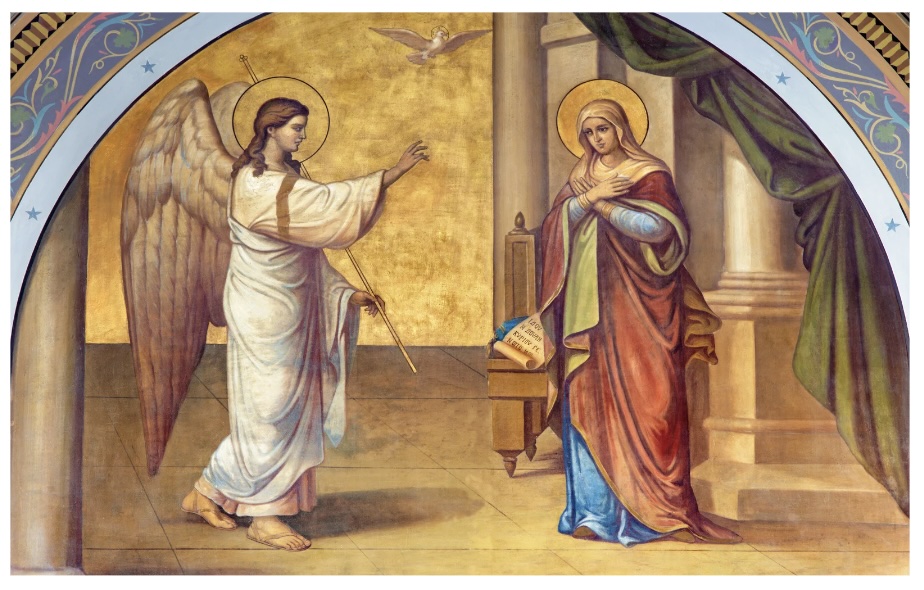
Annunciation of the Lord, Solemnity
Isaiah 7:10–14, 8:10b. Hebrews 10:4–10. Luke 1:26–38
According to Your Word
The Solemnity of the Annunciation to the Blessed Virgin Mary is known in older liturgical calendars by various titles: “The Feast of the Incarnation,” “The Conception of Christ the Redeemer,” or “The Lord’s Announcement.” Some Eastern Churches celebrate this feast on December 26. It likely began after the Council of Ephesus (AD 431). Pope Gelasius I (496 AD) is one of the first to mention it in writing.
In early Christianity, there was a search to determine the date of Jesus’ death. March 25 was identified as the day of the Lord’s death, and based on that, it was believed that the Incarnation (conception) also happened on the same day. Early Christian liturgical texts (as early as 568 AD) say that March 25 was also the day Adam was created, the day of the crucifixion, the crossing of the Red Sea, and the offering of Isaac as a sacrifice.
Later, the Ambrosian liturgy decided this feast should not be celebrated during Lent but on the last Sunday of Advent. The Armenian Church celebrates it on the eve of the Feast of the Transfiguration. Today, it is commonly accepted that this feast is celebrated exactly nine months before Christmas, the birth of Christ.
Just as in the beginning of creation God said, “Let there be light,” and light came to be—His word and action were one—so too here: the angel declares, “You will conceive and bear a son,” and immediately conception takes place. This is why Mary responds, “Let it be done to me according to your word.” The word and the event occur simultaneously.
What does this solemnity teach us?
(a) God’s nearness
The eternal God—beyond time and space—chooses to enter into time and space. The God who is “with us” draws near. In today’s First Reading, we hear the prophecy of Emmanuel (“God with us”). As soon as the Lord declares, “A virgin shall conceive and bear a son,” He fulfils that promise. This day assures us that God is near to us.
(b) Self-surrender
The Lord Jesus offers Himself for the salvation of humanity. He declares, “Here I am!” and takes on human form. Likewise, the Blessed Virgin Mary also responds with similar self-surrender: “Let it be done to me.” In doing so, she allows God to act in and through her.
Both Jesus and Mary exemplify a spirit of readiness. We, too, must be ready to fulfil God’s will.
(c) A new creation
Adam was the head of the first creation. Christ is the head of the new creation. When the angel declares, “Nothing is impossible for God,” Mary begins to see all things through God’s eyes.
The new creation is made possible for us through Christ.
In the light of this feast, known also as the Feast of the Good News, let us reflect on the words we speak. Let us speak only words that can become action. Let our words be words of blessing.
Just as God called Mary to a new mission, He is calling each of us too. May we offer a response worthy of that call.
Fr. Yesu Karunanidhi
Archdiocese of Madurai
Messenger of Mercy

 Yesu Karunanidhi
Leave a comment