Daily Catholic Lectio
Sun, 23 March ‘25
Third Sunday of Lent
Exodus 3:1–8, 13–15. 1 Corinthians 10:1–6, 10–12. Luke 13:1–9
Urgency of Conversion and God’s Patience!
One of the most essential calls of Lent is “conversion” “or “repentance” or “transformation of heart.” In today’s Gospel, Jesus Himself emphasizes its urgency: “Unless you repent, you will all perish as they did!”
Some people come to Jesus and inform Him of a tragedy: “Pilate has slaughtered Galileans while they were offering sacrifices.” Behind this message lie two commonly held assumptions:
(a) All those who die tragically must be sinners
That is, long life is seen as a gift given only to the righteous, while those who die young or suffer misfortunes—sickness, early death, physical disability—are punished for their sins. This was a prevailing mindset of that time. In the same line, for example, when Jesus encounters a man born blind, His disciples ask: “Rabbi, who sinned, this man or his parents, that he was born blind?” (cf. John 9:2).
(b) Sacrifices are useless
The people who bring this news subtly suggest that offering sacrifices has no value – and indirectly God has no value! The Galileans were killed while offering sacrifices—why didn’t God save them? The implication is that God is either powerless or absent. This kind of pragmatic fatalism is also found in the Book of Ecclesiastes: “The same fate befalls both those who sacrifice and those who do not” (Eccl. 9:2).
Jesus challenges both these assumptions. He shifts the focus from sin and fate to the urgency of repentance or conversion.
Jesus illustrates with another incident: “The tower in Siloam fell and killed eighteen people.” He clarifies: Those who die by violence or disaster are not necessarily greater sinners. These events should serve as warnings to us all.
What is the lesson?
Life is brief. Our time is limited. Anything can happen to us at any time. Therefore, we must repent now. We must turn our hearts toward God now—not later.
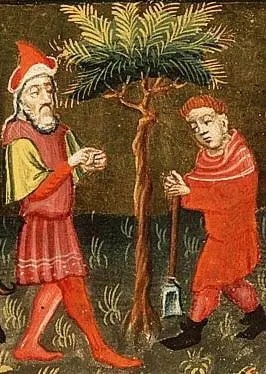
In the second part of the Gospel, Jesus presents a parable: a fig tree planted in a vineyard. For three years, the owner finds no fruit on it. Though it draws nourishment, water, and space, it produces nothing. It remains green but fruitless—it has not fulfilled its true purpose.
Then there is a dialogue: The owner says: “Cut it down!” The gardener says: “Leave it for one more year!” These two imperatives or commands reflect two theological perspectives.
The owner represents God of the Old Covenant, speaking in justice and finality: “Repent or perish!”
The gardener represents Jesus, who intercedes, pleads for patience, and gives us time for conversion.
God is indeed patient. But His patience is not a reason to delay. We must act urgently in our repentance.
In the First Reading, we read about Moses’ call. While tending his father-in-law Jethro’s flock, Moses sees a bush on fire but not consumed. From that moment, God redirects Moses’ path.
Introducing Himself as “The God of Abraham, Isaac, and Jacob,” God expresses His nearness to the people: “I have seen their suffering, I have heard their cries, I know their sorrow. I have come down to deliver them.”
God sees, hears, and knows us. He descends to be near us.
He asks Moses to remove his sandals—not only because the ground is divine, but also because there should be nothing separating God and man.
God draws close to us—we must draw close to Him.
In the Second Reading, Paul tells the Christians in Corinth that all the events in the Old Testament were written for our instruction. Instead of waiting for disaster to change us, we must learn from what happens to others and change now.
What is today’s invitation to us?
(a) The urgency of repentance
Death or destruction can come at any moment, through anyone—leaders, systems, disasters. Life is short and beyond our control. So we must take control of how we live – by transforming ourselves.
(b) Recognizing the signs
We must be alert, reflective, and conscious. Moses saw a burning bush—today we may not see such wonders, but God still speaks through signs and people around us. Are we attentive? God always gives second chances, as the gardener gave a second chance to the fig tree!
(c) Changing our perspective
Let us not cling to a narrow, fear-driven faith—believing that every misfortune is God’s punishment. Our God is not the one who says “Cut it down!” Our God is the one who says, “Let it be for now.” Let us also be patient, like God, in our relationships—with our family, community, and those we struggle to understand.
Fr. Yesu Karunanidhi
Archdiocese of Madurai
Missionary of Mercy
 Yesu Karunanidhi
Leave a comment